Portuguese
  Spanish


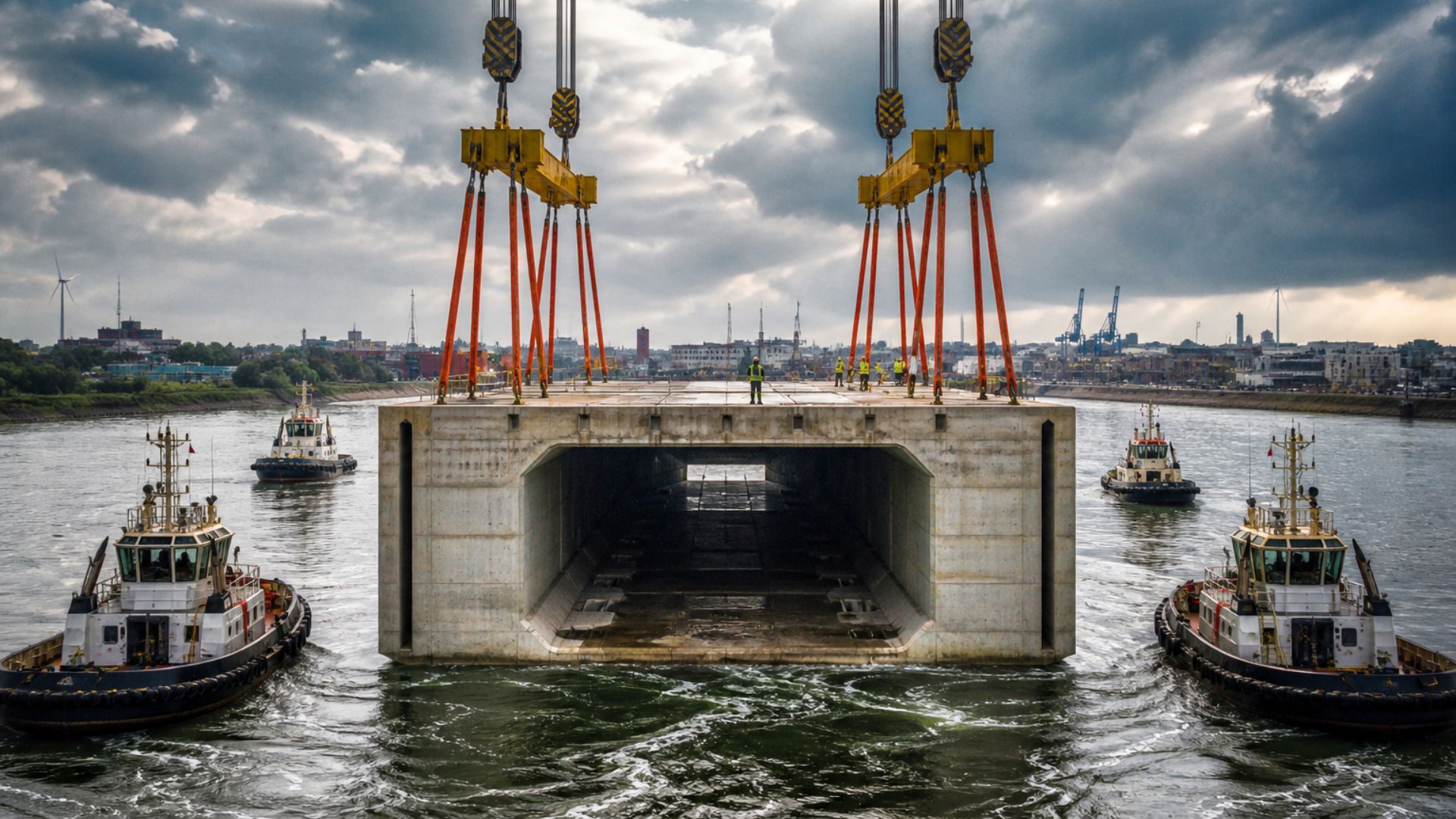

Engineering operation transports megablocks by waterway and redefines strategic crossing with direct impact on urban mobility and European logistics, involving immersed tunnel technique, millimetric precision, and integration between road and bicycle transport in one of the continent’s most congested regions.
The construction of a new tunnel under the Scheldt River in the city of Antwerp mobilizes an unusual engineering operation by moving gigantic structures over 100 kilometers before sinking them with millimetric precision into the riverbed.
Part of the Oosterweel project, the enterprise emerges as a response to persistent congestion in one of Europe’s main logistics hubs, where intense circulation compromises both urban commutes and the strategic flow of goods.
With a length of 1.8 kilometers, the new crossing was planned to accommodate three traffic lanes in each direction, as well as an exclusive gallery for cyclists, expanding crossing alternatives in a historically overloaded region.
-
Thailand Converts 8 Tons of PET Bottles into 3,500 School Backpacks, Showcasing Circular Economy with Over 40 Factories Involved

-
Mysterious Bats Spotted in Paris’s Père Lachaise Cemetery, Drawing Tourists to the “Vampire Cemetery”

-
From Selling Street Food to Leading a $300 Million Construction Firm: The Journey of a Brazilian Entrepreneur

-
Abandoned Penthouse in Houston Reveals Million-Dollar Suite with 24-Karat Gold, Tiffany Crystals, and Opulence Even Elvis Might Have Snubbed



Currently, a large part of the traffic is concentrated on a few axes, especially in the southern section of the ring road, which reinforces the need for a more balanced redistribution of circulation between different points in the city.
Immersed tunnel construction method draws attention due to its scale

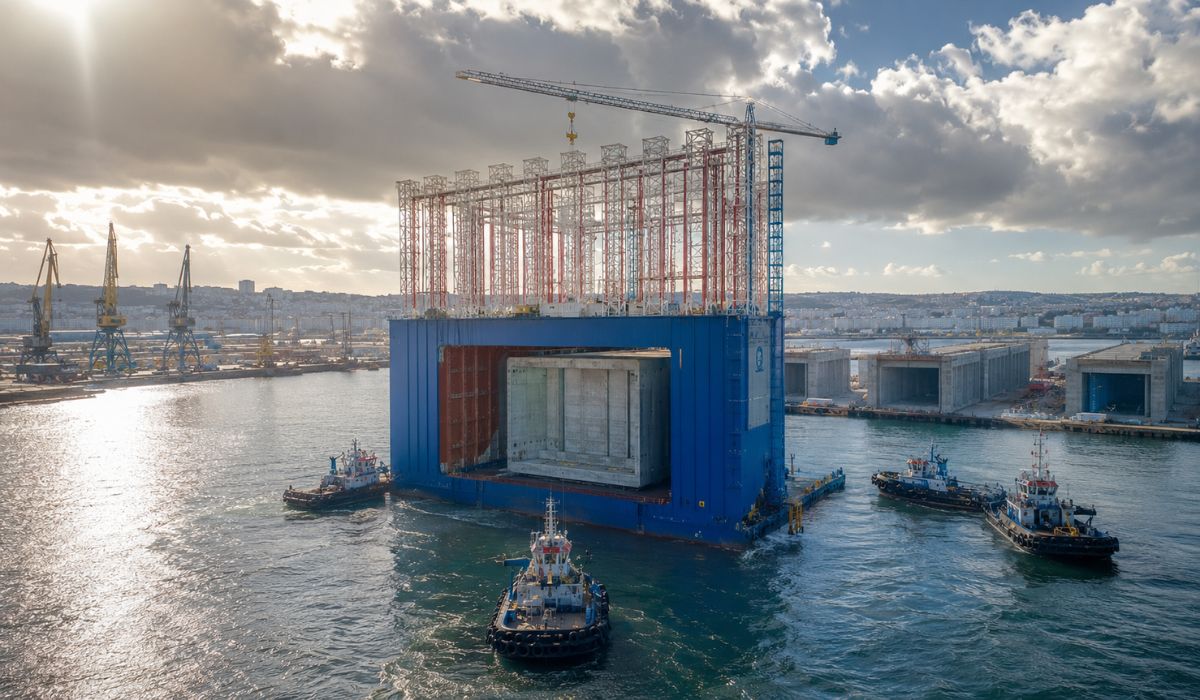
Unlike conventional works that dig directly into the riverbed, the adopted solution involved the prior fabrication of eight concrete blocks in a dock built in the Zeebrugge region, near the North Sea.
Each structure measures about 160 meters in length, 42 meters in width, and 10 meters in height, reaching an approximate weight of 60,000 tons and ranking among the largest modules ever used in European road infrastructure.
These dimensions place the modules among the largest ever used in road infrastructure on the European continent.
After completion, the pieces underwent specific preparation for flotation, using ballast systems that allow controlled movement to the final installation point in the Scheldt River.
Over the journey exceeding 100 kilometers, carried out by sea and river routes, each module is towed in an operation lasting about 30 hours and requiring precise coordination between support vessels.
Sinking of blocks requires precision and strict control
At the final destination, the process is not limited to simply submerging the structures, as each element needs to be positioned precisely over a previously excavated trench at the river bottom.
Dependent on specific conditions of current, tide, and weather, the procedure occurs within restricted operational windows, where any variation can compromise the alignment between the modules.
During immersion, ballast control ensures gradual and stabilized descent, while navigation and monitoring systems assist in the precise fitting between successive pieces.
Navigation and monitoring systems assist in the fitting of the structures, which are later sealed with special joints to ensure the tunnel’s watertightness.

According to the Oosterweel project, coordinated by Lantis, this phase represents one of the most sensitive moments of the work, due to the constant interaction between structural weight, water pressure, and natural forces.
Oosterweel Project seeks to alleviate historical logistical bottleneck
In the urban context of Antwerp, the investment addresses a historical problem of overload on the ring road, especially in the southern sector, where the concentration of vehicles directly affects traffic flow.
In addition to the impacts on daily commuting, this scenario compromises the logistical efficiency of a region strongly linked to cargo transport and port activity.
The expectation is to redistribute part of this flow to the north of the city, creating a more efficient alternative for light and heavy vehicles.
With the new connection, the trend is to improve the link between the left bank, the port area, and the main road corridors that support local industrial activity.
At the same time, reduced congestion can influence delivery times and operational costs, increasing predictability in European-scale logistics chains.
Integrated cycle path expands urban mobility in Antwerp
Parallel to the road focus, the project incorporates a six-meter-wide cycle gallery, completely separated from vehicle traffic, reinforcing the integration between different transport modes.
In a city that combines intense traffic with varied urban movements, this solution seeks to balance distinct demands within the same infrastructure.
Antwerp tries to balance distinct demands by combining heavy transport, urban commuting, and sustainable alternatives within the same infrastructure.
In this scenario, encouraging bicycle use appears as a complement to traditional road interventions, expanding mobility options and reducing dependence on motorized vehicles.
The cycle path also connects to other actions planned in Oosterweel, including road reorganization and the creation of green areas in regions impacted by the previous ring configuration.
Structure in Zeebrugge was essential to enable the work


To make the construction of the modules viable, a specific dock capable of supporting large structures and allowing their subsequent controlled flotation was necessary.
Once this stage was completed, the area was intentionally flooded, releasing the blocks for transport to Antwerp without compromising the structural integrity of the pieces.
The use of this temporary structure was crucial to ensure efficiency and reduce risks during project execution.
If they were produced directly in the bed of the Scheldt river, the modules would require more complex and prolonged operations, with significant impacts on the region’s river traffic.
This construction model, known as an immersed tunnel, has already been applied in other international projects, but in this case, it stands out due to the scale of the elements and the extent of the displacement carried out.
Tunnel opening will be gradual
The crossing will be opened in stages, with the cycle path being made available before the full opening to vehicles, a strategy that allows anticipating some of the benefits foreseen by the project.
Meanwhile, the final phases of road integration are still underway to ensure that the new axis functions efficiently within the existing system.
When fully operational, the tunnel is expected to become a central piece in the reconfiguration of Antwerp’s road system.
Given characteristics such as high logistical density, intense traffic, and the constant need for efficient connections, the city now has a solution that combines large-scale engineering and integrated urban planning.