Portuguese
  Spanish


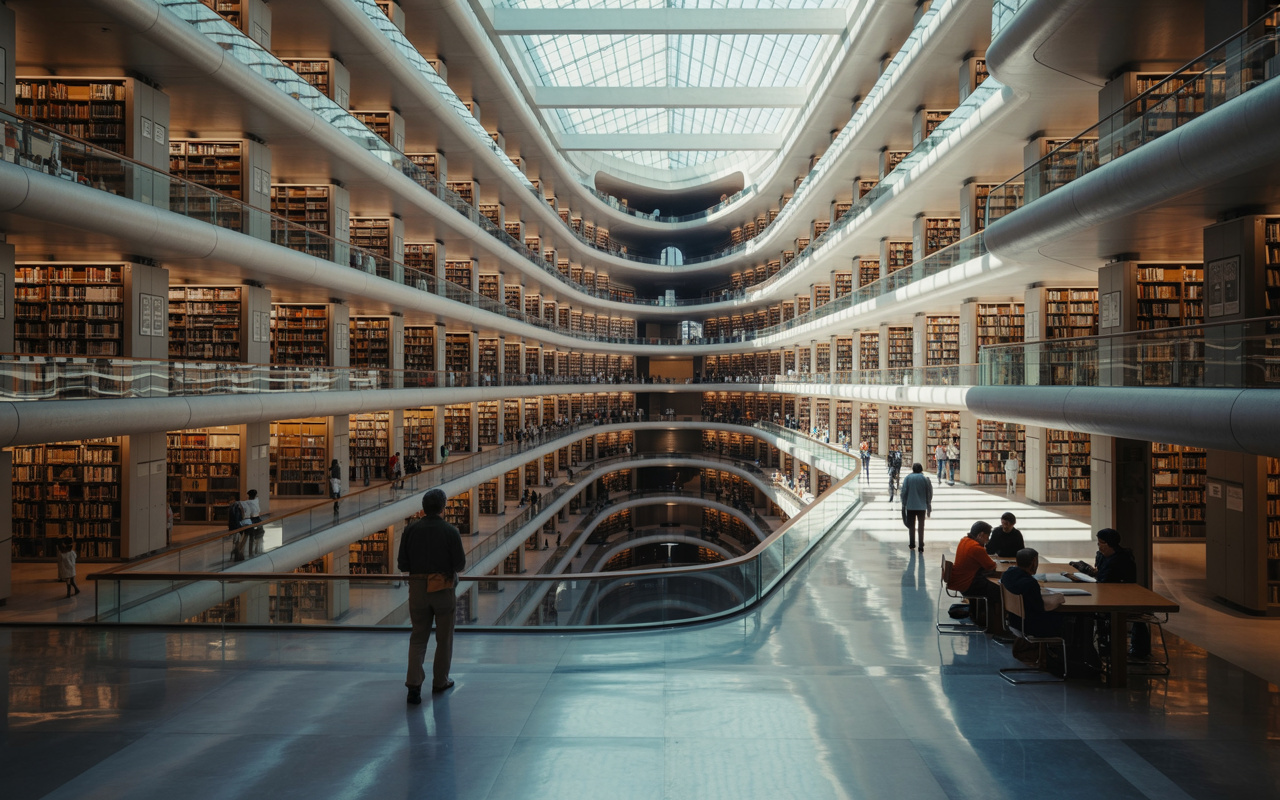


With 1.4 Million Books and Futuristic Design, the Vasconcelos Library is the Second Largest in Latin America and One of the Most Impressive Cultural Landmarks in Mexico.
In the heart of Mexico City stands one of the planet’s most fascinating constructions — a colossal structure of steel, glass, and concrete that resembles a cathedral of knowledge. This is the Vasconcelos Library, inaugurated in 2006, internationally recognized as one of the largest libraries in Latin America and one of the most impactful architectural works of the 21st century. Its collection houses 1.4 million books, distributed on suspended shelves that seem to float in the air, in a space designed to provoke the sensation of walking inside a living reading machine.
A Cathedral of Steel and Silence
With 38,000 square meters of built area, the Vasconcelos Library is a monumental work of engineering and design by the Mexican architect Alberto Kalach, who conceived the project as “a transparent organism, where knowledge is visible from all angles.” The structure is supported by exposed metal beams, walkways, and pillars that intertwine, creating a three-dimensional effect that gives visitors the impression of being in a suspended maze of books.


The building is surrounded by a botanical garden with over 60,000 species of native plants, designed as a symbolic extension of human knowledge — nature and culture intertwine. The glass walls allow for abundant natural light, while the interior is marked by volumes reminiscent of futuristic temples. For this reason, the Vasconcelos is often referred to by the Mexican and international press as “the Cathedral of Books”.
-
How to Prevent Brown Recluse Spider Bites: Common Hiding Spots and Free Tips to Reduce Risks

-
Natto: The Unusual Japanese Superfood Gaining Popularity on Social Media and Driving Record Exports
-
Brazilian Mayor Goes Undercover as Homeless for 24 Hours to Assess Public Services

-
15-Year-Old Entrepreneur Malu Lira Publishes 20 Children’s Books on Financial Education, Earns $500,000, and Expands Her Project to the Amazon Rainforest




A Project That Redefined Cultural Architecture
Construction began in 2004 and was completed in just two years, under an investment equivalent to US$ 100 million. Since its inauguration, the library has been compared to great cultural landmarks such as the Guggenheim Museum in Bilbao and the Centre Pompidou in Paris, both for its architectural boldness and for its proposal to integrate art, nature, and technology into a single environment.
The upper floors are connected by glass and metal walkways, which offer a panoramic view of the suspended shelves and the gigantic metal skeleton of the structure. In the center of the main hall, a gray whale skeleton, created by the artist Gabriel Orozco, floats above the visitors — a poetic symbol that reinforces the idea of the library as a living, organic space that is constantly moving.
The Collection and Educational Mission
With over 1.4 million cataloged volumes, the Vasconcelos collection goes far beyond books. It includes rare manuscripts, historical documents, digital archives, films, music recordings, and scientific collections. The location is open to the public free of charge and receives over 2 million visitors per year, including students, researchers, and tourists from all over the world.
The project was born with an ambitious purpose: to democratize access to culture and make reading an architectural experience. Instead of closed and silent rooms, visitors find a dynamic space where ambient sound and movement are part of the experience. The open format of the library symbolizes the ideal of José Vasconcelos, a philosopher and former Secretary of Education of Mexico, whose name the building bears — a visionary who advocated knowledge as “the most powerful energy of the human spirit.”
Cultural Impact and International Recognition
The Vasconcelos is now a symbol of the cultural revitalization of Mexico City. In 2017, it was named by The Guardian as one of the ten most beautiful libraries in the world, and in 2022, it became part of the World Monuments Watch, an international list recognizing the most relevant constructions of contemporary architecture.
The space has also become an important center for cultural and scientific events, with exhibitions, concerts, workshops, and debates that attract thousands of people every month. Furthermore, the library acts as one of the main centers for the digitization and preservation of literary works in Latin America, with a continuous modernization project that aims to include over 500,000 digitized documents by 2026.
A Monument to Human Intelligence
More than just a repository of books, the Vasconcelos Library is a sensory experience. Every detail — from the lighting to the metal walkways — has been designed to remind us that knowledge is something in constant construction. At night, the interior transforms into a galaxy of white lights and metallic reflections, and the silence of the shelves contrasts with the pulse of the city outside.
For those entering for the first time, the feeling is one of reverence. And perhaps that is the greatest merit of the Vasconcelos: to transform reading into a visual spectacle and architecture into a metaphor for the human mind.
As José Vasconcelos himself wrote, “to read is to climb the invisible building of thought.” In Mexico City, that building finally took shape — and it is monumental.