Portuguese
  Spanish


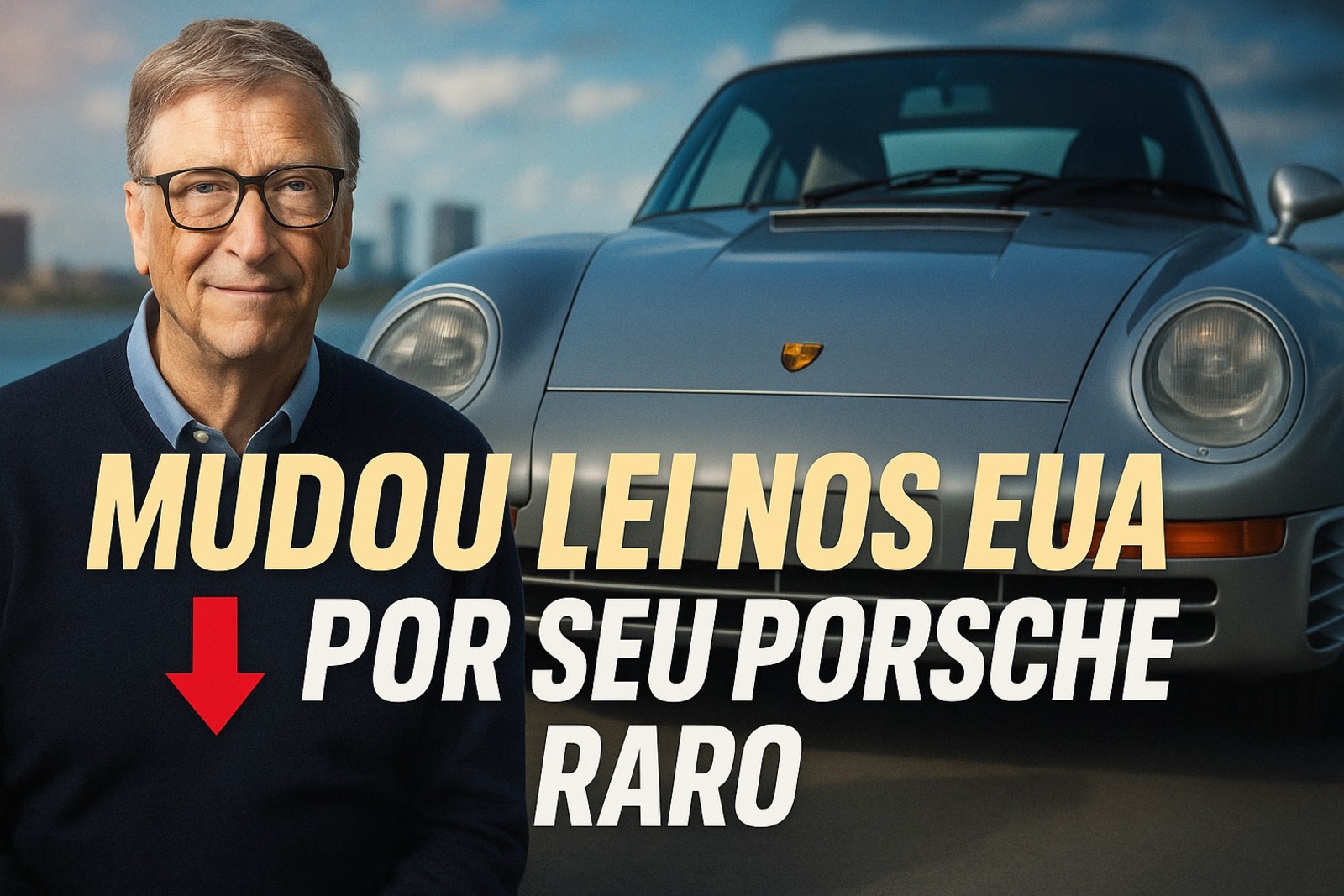


Bill Gates Fought A Battle Of Over A Decade To Free His Porsche 959, Changing American Laws And Clearing The Way For Collectors
Bill Gates, co-founder of Microsoft, has always been recognized for his interest in technology and innovation. But beyond that, he is also a supercar enthusiast, especially for Porsche models. This passion was marked by a long battle against U.S. legislation that prevented him from driving one of his most desired vehicles.
The most important thing is that, thanks to his persistence, Gates ended up changing a law. This change cleared the way for other millionaires, like Elon Musk and Larry Ellison, to legally import and drive limited edition hypercars on American soil.
The Arrival Of A Tech Icon
In 1987, Bill Gates decided to order a Porsche 959, which had just been unveiled by the German manufacturer.
-
When Do Brazil and Japan Face Off in the World Cup?

-
Three-Year-Old Fulfills Dream of Joining Garbage Collectors in Brazil, Captivates Thousands Online with Heartwarming Video

-
Nikon Project Uses Dog’s Heartbeat to Capture Photos, Revealing What Truly Makes Dogs Happy

-
In Los Angeles, Young Adult Opts for Garage Living with Bed, Kitchen, and Bathroom to Avoid Rent, Highlighting Comfort and Organization Challenges in Compact Housing




The car represented the most advanced in automotive engineering. It featured a six-cylinder, 2.8-liter twin-turbo engine, with 450 horsepower.
In addition, the vehicle had all-wheel drive and electronic systems that were innovative for the time.
With this configuration, the 959 was capable of reaching 317 km/h, an impressive speed for the late 1980s. It was not just a car, but a true technological showcase of Porsche.
Held At Seattle Customs
Despite the excitement, Gates faced an unexpected obstacle. When the car arrived in the United States, it was immediately held at the Seattle customs.
The reason was clear: the Porsche 959 had not been approved in the strict crash tests required by U.S. law.
Porsche refused to conduct the tests because the cost would be too high. Since the model had only 337 units produced, the brand could not recover the investment.
Therefore, the car remained in a legal limbo. It could not be registered or driven on public roads.
For Bill Gates, this meant seeing his Porsche 959 parked in a customs warehouse, with no prospect of release.
A Car Parked For 13 Years
What could have been just a temporary frustration turned into a true obsession. Gates could not resign himself to leaving the car parked indefinitely. Even so, he had to wait a long 13 years before he could take the wheel.
During this period, the billionaire spent US$ 28 daily to ensure his car remained safe in storage.
In the end, the amount paid exceeded US$ 138 thousand. A significant cost, but one he accepted to pay to preserve the supercar of his dreams.
This insistence showed not only his passion for the automobile but also his determination to find a legal solution to the problem.
The Legal Battle
Not satisfied with seeing the car parked, Bill Gates decided to take action. He assembled a team of lawyers and began a legal battle against the American authorities.
The objective was clear: to obtain a special authorization that would allow the Porsche 959 to circulate on U.S. territory.
This fight extended for over seven years. Gates pressured Washington, sought political support, and insisted on modifying the legislation.
Moreover, he argued that certain rare and collectible models deserved special treatment, as they had historical and technological value.
The Creation Of The “Show And Display” Law
The effort finally bore fruit. In 1999, President Bill Clinton signed the Show and Display Act, a new law that addressed exactly the situation.
This legislation allowed the importation and use of rare vehicles, even if they had not passed U.S. crash tests.
However, the law had specific rules. It applied only to cars with fewer than 500 units produced.
Additionally, it limited circulation to 4,023 kilometers per year, about 2,500 miles. The goal was to make it clear that these were collector’s vehicles, not for everyday use.
Thus, from that moment on, Gates could finally take his Porsche 959 out of Seattle customs and drive it on American roads.
The Legacy Of Perseverance
Bill Gates’ victory was not just personal. His insistence opened a door for collectors and millionaires who wished to import exclusive models.
Without his fight, many of the supercars seen in garages across the United States would still be banned.
Thus, the story of Gates’ Porsche 959 shows how a passion for a car can turn into a legal battle lasting over a decade.
An episode that united technology, perseverance, and the strength of one of the world’s most influential men.
With information from Xataka.