Portuguese
  Spanish


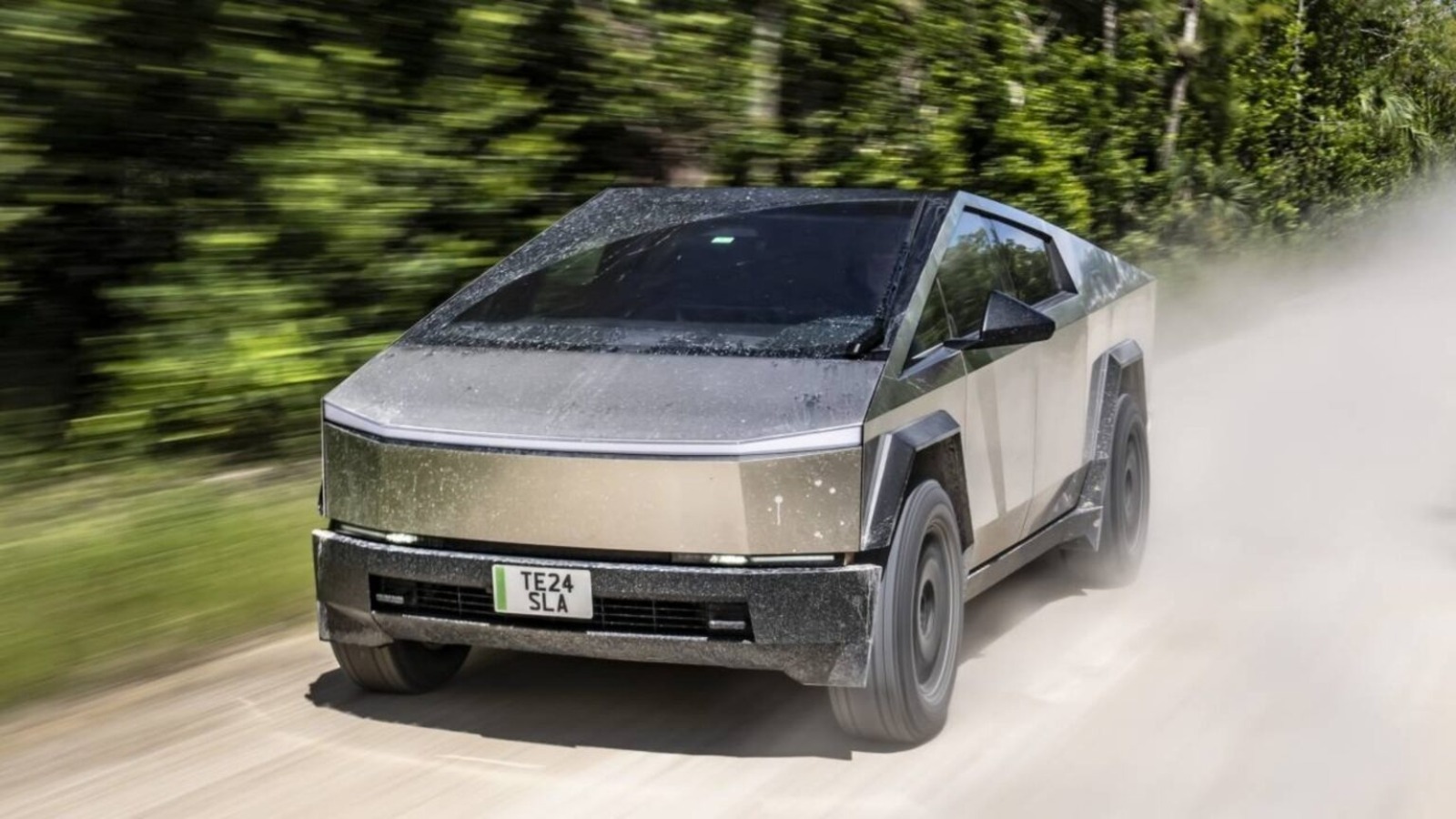

Tesla Cybertruck Cyberbeast Gets Exclusive Armor in Brazil; 60-Day Process Involves Special Glass, Tensylon, and Million-Dollar Costs
The armored car market is expected to reach a historic record in 2025, with an expected nearly 40,000 units in Brazil. Among this growth, one vehicle stands out: the Tesla Cybertruck Cyberbeast. Independently imported, the electric pickup costs around R$ 1.5 million in the country. Among more than 20 units circulating, it is the only one to feature complete armor.
Armor Made by Carbon
The responsibility for enhancing the model’s safety fell to Carbon, a leader in the segment in Brazil. The company plans to finish the year with 6,000 armored cars completed, averaging 500 to 600 per month.
One statistic stands out: 67% of these vehicles are already electrified. The champion of armor in 2025 is neither Volvo nor BMW. It is the Toyota Corolla Cross.
-
1983 Chevrolet Runs Over 100,000 km Without Gasoline, Powered by Wood Chips, Reaches 125 km/h in Airport Test

-
Workshop Converts Giant Tractor Tire Tricycle into a Three-Wheel Drive Hybrid with 36,000-Watt Electric Motor Capable of Climbing Hills

-
Sales of Brazil’s Cheapest Electric Car Halted Before First Deliveries: E-Motors Suspends Emova Easy Due to Import Tax Increase and Rising Freight Costs

-
Nissan Discontinues Qashqai SUV Amid Cost-Cutting, Chinese Competition, and Product Line Review


The Windshield Challenge
Right at the start, the Carbon team encountered an obstacle. The Cybertruck’s windshield required out-of-the-ordinary solutions.
“This part is equivalent to twice the windshield of a BMW X3,” explained Cacá Mancebo, the company’s marketing director.
To make production feasible, specific furnaces had to be developed, 70% larger than traditional ones. All to bend and sinter the glass.
The installation is also surprising. In conventional SUVs, the windshield angle is 25° or more. In the case of the Cybertruck, it is only 18°.
Armor of the Opaque Parts
Another delicate point was reinforcing the doors, pillars, and roof. Carbon resorted to a 3D scanner to design Tensylon mats.
This material is as strong as steel, but up to 80% lighter. The choice was crucial to not compromise the performance and range of the electric pickup.
Additionally, disassembly was only possible after importing original Tesla tools.
Delicate and Time-Consuming Process
To safely disassemble, the team needed to de-energize the vehicle, put it in service mode, and keep the battery charged. This way, the sensors and driving aids would not be miscalibrated.
The work was meticulous. From reception to delivery, the armoring took about 60 days.
This timeframe was longer than Carbon’s usual. For other vehicles, the average is 22 business days.
The Production Bottleneck
The reason for the difference lies mainly in the glass. In most armoring companies, they are imported and can take up to 40 days.
Carbon solved this problem by manufacturing its own glass. This reduced the delivery time from 40 to five days.
“With verticalized operations, we control the raw materials, ballistic safety, and final performance,” highlighted Mancebo.
More Expensive and Cheaper Models
The Cybertruck is the vehicle with the highest added value ever armored by the company. The list includes Audi RS6, Porsche 911 Turbo S, Mercedes G-Class, Range Rover SV, and Cadillac Escalade.
On the other end, the cheapest model to receive armor was the BYD Dolphin Mini.
Therefore, the range of services showcases Carbon’s versatility, catering to everything from luxury cars to popular compact models.
Cybertruck Already Has Factory Protection
A curious detail is that the Cybertruck leaves the factory with some ballistic protection. Its external body is made of brushed stainless steel, called Inox 304L.
This steel is 1.5 mm thick and already provides basic coverage against .22 caliber shots, considered Level I protection.
However, the glass does not have the same resistance. This was precisely the most labor-intensive part of the process in Brazil.
Elon Musk’s Troubled Test
The pickup’s protection fame began in 2019. During the launch, Elon Musk attempted to demonstrate the glass’s toughness by hitting it with a sledgehammer.
The result, however, was not as expected. The glass shattered, and the scene reverberated worldwide.
In Brazil, the armor made by Carbon raised the protection level to III-A, the highest allowed for civilians.
Armoring Costs
The exact cost of the process was not disclosed by the company. However, UOL Cars’ investigation shows that it does not come for less than R$ 500,000.
This does not include the price of the vehicle, which is already around R$ 1.5 million.
For other cars, armoring prices vary widely. They range from R$ 90,000 for compacts to R$ 200,000 for SUVs with panoramic roofs and larger dimensions.
Expanding Segment
The armoring market is experiencing a booming moment in Brazil. The growth can be explained by the increasing demand for safe cars.
Moreover, electrification has gained momentum and represents the majority of orders in 2025.
In this scenario, the Cybertruck has become a symbol of innovation, luxury, and protection.
A futuristic pickup, armored in a unique process, that reinforces Brazil’s position as a global benchmark in this sector.
With information from UOL.