






 Portuguese
  Spanish


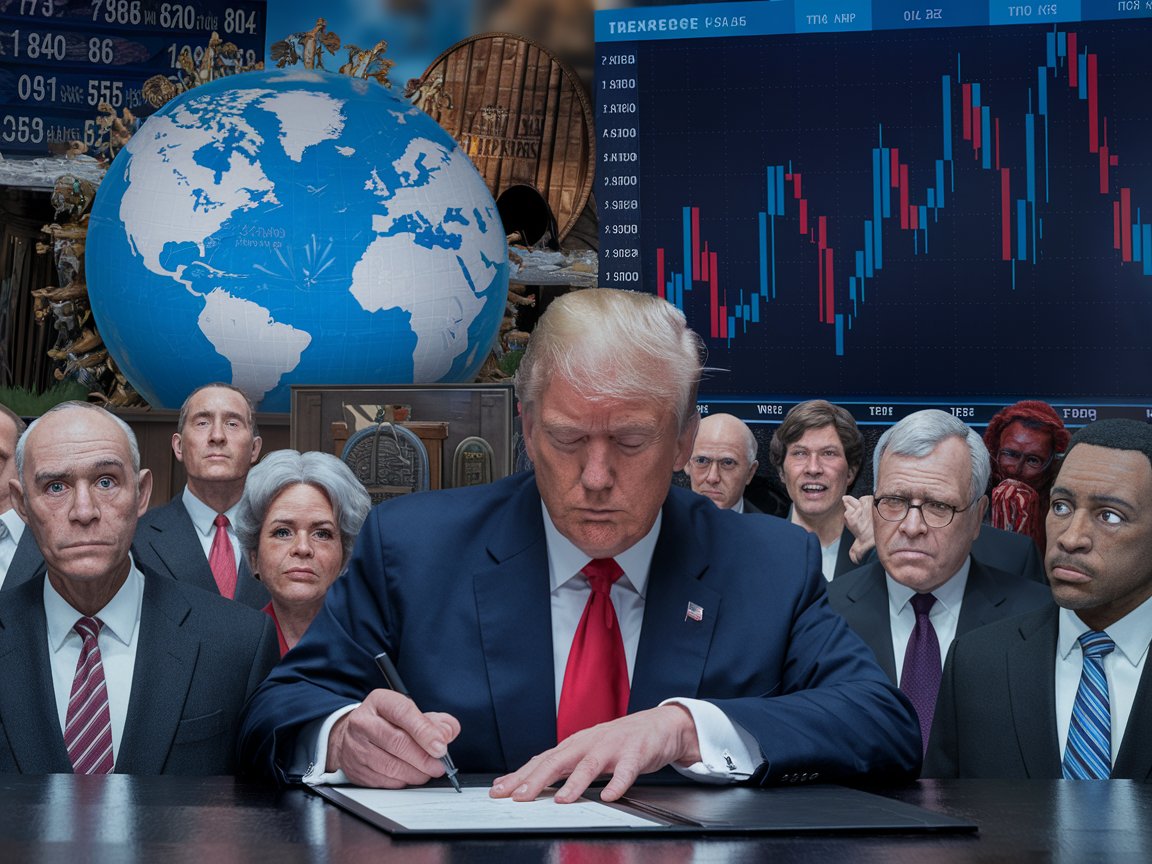

Markets React To New Tariffs Announced By The American Government; Stock Markets In Asia And Europe See Declines, As The Dollar Devalues And Gold Rises
The tariffs announced by the President of the United States, Donald Trump, on April 2, 2025, triggered immediate reactions in global financial markets. The impact was felt in stock exchanges, the dollar’s exchange rate, and sectors such as energy and technology.
According to the website O Globo, the Asian stock markets were the first to respond to the announcement. The Nikkei index from Japan fell 3.9%, reaching its lowest level in eight months. Companies linked to international trade, such as banks and exporters, led the losses. The Topix index decreased 3.3%, while the CSI 300 from China fell 0.6%, and the Hang Seng from Hong Kong dropped 1.5%.
The reactions occurred after the increase in tariffs on Chinese products, which rose from 20% to 54%, as reported by the website Reuters.
-
Brazil’s 2026 Tax Refund: Record 9.58 Million Filers in Largest Payout Ever, But a Key Detail on Priority Recipients Draws Nationwide Attention

-
Itaú Alters Hybrid Work Model, Increasing Office Days from 2028, Prompting Employees to Adjust to New Routine
-
Facing Labor Shortage, Japan Plans to Invest $34 Million to Attract Foreign Workers in Construction, Healthcare, Industry, and Commerce

-
Brazilian City Makes Remarkable Leap, Becomes 4th Wealthiest in the Country with GDP of R$ 134.1 Billion




European Stock Markets Follow Downward Trend
On the morning of April 3, the main European indices also recorded declines. The DAX from Germany fell 1.92%; the CAC 40 from France dropped 2.64%; and the FTSE 100 from the United Kingdom lost 1.41%.
According to an analysis by the portal Business Insider, investors expressed concern about the effects of the new tariffs on international trade and the growth of local economies.
In the United States, the Dow Jones lost more than 1,100 points, a decline of 2.7%. The S&P 500 and the Nasdaq fell 4% and 5%, respectively, reflecting the impact on large companies with global production chains.
Dollar Declines And Gold Sees Appreciation
According to The Guardian, the dollar lost strength against other currencies following the announcement of the tariffs. The dollar index reached its lowest level in the past six months, pressured by investors’ concerns about the stability of the American economy.
As a reflection of this movement, gold — a traditional safe-haven asset — reached the mark of US$ 3,167.84 per ounce before retreating to around US$ 3,068.88.
According to principles established by the World Trade Organization (WTO), unilateral tariff measures can create imbalances in multilateral trade relations, in addition to opening room for formal disputes between affected countries.
Oil Also Falls And Global Scenario Becomes More Unstable
The price of a barrel of Brent fell 3%, being traded at US$ 72.56, according to the portal O Globo. The decline was attributed to the prospects of a global economic slowdown due to the new trade barriers imposed by the United States.
The announced tariffs include a universal rate of 10% on all imported products. In addition, there are additional tariffs: 34% on products from China, 20% on items from the European Union, and 24% on goods from Japan.
Diplomatic Reactions And Possible Countermeasures
In response, the Chinese government indicated that it may adopt retaliatory measures, although it has also reinforced its willingness for dialogue, according to Reuters. The European Union criticized the tariffs but signaled openness to negotiations.
Brazil, which was also included in the 10% rate, initiated diplomatic efforts to minimize the trade impacts and is considering legal and political alternatives, as detailed by O Globo.
Expectations Of Volatility In The Coming Days
Analysts consulted by The Guardian warn that the measures may generate consequences such as economic slowdown, rising inflation, and pressure on industrial and technological sectors. The moment requires caution and constant monitoring by investors and governments.
With increasing uncertainty, markets are expected to maintain high volatility in the coming days. Investors tend to concentrate their resources in safer assets until there is greater clarity on the next steps of American trade policy.







