





 Portuguese
  English
  Spanish
  5 min of reading
  0 comments


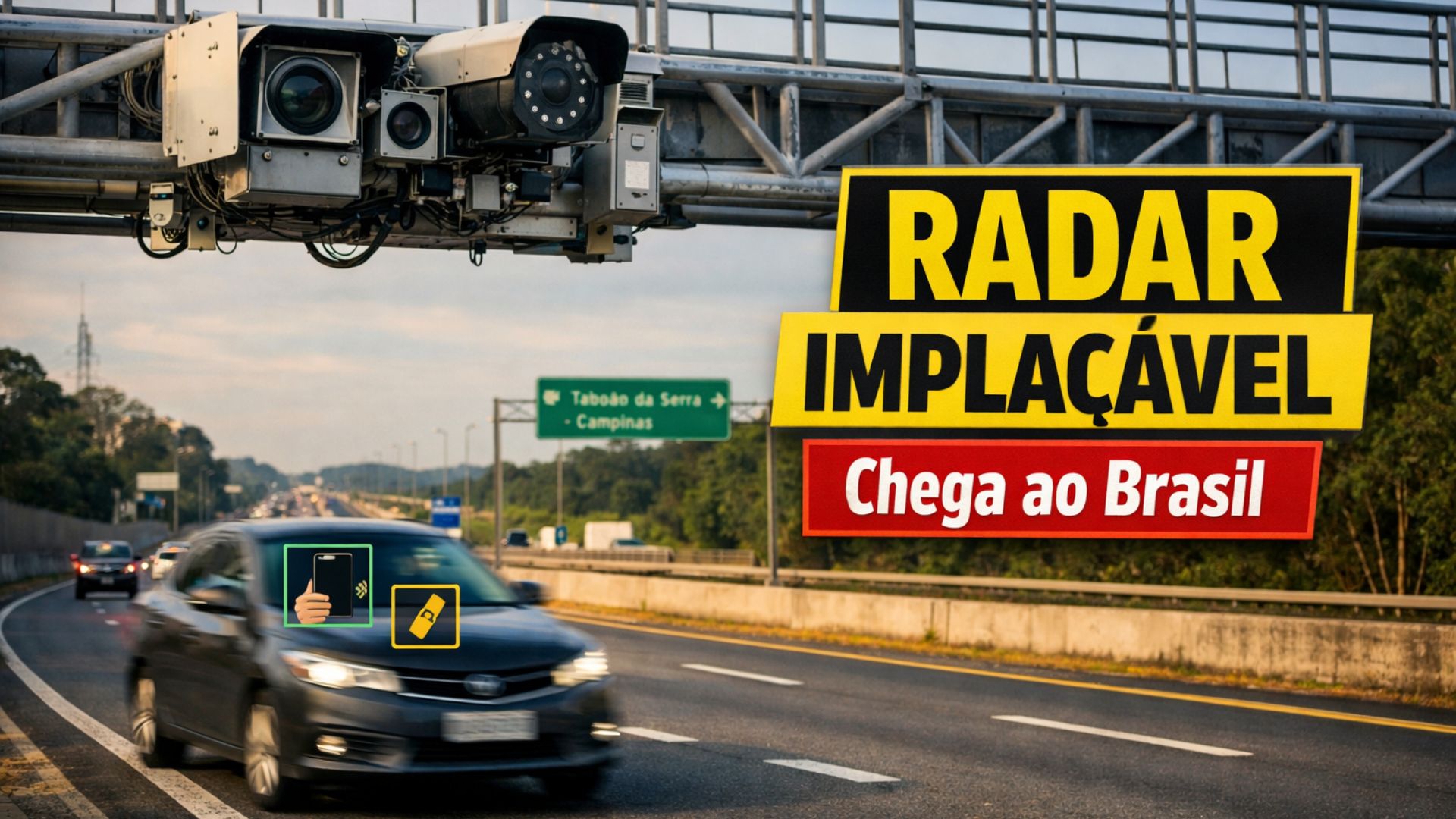
Traffic Enforcement on Highways Gained New Eyes, Expanded the Range of Cameras, and Started Observing Behavior Inside Vehicles, in a Change That Transforms the Routine of Drivers and Exposes How Technology Goes Beyond Simple Speed Control.
Electronic enforcement on Brazilian highways has gone beyond speed measurement and now incorporates, in some sections, video monitoring systems with high-resolution cameras and real-time image analysis.
In practice, the new structure allows for identifying behaviors such as use of cell phones while driving, failure to wear seat belts, and illegal transportation of children, provided that the road is marked and the citation is made according to the rules established by the National Traffic Council.
What Changed in Highway Enforcement
For years, the equipment most associated with highway control was the fixed radar aimed solely at speeding.
-
Almost 10,000 km/h, 110,000 feet altitude, and New York–Paris in less than an hour: Venus Aerospace tests a rotating detonation engine and aims to transform the Stargazer into a reusable Mach 9 hypersonic plane, but still needs to prove that the promise moves beyond the prototype.

-
Air bubbles from 3 million years ago extracted from Antarctic ice reveal that the current level of CO₂ has already surpassed that of the ancient, warm world, when the sea was up to 20 meters higher and there were no factories or cars burning fuel.

-
Brazil went to China to seek money and technology to reinvent TV and bring the internet to places where fiber does not reach. The mission negotiated with the BRICS Bank led by Dilma and paved the way for a Chinese rival of Starlink to connect the Amazon.
-
Iceland is going to lower a drill five kilometers to reach rock at 400 degrees and try to extract clean energy on a scale that a common well cannot achieve.




This scenario began to change with the expansion of systems that combine image capture, automatic license plate reading, adequate lighting for nighttime operation, and software capable of recognizing visual patterns related to violations.
Instead of merely observing the vehicle passing a point, technology began to also record the behavior of the driver and passengers.
Although many drivers refer to all these devices as “radars,” part of this enforcement operates, in practice, as intelligent video monitoring.
The distinction is important because the legal framework does not rely solely on the device installed on the road, but also on the method of operation, the prior signaling, and the remote action of the authority or traffic agent, as stipulated by Resolution 909 of Contran.
How Artificial Intelligence Identifies Violations in the Car
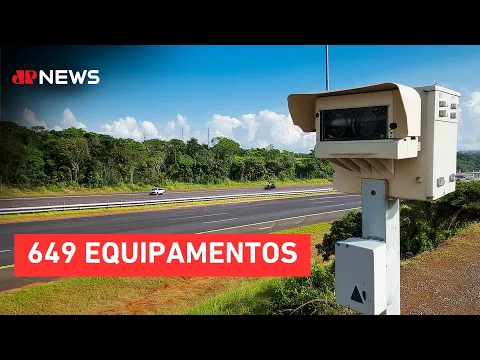

The latest systems analyze high-definition images to locate specific visual signals inside or around the vehicle.
These include the absence of a seat belt on the driver or passenger, the handling of a phone by the driver, and situations involving inadequate transportation of children.
In operations reported by public agencies and concessionaires, there is also reference to other risky behaviors, such as an arm outside the window or the improper presence of animals and children in the front seat, depending on the system used and what is authorized for enforcement in that section.
This type of reading does not mean that every captured image automatically results in a fine.
The Contran rule states that violations detected by video monitoring must be recorded “online” and cited by the authority or the agent responsible for remote enforcement.
In other words, technology extends the range of surveillance, but the validation of the citation remains tied to the legal procedure of the National System of Traffic.
Cell Phones, Seat Belts, and Illegal Transport Come into Focus
The use of a cell phone while driving is already a violation under the Brazilian Traffic Code and remains one of the priority targets for enforcement.
According to DNIT, driving while handling a phone results in a fine of R$ 293.47 and seven points on the National Driver’s License, a penalty classified as very serious.
With the new generation of cameras, this infraction no longer depends solely on the physical presence of an agent on the highway.
The same applies to the seat belt, which is mandatory for both the driver and passengers on all roads in the country, as per Article 65 of the CTB.
As cameras have begun to capture details of the vehicle’s interior more clearly, violations of this rule have become more easily identifiable in remote operations, even in low light conditions, when the system has its own lighting and capture resources.
For child transportation, there was already a legal basis, which remains in effect.
Article 64 of the CTB and Resolution 819 of Contran stipulate that children under 10 years old and those who have not reached 1.45 meters must be transported in the back seat, using the appropriate restraint device.
There are exceptions provided in the regulation itself, which requires caution before turning any image into a citation.
Therefore, not every child in the front seat constitutes an automatic violation.
Where the New Enforcement Already Appears on Highways
The advancement of this enforcement does not mean that the entire country operates under the same model or with the same technological capacity.
What exists today is a gradual adoption in specific sections managed by concessionaires or monitored by enforcement agencies, with different equipment and scopes.
In 2023, the PRF reported the use of video monitoring on highways in Mato Grosso based on Resolution 909.
More recently, the agency also disclosed the use of cameras with artificial intelligence installed on BR-101 in Espírito Santo to bolster enforcement.
In recent public announcements, concessionaires reported that these systems can identify, at least initially, violations related to failure to wear a seat belt, use of a cell phone, and illegal transportation of children or animals in the front seat.
There are cases where reports mention a higher number of monitored irregularities, but this varies according to the technology employed, the operational agreement, and what each agency effectively approves for enforcement.
Thus, the idea that every “new radar” in Brazil already detects five different violations simultaneously simplifies a reality that still depends on the location and the model installed.
The Impact on Drivers with Cameras and Video Monitoring
In a driver’s routine, the main change is that reducing speed only when approaching a radar no longer captures the logic of electronic enforcement.
With high-definition cameras and continuous image reading, behaviors previously observed almost exclusively during in-person stops have started to be recorded throughout the monitored stretch.
This expands the capacity for punishment but also the preventive potential of enforcement, as technology discourages dangerous behaviors that contribute to serious accidents.
Furthermore, the distinction between radar and video monitoring is likely to gain weight in public debate.
For the driver, the immediate effect may seem the same, since both result in enforcement and citation.
Still, from a legal and operational perspective, the intelligent camera system operates more broadly, records context, and relies on specific protocols for signaling and validation.
This entire set explains why modern enforcement can see more than just speed and also reaches behaviors that put at risk those inside and outside the vehicle.






Be the first to react!