Portuguese
  Spanish


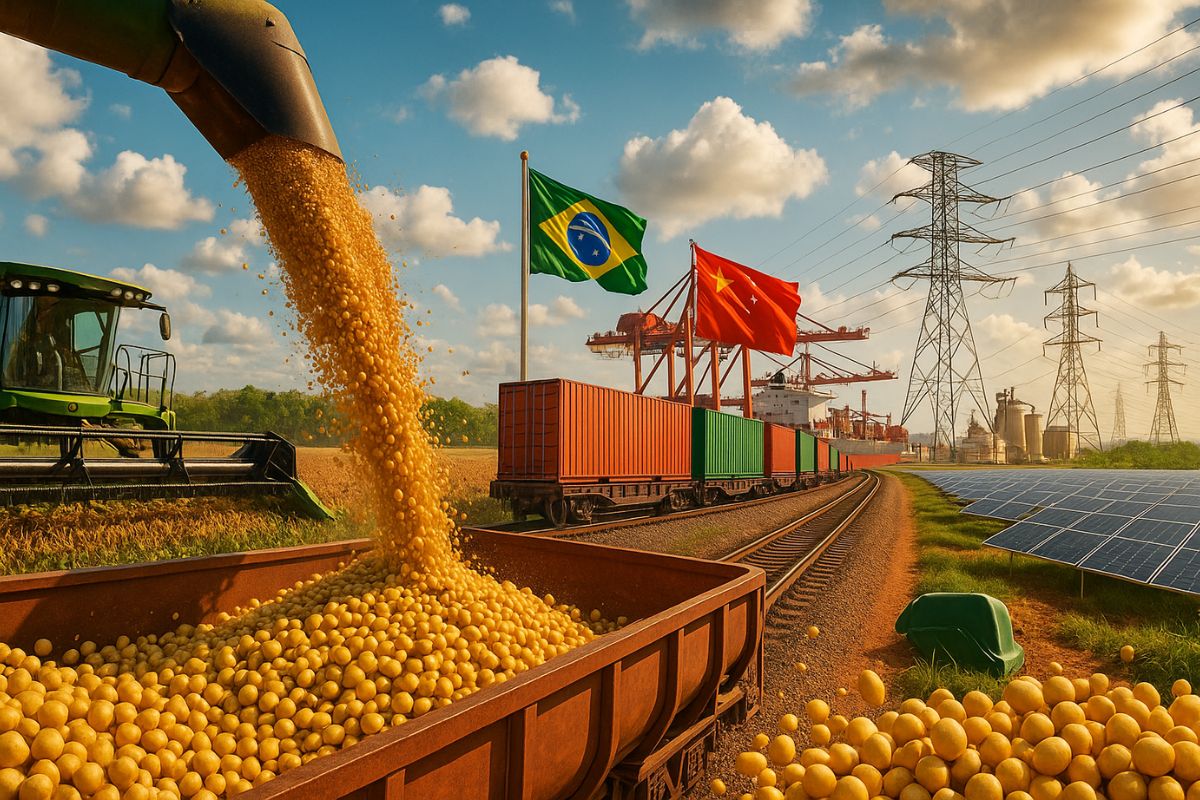


With US$ 94 Billion in 2024, Brazil and China Boost Agribusiness; Soybean Leads the Agenda While Energy and Railways Reduce Costs and Expand Market Access
The Brazilian agribusiness has reinforced its relevance by finding in China a destination with continuous appetite for soybeans, meat, and corn, resulting in US$ 94 billion exported in 2024 and a relationship that influences prices, investments, and logistical decisions. In June 2025, 80% of the soybeans imported by China came from Brazil, highlighting a productive complementarity that supports the trade balance and reduces volatility in producers’ revenue. In the relationship between Brazil and China, soybeans anchor the exporting agribusiness.
According to analyst Manoel Perez, this dynamic goes beyond the shipment of grains. Energy, railways, and electric transmission form the basis of agribusiness competitiveness by shortening routes, reducing losses, and allowing for more efficient outflow windows. The strategic challenge is to add value, increasing the share of processed products, biofuels, and industrial inputs connected to the agricultural chain to diversify revenues and mitigate risks.
Bilateral Trade and the Weight of Agribusiness
The Brazil–China relationship has consolidated itself as a cornerstone of Brazilian foreign trade, with agribusiness accounting for a significant share of sales.
-
Brazilian Scientists Develop World’s First Tropical Wheat for Biscuit Production, Yielding Up to 150 Bags per Hectare and Highly Resistant to Common Crop Disease

-
El Niño may boost corn and soybean harvests in Brazil and Argentina, offering potential relief for global food prices.

-
Japanese Wagyu Gains International Fame for Its Intense Marbling, Tender Cuts, and High Prices in Brazil
-
Brazilian Farmers with Basic Education Create Backyard Machines That Win National Invention Contest, Beating 242 Projects


The Chinese demand stabilizes volumes, favors long-term contracts, and improves cash predictability for cooperatives and trading companies operating across multiple harvests and regions.
At the same time, the shipment profile reveals a concentration in soybeans, meat, and corn.
This concentration ensures scale and port efficiency but requires fine logistical planning to synchronize planting, harvesting, storage, and export windows, especially in high-flow corridors.
The coordination between Brazil and China defines shipping windows and logistical financing.
Soybean Leader and Diversification of the Agenda
Soybeans are the dominant vector in agribusiness, with strong traction in the Chinese market.
The presence of crushing plants and animal feed and protein chains increases demand for Brazilian grain, generating multiplier effects on transportation, storage, and inspection and quality services.
There are signs of gradual diversification with meat and corn, which are gaining ground in contracts and specific sanitary programs.
To consolidate this expansion, agribusiness needs robust sanitary standards, traceability, and standardized processes that ensure delivery consistency and industrial performance at the destination.
Industrial Interdependence and Technology
China maintains industrial leadership in equipment, solar panels, and components widely used in Brazil, creating a cycle of interdependence.
Agribusiness exports food and fibers while importing technology, machinery, and systems that increase productivity in the field and reduce post-harvest costs.
This exchange strengthens technological transfer and raises the demand for skilled labor to operate more sophisticated machinery.
The decision to invest in automation and clean energy in warehouses and logistics terminals lowers the cost per ton, improves the environmental footprint, and enhances operational resilience.
Infrastructure: Energy and Railways as Levers
For agribusiness, reliable energy and efficient railways determine the cost per ton. The competitiveness of agribusiness depends on reliable energy and railways with the capacity for increasing volumes.
The expansion of transmission lines and railway corridors reduces bottlenecks, shortens cycle times, and lowers freight costs in the most sensitive stage of outflow.
By integrating modernized ports with railway yards and retroport terminals, Brazil gains predictability in the export window and reduces logistical costs that erode margins.
This alignment between infrastructure and production boosts external competitiveness and sustains the growth of shipped volume.
Add Value: From Grain to Branded Product
The next leap for agribusiness is to add value with more processed products, biofuels, ingredients, and packaged goods that capture higher margins and dilute grain price risks.
Agricultural clusters near production areas can reduce losses, utilize residual heat, generate jobs, and strengthen the regional ecosystem.
To achieve this, policies for innovation, financing, and qualification need to align incentives with industrialization projects anchored in efficient logistics and competitive energy contracts.
The focus is to transform agricultural scale into industrial scale, maintaining complementarity with Chinese demand and expanding the export portfolio.
Sustainability and Traceability as Competitive Advantages
The expansion of agribusiness requires traceability, environmental compliance, and clear emissions metrics to access premium markets.
Digital origin and monitoring systems attest to good practices and unlock premiums for quality and sustainability, especially in sensitive chains such as soy and meat.
By incorporating renewable energy in storage and processing, and logistical efficiency in multimodal systems, agribusiness improves its carbon intensity and positions Brazil as a reliable supplier for buyers who value ESG criteria without giving up scale and regularity.
The Brazil–China partnership drives agribusiness, expands the market for soy, meat, and corn, and accelerates investments in energy and railways that sustain competitiveness.
The decisive step is to add value, internalizing industrial stages and consolidating traceability to capture margins and reduce vulnerabilities.
What is, in your opinion, the number one priority for Brazilian agribusiness in the next 24 months: railways, competitive energy, or industrialization close to the origin?