Portuguese
  Spanish




Study points out that mining in Brazil has mature reserves and productive base, but loses speed due to geological uncertainties, tax insecurity, slow environmental licensing, and lack of capital, precisely when investors tighten demands and the country becomes a target for global money
Brazil has become a target for investors in the mining sector, driven by the race for new technologies and the growing demand for critical minerals and commodities such as iron ore. A study presented in an interview on CNBC Brazil states that the market is more demanding than ever and that, to close a deal, it’s not enough to produce well: it’s necessary to demonstrate delivery capacity and respect for the environment.
At the same time, the country carries obstacles that hinder decisions and delay projects, even with reserves considered a competitive advantage. Among the main points raised are geological uncertainties, tax insecurity, slowness in environmental licensing, and a still incipient capital market, a scenario that helps explain why so many companies seek financing outside Brazil.
Mining in Brazil above average, but in a global dispute that shows no mercy
According to the analysis presented, Brazil is not “behind,” but is within a globally competitive market where the bar is high and the demand for performance is constant. The country would have a mature productive chain, relatively stable and recognized regulations, although still below benchmarks like Canada and Australia, but above competitors like Peru and Congo in the same market.
-
Half of Brazilians Prefer Lower Taxes with Private Health and Education, While 44% Opt for Higher Taxes for State-Provided Services, Datafolha Survey Reveals

-
Brazil’s Most Expensive Toll Rises to R$ 40.60 on Route from São Paulo to the Coast, Nearly Matching Bus Fare to Santos

-
As Brazil Expands Social Welfare, Survey Reveals 40% Blame Poverty on Laziness, While 58% Cite Lack of Opportunities

-
China Tightens Control on Antimony, Driving Prices from $22,000 to Nearly $40,000 per Ton as U.S. Rushes to Bolster Strategic Reserves




The central differential, however, lies underground: reserves of critical minerals and large-scale minerals, such as iron ore, are in Brazil and need to be developed. The study’s message is direct: it’s not just about extracting ore; it’s about advancing in the chain, processing more in the country, and transforming production into wealth with higher added value.
The bottleneck that changes everything: only 27% of the territory precisely mapped for investment
The most sensitive point of the study is the so-called “geological uncertainty.” In practical terms, the interview summarizes it thus: approximately 27% of Brazilian territory would be mapped at a level of precision that allows for investment decision-making.
The consequence is significant. The interpretation presented is that the country would have “three-quarters” of its territory with mineral potential still little known at the level necessary to attract capital and accelerate exploration. In competing countries, this stage would be more advanced. Therefore, the study advocates an agreement between government institutions and the private sector to intensify mapping and exploration stages in Brazil.
The money bottleneck: why the Toronto Stock Exchange attracts 10 times more Brazilian mining companies
In addition to geology, the study points to a financing problem. The criticism is that there is a lack of investment initiative and a lack of understanding from the financial system, the government, and investors themselves regarding the financing stages of mining projects, especially in the initial and riskiest phase, exploration.
The most striking data cited is direct: there would be 10 times more Brazilian mining companies listed on the Toronto Stock Exchange than on Bovespa. The interview highlights that, for large companies, the cost of fundraising would be on par with the international market, but for smaller companies, which depend on a project and an initial exploration phase, there would be a lack of financing instruments in the country.
What changes for those on the front line: exploration needs instruments and the market needs to understand the risk
The central point is that the financial sector needs to know more about the mining market in Brazil, especially the risk logic of exploration. Without an adequate range of instruments, smaller companies become more dependent on external markets or more difficult capital cycles, which can delay discoveries, slow down the pace of new projects, and concentrate activity where infrastructure already exists.
In practice, this pushes part of the ecosystem outwards, reduces the number of fundable projects in the initial stage, and limits the ability to transform geological potential into real investment.
BNDES entered the game with a R$1 billion fund, but the study says it’s still modest
The interview cites a concrete initiative: last year, BNDES launched a R$1 billion fund, with participation from BNDES and the private sector, aimed at small and medium-sized companies and the exploration stage.
The comment itself highlights that the value would still be modest compared to what is needed, which reinforces the study’s thesis that the bottleneck is not just having reserves, but creating conditions for financing and predictability for the chain to advance.
The numbers that explain why mining is important to Brazil’s economy
The study reinforces the size of the sector with indicators that place mining as a structural component of the country. According to what was stated in the interview, 55% of Brazil’s trade balance last year came from mining.
Furthermore, the statement points to nearly R$300 billion in revenue for the country and an investment portfolio of over US$70 billion. These numbers help explain why international investors are eyeing Brazil and why the debate about unlocking projects has a direct impact on employment, revenue, and competitiveness.
Why this is attracting attention now: critical minerals, rare earths, and a Brazil outside conflict zones
Among the advantages, the interview cites the abundance and quality of critical minerals, with an emphasis on rare earths, in addition to Brazil being outside conflict zones and not involved in war, which reduces geopolitical blockages and noise with both the United States and China.
The study also mentions “minerals that fill global gaps” and a potential for industrialization to add value, signaling that capital’s appetite is not just for volume, but for more complete supply chains, with processing and refining.
Industrialization and added value: where Brazil loses to G20 giants
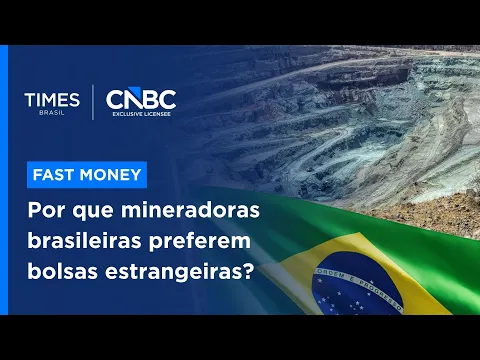

Despite the strength of mining, the interview points out that Brazil is poorly positioned when compared to G20 countries in high value-added products. The interpretation is that the country is a champion in commodity exports, which is not “bad,” but becomes a limitation when the goal is to capture larger margins.
The study argues that with each step forward in the value chain, revenues and margins increase. It provides examples of other jurisdictions that process ore more, such as Australia, Canada, the United States, and China. It also mentions that there are countries, like Chile, considering models to encourage processing and refining within their own territory.
US$77 billion between 2026 and 2030: what the study projects and why execution becomes the real test
The final section presented in the interview brings the most striking projection: investments between 2026 and 2030 in the order of US$77 billion, described as the highest value in the historical series recorded since 2014. The analysis also points to concentration, with nearly US$20 billion in just one region, in the state of Minas Gerais.
The interview reinforces that mining tends to concentrate in certain states, which would not be uncommon. Minas Gerais, Pará, Bahia, and Goiás were cited as states that “spearhead” this process. At the same time, the need to diversify beyond iron ore, gold, and copper was advocated, with potential for lithium, rare earths, and an expansion of copper production, which could spread participation to more states over time.
In the interviewee’s statement, this investment volume also appears as a US$76 billion plan that needs to be executed. And execution, according to him, depends on correct and more agile licensing, regulatory stability to attract capital, and technical competence to carry out projects, including engineering, sustainability requirements, workforce, and supplier chain.
The next steps to unlock the cycle: mapping, more agile licensing, and stability for capital
The study outlines a clear path: intensify precise territorial mapping for investment, expand exploration stages, and create means of cooperation between government and private initiative. In parallel, reducing tax uncertainty and unlocking environmental licensing with greater agility, while maintaining correctness and criteria, appears as key to getting projects off the ground.
The final logic is simple and practical: the more competent the execution and the more predictable the environment, the more capital Brazil tends to attract for mining, especially at a time when the world is scrambling for minerals and metals essential for new technologies.
Do you think Brazil will be able to unlock mapping, licensing, and financing in time to transform this interest into real investment between 2026 and 2030?