






 Portuguese
  Spanish


Brazilian producer develops low-cost agricultural tool for banana leaf removal; solution validated by Embrapa strengthens banana cultivation.
A solution created in the interior of Amazonas is gaining national attention for combining field creativity and scientific validation. The Brazilian producer Raimundo Miguel Barbosa de Lima, known as Barbosa Batiferro, developed a handcrafted agricultural tool to facilitate banana leaf removal, a fundamental activity for the productivity of banana cultivation.
Named “Rabo de Jaraqui,” the equipment caught the attention of Embrapa Western Amazon. The institution published on June 9th, detailed guidelines for reproducing the tool, strengthening an initiative that demonstrates how rural innovation can arise from practical observation and generate benefits for the entire production chain.
From necessity in the field came an efficient solution
The development of the tool took place in Itacoatiara, Amazonas. In the daily routine of the property, Barbosa Batiferro faced difficulties in removing leaves from taller banana trees using the conventional equipment available on the market.
-
Tail of the Dragon: 318 Tight Curves in 18 km Make This Mountain Road a Psychological Challenge for Drivers and Tourists Alike

-
Brazilian Official Proposes Plan to Revive 223 km Railway, Connecting 13 Cities and Transporting 32,000 Passengers and 600 Containers Daily, Plus a Tourist Train in Just 2 Hours 20 Minutes.

-
China Completes Mountain-Top Airport After Major Engineering Feat Near Three Gorges
-
Small Brazilian Town in Santa Catarina Boasts Latin America’s Largest Wooden Church, Preserves German Traditions, and Offers Thermal Waters



Realizing that machetes and other utensils did not offer the necessary reach, the farmer decided to create his own alternative. After analyzing the problem, sketching ideas, and conducting tests, a curved-shaped tool emerged capable of reaching leaves located in higher positions.
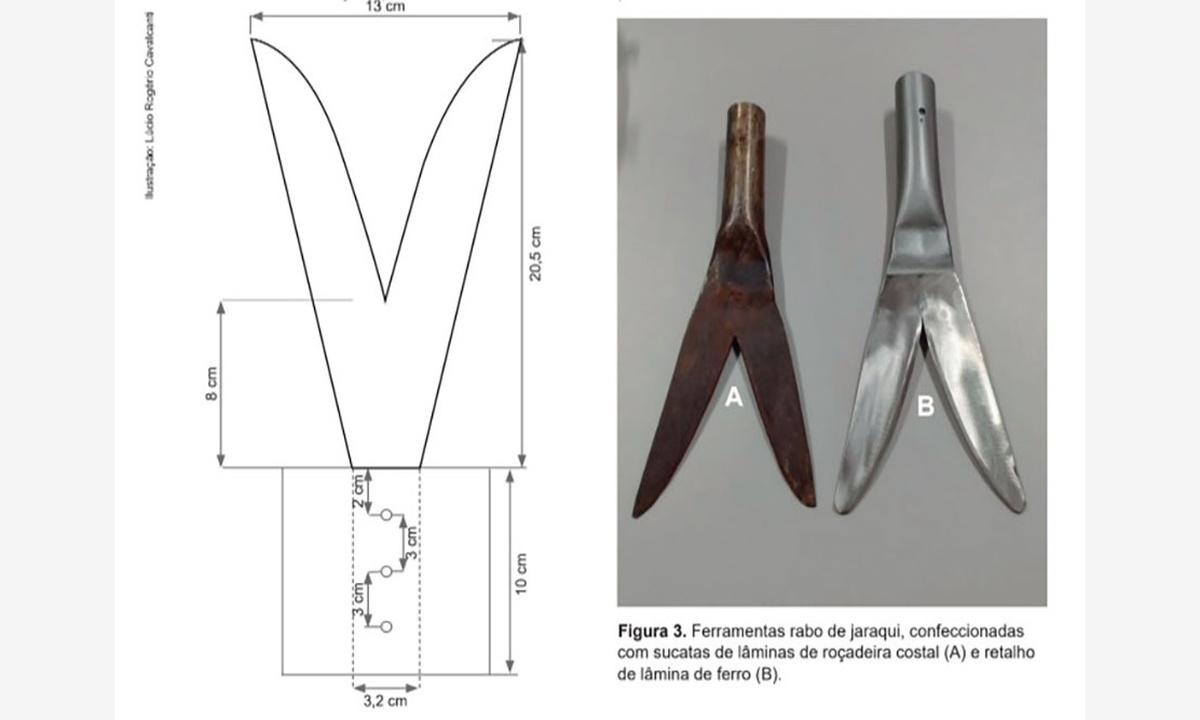
The name “Rabo de Jaraqui” arose from the visual similarity of the piece to the tail of the jaraqui, a very popular fish in the Amazon region. The name refers to the species Semaprochilodus taeniurus and Semaprochilodus insignis, well-known by the residents of the Northern region.
Why banana leaf removal is so important for productivity
Banana leaf removal is an essential practice within banana cultivation, as it directly contributes to the health of the plants and the development of the bunches.
According to information released by Embrapa, a banana tree produces between 40 and 50 leaves throughout its cycle. Over time, some of these leaves age, suffer damage, or start showing symptoms of diseases, making their removal necessary.
The elimination of old leaves provides several advantages to the banana plantation:
- Improves sunlight penetration;
- Increases air circulation among the plants;
- Reduces excess moisture;
- Decreases the favorable environment for the emergence of fungi;
- Aids in pest and disease control.
Among the problems that can be reduced with proper management is the banana weevil, one of the main pests associated with the crop.
Brazilian Producer Gains Recognition from Embrapa
Upon learning about the equipment developed by the Amazonian farmer, researcher Luadir Gasparotto from Embrapa Western Amazon identified technical potential in the solution.
The specialist decided to document the tool’s operation and create a technical drawing capable of guiding its reproduction on other farms. The work resulted in the publication of Technical Communiqué 181, a document that presents details of the construction and use of the equipment.
In addition to expanding access to technology, the publication ensured due recognition of the creativity of the Brazilian producer, valuing the knowledge generated within the farm itself.
The initiative also reinforces the importance of the partnership between farmers and research institutions for the advancement of national agriculture.
Agricultural Tool Can Be Built with Recycled Materials
One of the biggest differentiators of the “Rabo de Jaraqui” is its low manufacturing cost. The agricultural tool was created from recycled materials found on the property, reducing investments and encouraging sustainable practices.
According to the guidelines released by Embrapa, different types of metal scrap can be used in the piece’s construction, including:
- Scraps of iron blades;
- Discarded backpack brushcutter blades;
- Machete blades;
- Wolf mouth;
- Sickles;
- Hoes and mattocks;
- Shovels;
- Disc harrows and plows with approximately 2 to 3 millimeters thickness.
These materials can be cut and welded following the technical drawing provided by the institution, forming the main piece that will be attached to a suitable handle.
The proposal shows how rural innovation can combine economy, sustainability, and functionality in a single solution.
Design reduces plant damage and improves farmer’s work
Besides practicality, the tool was designed to minimize damage during handling.
The curvature of the blade allows for leaf removal without hitting the banana tree’s pseudostem, reducing the risk of injuries that could compromise the plant’s development.
According to Barbosa Batiferro, the equipment’s efficiency depends on proper maintenance of the cutting edge. A well-sharpened blade provides cleaner cuts and reduces the effort needed to perform the task.
The farmer also highlights the importance of using personal protective equipment during operation, especially gloves and protective glasses, which help prevent accidents caused by plant debris or insects present on the plants.
Proper hygiene strengthens banana cultivation
Another aspect valued by the tool’s creator is the prevention of disease spread within the banana plantation.
As he cultivates different varieties, including Plantain, Fia 18, Pratão, and Nanico, the farmer adopts a simple tool sterilization process whenever changing lots.
The recommendation is to dip the blade in a mixture of water and bleach before starting work in another area of the property.
Although simple, this care helps prevent the transmission of pathogens between plants, strengthening the health of banana cultivation and reducing contamination risks.
Benefits go beyond banana tree defoliation
Embrapa highlights that the equipment is not only for leaf removal.
The tool can also be used to remove the heart or mangará from the bunches, especially in tall varieties. This expands its utility within the daily management of crops.
Another benefit is related to worker safety. Removing the leaves reduces places that could serve as shelters for venomous animals, making the environment safer for agricultural activities.
Additionally, the removed plant material remains on the soil and undergoes a natural decomposition process.
Rural innovation contributes to soil fertility
The leaves eliminated during management do not represent waste. On the contrary, they can bring important advantages to soil quality.
According to Embrapa, the decomposition of this organic material contributes to:
- Improve the physical structure of the soil;
- Increase water retention;
- Favor biological activity;
- Stimulate biodiversity;
- Provide nutrients for plants.
These factors help create more favorable conditions for the development of the banana plantation and can positively reflect on productivity over time.
At the same time, the use of scrap in the manufacture of the agricultural tool reduces the disposal of metallic waste, strengthening the sustainable character of the proposal.
When the farmer’s experience meets scientific research
The trajectory of the “Rabo de Jaraqui” shows that great advances do not always arise in laboratories or technological centers. Often, they are born from the attentive observation of those who live the reality of the field daily.
The partnership between the Brazilian producer Raimundo Miguel Barbosa de Lima and the researcher Luadir Gasparotto transformed a local solution into accessible technology for other farmers. The result is a concrete example of how rural innovation can improve banana leaf removal, strengthen banana cultivation, reduce costs, and increase the efficiency of properties.
With the support of Embrapa and the dissemination of the technical model, the expectation is that the tool will continue reaching new producing regions, bringing practicality, sustainability, and better working conditions to farmers in different parts of Brazil.


