Portuguese
  Spanish


A public school student developed Flexia, a virtual assistant with artificial intelligence to personalize the studies of neurodivergent students.
Kelvin Moraes, a 17-year-old student from the state school network of Novo Hamburgo, in the Metropolitan Region of Porto Alegre, developed an AI for neurodivergent students that adapts school monitoring to the needs of students with ADHD and dyslexia. Named Flexia, the assistant acts as a tutor, guiding the user through questions instead of providing ready-made answers.
The tool was born as a final project for the technical course in Systems Development taken by the young man at Senac. Currently in the 3rd year of high school at Colégio Estadual 25 de Julho, Kelvin states that the system can already be used, but still depends on the interest of students and educational institutions.
The project seeks to offer support at times when the teacher is not available, without taking the place of the educator. The proposal is to use artificial intelligence as a complement to the learning process and make the content more accessible for different forms of attention, reading, and understanding.
-
Internet Cables Installed Under Cities Detect Over 100 Water Leaks in Three Months, Cover 650 Kilometers, and Help Save 2 Million Liters Daily

-
Australia Plans to Export Desert Solar Energy to Singapore via 4,300 km Undersea Cable in a $35 Billion Project
-
Archaeologists Discover 9,000-Year-Old Stone Hammer with Perfect Hole During Routine Inspection for Norwegian Bike Path

-
New Regulations in Brazil Require Dedicated Circuit and Safety Measures for Electric Car Chargers in Condos, Highlighting Hidden Risks of Overnight Charging





Flexia guides the student through questions
Instead of solving the activity for the user, Flexia was configured to stimulate reasoning. Kelvin explains that he adopted a Socratic method of learning. In this format, the artificial intelligence presents questions that help the student build the path to the solution.
“We use a Socratic method of learning, where we question the student instead of delivering something ready,” highlights the student.
This choice seeks to prevent technology from becoming a tool used only to copy answers. The goal is to keep the student engaged in the activity, respecting their pace and helping them understand the content.
The AI for neurodivergent students also receives adaptations according to the needs presented by the user. In this way, the monitoring does not necessarily follow the same approach for everyone.
How the assistant created by Kelvin works
Flexia gathers some central features:
- acts as a tutor during studies;
- provides support when the teacher is not available;
- adapts interaction for different neurodivergences;
- uses questions to guide reasoning;
- avoids providing the complete solution immediately;
- can be tested through vouchers provided by the project.
The tool was built with prompt engineering, a technique used to define the instructions that guide the behavior of artificial intelligence.
The clearer and more detailed this guidance is, the closer the system’s output tends to be to the expected goal. Kelvin used this process to establish how Flexia should converse, question, and support the student.
Tool does not intend to replace teachers, but rather to help students
The student emphasizes that the technology was designed as support, not as a replacement for the work done in the classroom.
“Flexia is a tutor AI, it was created to assist studies, we do not intend to replace the teacher, but rather to help the student when the teacher is not available or truly qualified,” explains Kelvin.
The assistant can be used during individual study periods when the student encounters a difficulty and cannot immediately clarify the doubt with an educator.
In this context, the system acts as a temporary bridge. The student continues participating in problem-solving while the artificial intelligence organizes questions to help them progress.
Google contest led young person to seek a real problem
The starting point for the project was the Gemini 3 Hackathon, a contest promoted by Google.
The competition description established that participants should create something capable of solving a problem or benefiting a community. Analyzing the challenge, Kelvin decided to look for a situation related to his own reality.
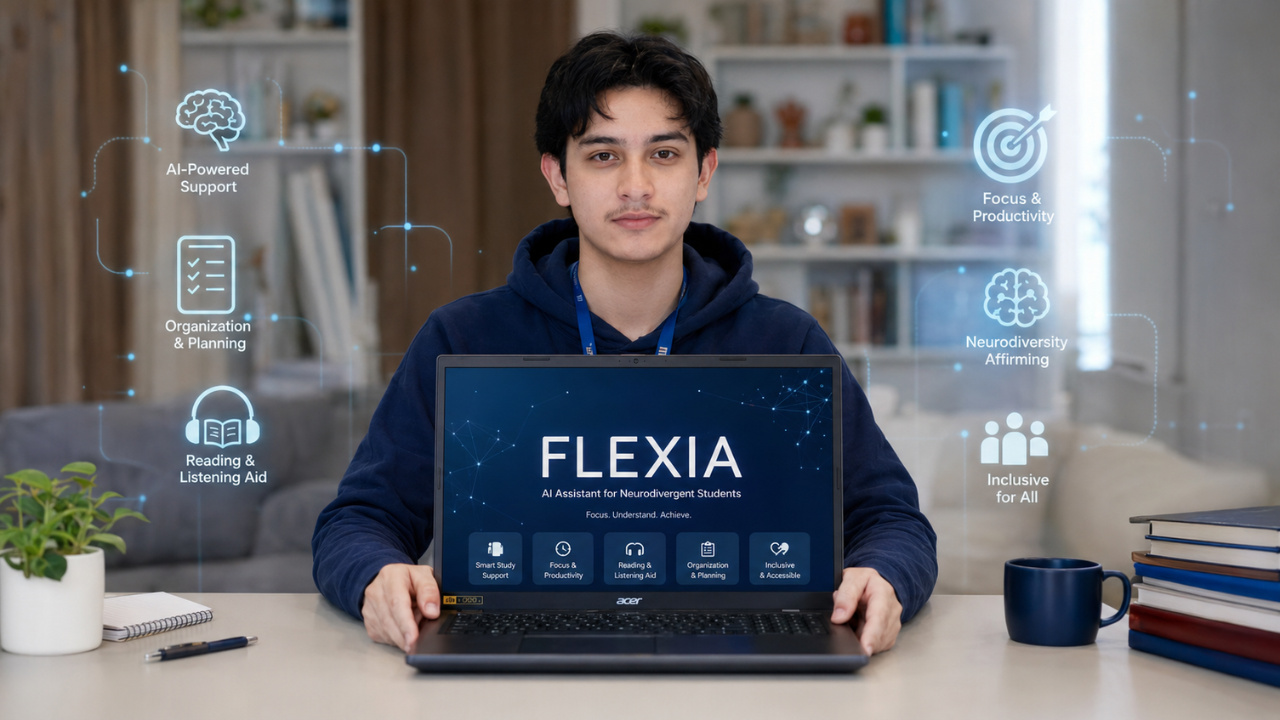
“I wanted to do something that would also be useful for me,” he says.
From there, the student began consulting articles, academic papers, and other materials. In one of the researches, he found the information that ADHD and dyslexia are among the most frequent diagnoses in Brazilian children with low academic performance.
This data directed the proposal towards inclusive education and led Kelvin to think of a technology capable of supporting students who face difficulties during learning.
Personal experience and school interaction influenced the project
The choice of theme was not motivated solely by the competition.
Kelvin’s experience and observation of the difficulties faced by peers contributed to defining the tool. The young man sought to develop a solution that could be applied in everyday school life and also be useful to him.
His mother, who has a background in psychoanalysis, helped the student better understand the scenario related to neurodivergences.
The combination of personal experience, research, and family guidance allowed Flexia to be conceived from concrete needs, not just as a technical demonstration of artificial intelligence.
Project emerged in Senac technical course
Kelvin developed the assistant as a final project for the technical course in Systems Development. The training was conducted by Senac and completed at the beginning of this year.
During the process, the student applied programming knowledge and artificial intelligence system configuration to turn the idea into a functional tool. The project also connects two areas he intends to continue studying: technology and human behavior.
After finishing high school, Kelvin plans to study Systems Analysis and Development, Computing, and Psychology. The choice shows that the young man intends to deepen both the technical part of Flexia and the understanding of the students who could use it.
Maintaining artificial intelligence has a cost
Although it is ready for testing, the tool is not yet offered for free on a wide scale. Kelvin explains that maintaining an artificial intelligence system involves expenses, and therefore, experimental access is provided in a limited manner.
“Unfortunately, the tool is not free, maintaining an artificial intelligence is not cheap. Tests can indeed be conducted, but we only release some vouchers for testing,” he states.
The cost represents one of the barriers to expanding AI for neurodivergent students. To reach a larger number of users, the project will need to find a way to sustain the technology’s operation.
Flexia seeks interested schools and students
The development stage has already allowed Kelvin to consider the tool ready for use. “The only thing missing are the interested students or schools,” declares the student.
Adoption by educational institutions would allow observing the assistant’s performance in real situations and gathering experiences from students with different needs. Use within schools could also show which content the tool offers more support for and which adaptations still need to be made.
Created by a student familiar with the public school routine, Flexia stems from a problem observed within the school community itself. Now, the project’s future depends on connecting with institutions and students interested in testing a new form of learning support.