Portuguese
  Spanish


The award-winning research shows that zebra finches, known in Brazil as mandarins, do not emit random sounds. The birds use different calls to indicate identity, contact, hunger, danger, courtship, and conflict. The finding brings science closer to an ancient question: how far can humans understand the communication of other species without turning animal behavior into fantasy?
Researcher Julie Elie, from the University of California at Berkeley, received the Coller-Dolittle Prize of 2026 after identifying 11 core vocalizations of zebra finches and showing that these sounds carry information recognized by the birds themselves.
The prize was valued at US$ 100,000, about R$ 500,000 in the conversion used by the report. The recognition came from over a decade of work, which combined observation, recordings, tests with birds, and machine learning.
According to The Guardian, Elie showed that the birds not only emit different calls but can also recognize who is vocalizing and what that vocalization means in each context.
-
Brazilian National Team Traveled by Ship to First World Cup, Boarding Conte Verde to Reach Uruguay

-
Ancient Burial Site Uncovered in Brazil: 11,000-Year-Old Artifacts Found Beneath 300-Ton Rock

-
18-Year-Old Student Designs Modular Microhouse from Fiberglass and PET to Combat Homelessness in Brazil, Plans to Live in Prototype for a Year to Demonstrate Quick Assembly

-
The Frenchman Who Brought the World Cup to Life: Overcoming Resistance and Crossing the Atlantic with the Trophy to Create Football’s Biggest Tournament




The discovery does not allow us to say that humans can already “talk” with animals, but it places interspecies communication research on another level.
The studied bird is small, lives in groups, and produces data in quantity
The zebra finch, popularly called mandarin in Brazil, is a small bird, common in vocalization studies. The choice was not casual. These birds are social, noisy, and use sounds in various daily situations.
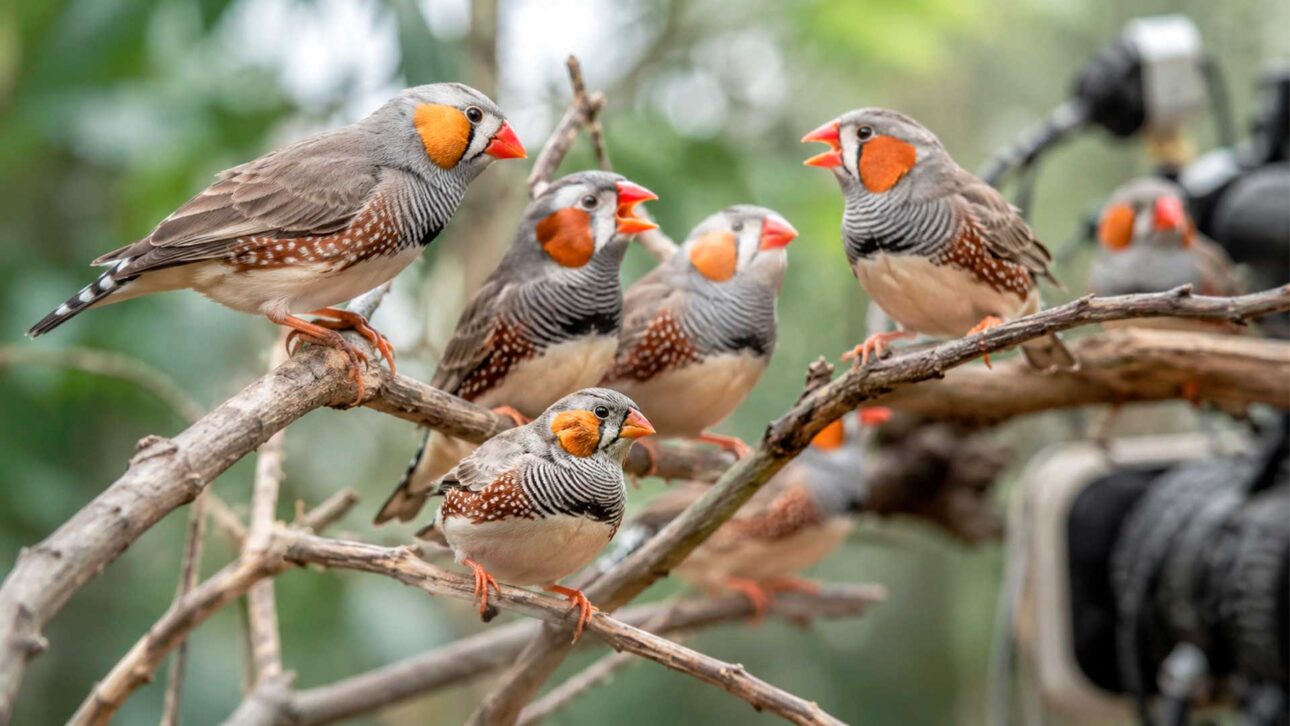
The University of California at Berkeley reports that mandarins live in vocal groups and form lasting pairs. Young males also learn mating songs in a manner compared, in some studies, to human vocal learning, which has made the species a model used for decades in research on the brain, sound, and behavior.
This detail changes the weight of the discovery. The research was not limited to the male’s beautiful song, common in bird studies. Elie focused on short, repeated, and less showy calls, those used for contact, alert, approach, dispute, and other social interactions.
More than 8,000 sounds helped to create a map of vocalizations
The study published in the journal Science on September 18, 2025, describes that zebra finches use about 11 types of calls related to hunger, danger, social conflict, contact, and bonding between individuals. The article is indexed in PubMed with DOI 10.1126/science.ads8482.
To achieve this result, the researchers gathered thousands of vocalizations from dozens of birds. It was not enough to record the sound. It was necessary to register what the animal did before, during, and after the call.
From there, each vocalization was compared with the context. A sound could appear when the bird sought contact. Another emerged in an alarm situation. Another was linked to hunger, courtship, aggressiveness, or partner bonding.
Machine learning was used to help manage the amount of data. The algorithms allowed for searching acoustic patterns and separating differences that the human ear would hardly classify accurately.
The strongest test came when the birds responded to their own calls
The most relevant part of the research was not just creating a list of sounds. The central point was to test if the mandarins themselves recognized these categories.
In the experiments, the birds listened to different vocalizations and could interrupt sounds that did not lead to a reward. When they got the call associated with the prize right, they received seeds. Over time, they learned to separate the types of sounds.
The result drew attention because the errors did not follow just acoustic similarity. In many cases, the birds confused calls with similar meanings, even when the sounds were different.
This pattern suggests something more complex than reflex. The birds seemed to organize the calls by meaning, not just by noise. For science, this difference is significant. An animal reacting to a sound is one thing. Showing signs of separating sounds by social function is another.
The prize targets interspecies communication, but there is still a clear limit
The Coller-Dolittle Prize was created by the Jeremy Coller Foundation in partnership with Tel Aviv University to recognize advances in communication between humans and other organisms. The official page states that the annual prize is US$ 100,000 and that the larger challenge offers US$ 10 million in investment or US$ 500,000 in cash for a broader solution in interspecies communication.
This detail is important because Julie Elie’s research does not deliver a universal animal translator. The work demonstrates a rigorous method for associating vocalizations, context, and behavioral responses in a specific species.
It also does not mean that birds speak like humans. What the research indicates is that some vocalizations carry categories recognizable by the birds. The difference is subtle but crucial to avoid exaggerations.
Scientific American highlighted that Elie managed to validate part of the interpretation by “asking” the birds themselves, through discrimination and reward tests. This step is what separates the discovery from a mere assumption made from recordings.
Artificial intelligence accelerated the process, but did not replace years of observation
AI appears in the research as an analysis tool, not as a magical shortcut. The work required years of listening, cataloging, and comparison with the actual behavior of the birds.
Without field and laboratory records, the algorithm would have only loose sounds. The strength of the study lies precisely in the combination of behavioral biology, neuroscience, statistics, and controlled tests.
This path also explains why talking about “translating animals” still requires caution. To advance, scientists need to prove that the sound has a function, that other animals recognize this function, and that the response is not merely automatic.
Even so, the study with the finches shows a concrete direction. Instead of trying to guess human emotions in animals, researchers analyzed patterns, tested hypotheses, and let the birds themselves indicate if the classification made sense.
What this discovery can change in future research
The advancement can influence studies with other vocal species, such as crows, parrots, dolphins, bats, primates, and rodents. Each group has its own sounds, contexts, and limits, but the experimental logic can be reused.
The research also helps to discuss animal welfare. If scientists can identify signs of fear, hunger, contact, stress, or social bonding more accurately, breeders, laboratories, zoos, and conservation centers may have better tools to interpret behavior.
The path is still long. Bidirectional communication would require humans to emit signals understandable to animals and receive consistent responses in varied contexts. Today, the study of the finches shows a piece of this puzzle, not the complete picture.
If a bird weighing only a few grams can organize sounds by meaning, how many messages from other species still go unnoticed every day? Leave your comment and say if you believe that science will be able to create a real translator for animals in the coming years.