Portuguese
  Spanish


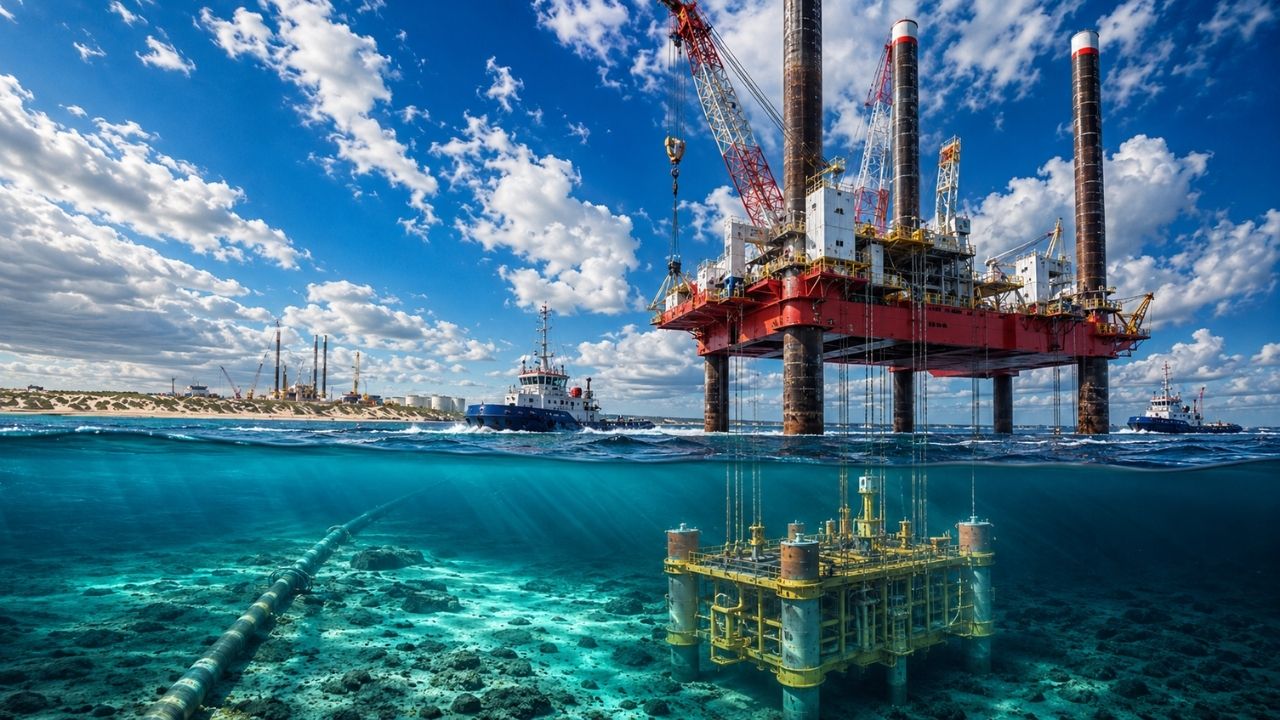


Desalination in Alkimos advanced on May 4, 2026, with Beverley platform relocated, intakes 1.6 km from the coast, underwater tunnels, onshore works, and a forecast of potable water for Western Australia in 2028, reaching 50 billion liters per year in the first phase of the water project.
Desalination returned to the center of water security for Western Australia with the advancement of the Alkimos plant. In an update on May 4, 2026, the Water Corporation reported the completion of offshore intake structures and the relocation of the self-elevating platform Beverley to continue maritime works and underwater tunnels.
The project was created to respond to decreasing rainfall and population growth in the region. The first phase of the plant is expected to be ready in 2028 and provide up to 50 billion liters of potable water per year, before a future expansion to 100 billion liters annually.
Beverley platform was repositioned for a new stage at sea
The maritime construction of the Alkimos plant advanced with the completion of pile driving at the intake structure site, located approximately 1.6 km from the coast. According to the project update, the two intake structures have also been installed.
-
Concrete-filled PVC homes could be cheaper than traditional masonry, UPF research finds; with ready modular panels, less waste, and faster construction, the Concrete-PVC system aims to cut costs and transform affordable housing in Brazil.

-
Brazilian House Built with 32.8 Tons of Construction Debris Offers Affordable Housing Solution
-
Americans Build Entire Homes in a Day Using Compact Sand Foundations and Pre-Made Wooden Trusses, Reducing Construction Costs

-
China’s Largest Floating LNG Plant, NGUYA, Sets Sail for Congo: 2.4 Million Tons Annually for Italy’s Eni


After this stage, the self-elevating platform Beverley was repositioned about 3 km from the coast. At the new point, it will support the installation works of the discharge structure, with completion expected by mid-2026.

This movement marks the transition from intake to the stage related to returning the brine to the ocean. The plant will need to both bring seawater for treatment and return the concentrated saltwater in a controlled manner.
For the safety of vessels and sea users, exclusion zones remain in effect at work sites. The guidance is to keep a distance from maritime construction areas while platforms, vessels, and equipment operate around Alkimos.
Ocean intakes will connect to underwater tunnels

The plant will feature two main underwater systems. One will be the intake pipeline, responsible for bringing seawater to the treatment unit. The other will be the discharge pipeline, used to return the brine to the ocean.
These pipelines will be installed in underground tunnels beneath the seabed. The choice of deep tunnels aims to reduce impacts on dunes, reefs, and marine life, keeping the infrastructure protected below the sea floor.
In Alkimos, the underwater tunnels are a central part of desalination because they connect the ocean to the onshore plant. This structure will allow seawater intake, treat the necessary volume, and deliver drinking water to Western Australia without directly relying on rainfall.
The schedule foresees the installation of structures on the seabed for the intake and discharge diffusers between December 2025 and June 2026. Meanwhile, the construction of the two underwater tunnels will occur between mid-2025 and the end of 2026.
In practice, desalination in Alkimos depends on engineering that starts far from the coast, passes through tunnels under the ocean, and ends at an onshore treatment plant.
Tunnel Boring Machines Karli and Mary advance under the ocean
The tunnel boring machines Karli and Mary are ahead of schedule, according to the project update. Both are already excavating under the ocean to form the paths for the underwater pipelines.
Karli has completed more than 1.5 km of the 4 km discharge tunnel. Mary, on the other hand, has advanced more than 1.2 km of the 2.5 km intake tunnel.
The tunnel boring machines excavate an average of 16 meters per shift and have already achieved a project record of 33.7 meters in a single day. A booster pump has also been installed in the longer tunnel, while another pump is expected to be installed in the Mary tunnel.
The advancement of the tunnels is crucial because the plant will only operate fully when intake, treatment, and discharge are integrated. Without this underwater connection, seawater does not reach the plant, and the brine does not return to the ocean through the planned system.
Plant will have a capacity of 50 billion liters per year

The first phase of the Alkimos Seawater Desalination Plant is designed to provide up to 50 billion liters of drinking water per year. This volume will be allocated to millions of residents in Western Australia.
With additional investments and works, the second phase could increase the capacity to 100 billion liters per year. The project, therefore, is already born with a logic of future expansion.
Desalination emerges as a new source of water independent of rainfall. This is relevant because the region faces a reduction in precipitation and an increase in population, a combination that pressures reservoirs and traditional systems.
The proposal is to diversify the supply before climate dependence becomes an even greater risk. Instead of relying solely on rainfall, Alkimos transforms seawater into a structural part of the water system.
Onshore work also progresses at the treatment plant
While the maritime work progresses, the onshore structures continue to take shape. The pre-treatment building undergoes hydrostatic testing, and the construction of the external walls is almost complete.
In the reverse osmosis building, more than 1,500 tons of reinforcement are almost fully installed, while the foundation slab is underway. The adjacent discharge tank also passed the hydrostatic test and is ready for roof sealing.
Large concrete panels are being molded on-site due to the size and weight of the pieces. At the same time, teams are installing underground services, including drainage, electrical systems, and piping.
The plant is not just a coastal structure: it is an integrated complex of maritime works, tunnels, concrete, energy, drainage, and advanced treatment. Everything needs to operate together to transform seawater into drinking water.
33.5 km pipeline will carry water to the integrated system

In addition to the desalination plant, the project includes the construction of a new pipeline of 33.5 km between Alkimos and the Wanneroo reservoir. This connection will allow the treated water to be transported to the Integrated Water Supply System.
This step is essential because producing drinking water is not enough. The resource needs to reach the network that supplies homes and businesses throughout the region.
Smaller projects are also planned in Perth to increase the capacity of the current distribution system. The idea is to allow mass transfer of the new water source through the existing network.
The project shows that water security depends on both production and distribution. A large plant loses efficiency if the water cannot circulate adequately to consumers.
Groundwater will be mixed with desalinated water
Another front of the project involves the construction of a groundwater treatment station on site. This structure will mix naturally mineralized groundwater with desalinated water.
According to the Water Corporation, this combination reduces the amount of treatment needed for the new water source, as well as lowering costs and environmental impacts of the project.
The work is part of the so-called Eglinton Groundwater Scheme, with drilling of a third well and construction of piping between mid-2025 and the end of 2026.
The mixture with groundwater helps transform desalinated water into suitable drinking water for distribution. This step shows that treatment does not end when the salt is removed; the final composition of the water also needs to be adjusted.
Construction tries to reduce impacts on sea and community
The Water Corporation states that it conducted studies to minimize environmental impacts. The underwater pipelines will be installed in deep tunnels under the seabed to avoid damage to reefs and marine life.
During pile driving, noise monitoring is ongoing. Although 24-hour work has been approved by the Wanneroo City Council, pile driving will only occur during the day, approximately between 6 am and 7 pm, when there is visibility to protect marine mammals.
Exclusion zones of 1 km have been established around work areas. Residents may also hear intermittent hammering sounds from a distance, depending on the wind and location.
The work tries to balance water urgency, heavy engineering, and environmental care. In maritime projects of this size, noise, navigation, fauna, beach, and community are part of the planning.
Alkimos is expected to become a new water source in 2028
The completion of the Alkimos Seawater Desalination Plant and the first production of water are scheduled for 2028. The construction and operation of the plant will be conducted by the Alkimos Seawater Alliance, formed by Water Corporation, Acciona, and Jacobs Group.
The station will be built in the Alkimos Water District, between Marmion Avenue and the coast, on land owned by Water Corporation, which already operates a wastewater treatment plant on the site.
With the first phase, Western Australia will have a new source of potable water on a billion-dollar scale, independent of rainfall and connected to the integrated supply system. The second phase could double this capacity in the future.
In the end, desalination in Alkimos shows how regions pressured by climate and population are resorting to underwater tunnels, offshore platforms, and reverse osmosis to ensure water supply.
Do you think large desalination plants are the safest path for coastal cities, or does the environmental cost still require more debate? Share your opinion.