






 Portuguese
  Spanish


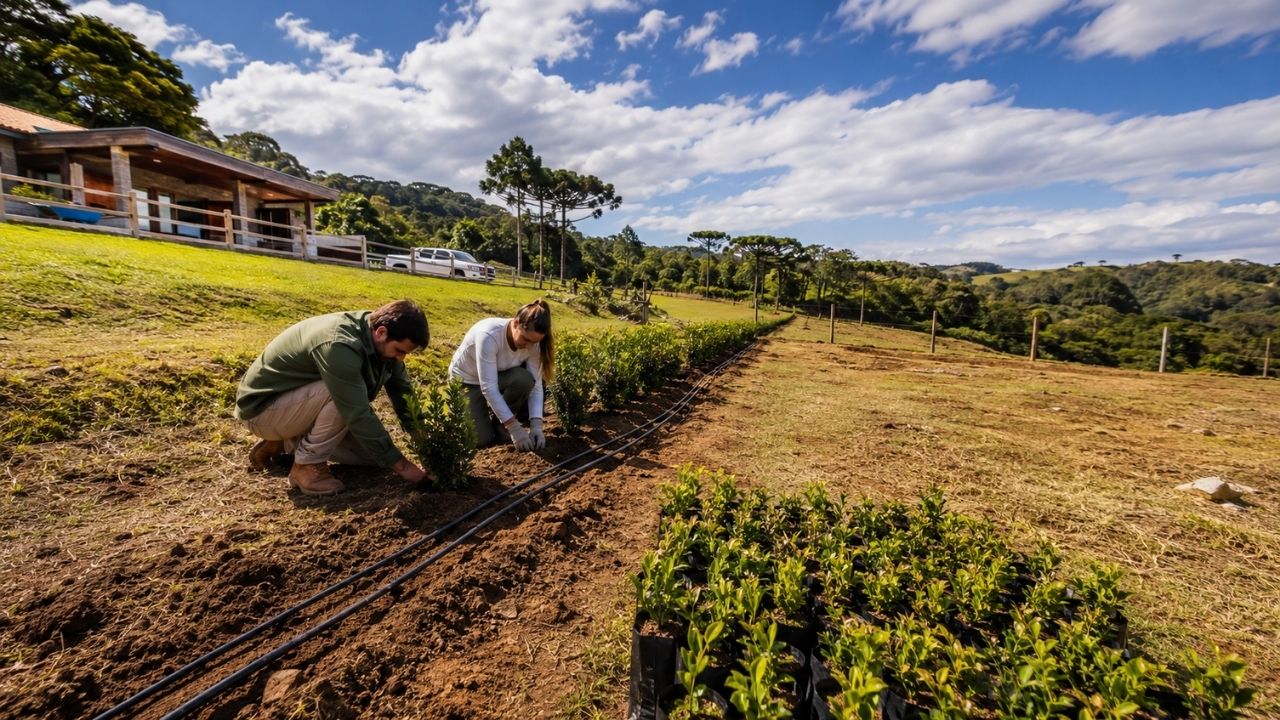


Living fence with 380 seedlings purchased online marked a new stage at the couple’s site, who opened boxes, checked shrub thunbergia plants, tested drip irrigation over 80 meters, prepared soil with lime, manure, and fertilizer, and began creating a green wall at the refuge in Santa Catarina.
The planned living fence for the couple’s site started with an unusual purchase: 380 seedlings online, delivered in just three boxes. The idea is to form a green wall of approximately 80 meters, covering an open area in front of the cabin and helping to transform the rural land into a more private refuge.
The chosen seedlings were of shrub thunbergia, a plant used to form green barriers when it grows and blocks the view. Before planting, the couple decided to open the boxes, check the condition of the plants, water the seedlings for a few days, and test the irrigation, as manually watering the entire length would be unfeasible in the site’s routine.
Couple bought 380 seedlings online and were unsure about the delivery

The first surprise came even before planting. The couple received the 380 seedlings in three boxes and were skeptical if everything would fit there, as the ad gave the impression of larger plants. The concern was simple: to know if the seedlings would arrive alive, complete, and in good condition after the journey.
-
Innovative Project Demonstrates How to Build a Modular, Eco-Friendly Cabin Using Recycled Timber Logs

-
Transform Your Bathroom with Paint, Mirrors, LED Lighting, and Accessories for a Quick, Cost-Effective Makeover
-
Couple Converts 1925 Detroit Bank into Home, Earns $40,000 Annually on Airbnb

-
Tired of Seeing People Sleep in the Cold, London, Canada Opens First Modular Shelter for Homeless with 60 Cabins, Heating, Meals, and Dog Area


Upon opening the first box, the surprise was positive. The plants were green, rooted, and better than they expected. Some seedlings had lost soil during transport, but most arrived in a state considered good for recovery and subsequent planting.
In the second box, some plants were more disorganized, with exposed roots and less soil. Even so, the couple assessed that the problem likely came from transport and that it would be possible to recover the seedlings with water, care, and soil replacement.
The purchase highlighted a common risk for those trying to accelerate a rural project online: the product arrives more compact, suffers during transport, and requires immediate handling to maintain quality before going into the soil.
Hedge will be formed with shrub thunbergia
The species chosen for the hedge was the shrub thunbergia. The plant should be used to form a green wall along the cut area of the land, helping to hide the open view and improve the landscaping in front of the cabin.
According to the couple, the idea is to create a visual barrier that starts at one end of the land, passes behind the post, and continues to the highest part of the prepared area. The main stretch is about 80 meters, with holes already dug to receive the seedlings.
Initially, the result should still be simple because the plants arrived small. The couple themselves acknowledge that the hedge will take time to gain volume and achieve the expected appearance.
This is an important point in rural landscaping projects: the green wall doesn’t come ready-made. First come the small seedlings, then adaptation to the soil, rooting, irrigation, and only then the visual closure.
Seedlings needed to be watered before planting
After opening the boxes, the couple decided to water the seedlings immediately. The recommendation seen in the advertisement was to keep the plants hydrated for a few days before putting them in the ground because they arrive dehydrated from the trip.
The seedlings were taken to another location on the site, carefully watered, and left for recovery. Even though they were green, many had dry soil, which reinforced the need for hydration before definitive planting.
The couple started watering the plants about twice a day, also counting on help from the rain at times. The expectation was that the roots would strengthen before being transferred to the planting line.
This initial care can determine the success of the hedge, especially when the seedlings undergo long transportation, arrive cramped in boxes, and still need to face new soil, sun, and adaptation on the site.
Drip irrigation was tested over 80 meters

Before planting, the couple started setting up the irrigation. The idea was to install a drip hose along the 80 meters of the future hedge, avoiding the need to water everything manually.
The chosen hose already came with small drip holes, different from the system used previously in the orchard, which required holes made by hand. This time, the installation seemed simpler, but it still depended on sufficient pressure to carry water to the end of the line.
The plan was to connect the fence irrigation to the orchard’s automatic system, using the same timer. This way, the water would reach the seedlings at the same time the orchard was irrigated, reducing daily work.
The test showed that everything on the site still depends on adaptation. The water pressure seemed limited by the timer, but since the system works by dripping, the couple decided to test if the flow would be sufficient to water the entire length.
Water pressure and dogs became part of the challenge
During installation, the hose needed to be stretched along the entire route, passing behind the post and following the line where the seedlings would be planted. When filled with water, it went from flat to round, revealing where there were kinks that blocked the flow.
The couple noticed a leak at the connection and also needed to adjust the end of the hose, cutting the tip and tying a knot to prevent water loss. Even so, the system started dripping better than expected.
Another problem quickly appeared: the dogs started biting the new hose. The situation led the couple to consider some temporary protection until the animals got used to the novelty on the land.
The construction of the living fence does not just depend on buying seedlings and digging holes. Water pressure, connections, animals, hose kinks, soil, and maintenance routine all come in the same package.
Soil will receive lime, manure, and fertilizer before planting
With the irrigation practically tested, the next step will be to prepare the soil. The couple intends to use lime, manure, and fertilizer before planting the bush thunbergia seedlings.
The manure should already come from the family, stored at the relatives’ site. However, the lime and fertilizer still need to be provided, mainly because the region’s soil was described as poor in lime.
The preparation will be done along the 80 meters, placing the inputs at the bottom or near the holes and covering with soil before planting. The idea is to give the seedlings better conditions to grow strong.
This preparation is essential for the living fence not to just be planted, but to really develop. Without water and corrected soil, the green wall may take longer, fail in sections, or grow irregularly.
Green wall should bring more privacy to the refuge


The visual goal of the living fence is to transform an area that is currently open and exposed into a natural barrier. The couple wants to close the view in front of the cabin and also cover sections where there are neighbors and nearby constructions.
The expectation is that, over time, the seedlings will grow and form a green wall along the entrance of the site. When full, the fence should complement the landscaping and help create a sense of refuge.
The project will also integrate with other changes on the land, such as planting cassava in the neighboring area and future trees near the road. Gradually, the space will stop looking like an open field and start to take on the design of a planned rural property.
The most interesting thing is that the couple is building everything in stages: first, they clear the land, then dig holes, buy seedlings, test irrigation, prepare the soil, and only then plant.
Living fence shows that rural landscaping is also a process
The story of the 380 seedlings reveals the real side of transforming a site. Nothing appears ready. Online purchases raise doubts, boxes arrive disorganized, plants need water, hoses leak, dogs bite, and the soil still needs to be prepared.
Even so, the couple keeps moving forward. The future living fence should function as a green wall, landscaping, and visual protection, providing more privacy to the refuge in Santa Catarina.
The project also shows that life on the site requires patience. The seedlings are still small, and the beautiful result in the photo will only come after time, care, and maintenance.
In the end, the living fence starts as a test of online shopping, irrigation, and soil preparation but can completely change the entrance of the refuge.
Do you think a green wall is more worthwhile than a conventional wall in sites and rural homes, or is it too much work to maintain? Share your opinion.


