






 Portuguese
  Spanish


Expansion of Brics, Use of Local Currencies and Tensions with the USA Extend Debate About the Future of the Dollar and Move Global Geopolitics, with Direct Reactions from Donald Trump and Strong Responses from President Lula.
The rise of Brics and its approach towards alternatives to the dollar could jeopardize one of the main pillars of the United States’ power.
The assessment is from finance professor and businessman José Kobori, in an interview published in the Flow Podcast.
According to him, the coordination among Brazil, China, Russia, and other members of the bloc represents a “counter-hegemonic” movement capable of accelerating the loss of supremacy of the U.S. currency in international trade.
-
Brazil’s 2026 Tax Refund: Record 9.58 Million Filers in Largest Payout Ever, But a Key Detail on Priority Recipients Draws Nationwide Attention

-
Itaú Alters Hybrid Work Model, Increasing Office Days from 2028, Prompting Employees to Adjust to New Routine
-
Facing Labor Shortage, Japan Plans to Invest $34 Million to Attract Foreign Workers in Construction, Healthcare, Industry, and Commerce

-
Brazilian City Makes Remarkable Leap, Becomes 4th Wealthiest in the Country with GDP of R$ 134.1 Billion




Origin and Objectives of Brics
The group emerged in 2009, initially with Brazil, Russia, India, and China — the acronym was simply “Bric.”
The entry of South Africa in the same year transformed the name to Brics.
As Kobori explained, the term was coined by an American economist but gained traction from cooperation initiatives, particularly with Brazil’s active participation at the time.
The objective, according to him, was already to counter the unipolar order led by the United States since the end of the Cold War.
Initially, Washington did not view the bloc as a concrete threat. “Until Trump’s inauguration, Americans did not really understand what Brics was,” he commented.

However, when he assumed the presidency, Donald Trump started to mention the group critically, especially due to the creation of the New Development Bank, nicknamed the “Brics Bank.”
One of the central points that disturb the USA, Kobori highlighted, is the intention to conduct international transactions without using the dollar.
The Impact of Dollar Hegemony
For the professor, this change directly impacts the machinery that sustains American power.
“Losing dollar hegemony is like losing a world war,” he said, citing a statement from Trump himself.
Kobori explained that the dollar’s privileged status allows the United States to issue debt on a large scale and sell it globally.
Should the international market stop buying these bonds, Washington would need to finance itself internally — something he considers unfeasible at the current scale.
In addition to the five founding countries, Brics is expanding its influence with the entry of new nations, including Iran.
“Today, the bloc already comprises more than 50% of the world’s population and about 40% of global GDP,” he pointed out.
China alone already has industrial production that exceeds that of the United States and the European Union combined.
This economic weight strengthens initiatives such as increasing bilateral transactions in local currencies, avoiding conversion to dollars.
Local Currencies and Currency Swaps
Kobori also mentioned agreements like “currency swaps” conducted outside the U.S. currency.
The recent trip of President Luiz Inácio Lula da Silva to China, according to him, reinforced this type of cooperation.
For the professor, it makes more sense for countries to protect their economies and companies using their own currencies, without the need to go through the dollar.
In Kobori’s view, this strategy explains why Washington sees the strengthening of Brics as a direct threat.
Attacking countries like Brazil, Iran, or Russia economically, he said, is also a way to weaken the bloc.
He further emphasized that China’s economic rise “is irreversible” and that Beijing is expanding its network of partnerships with Africa, Central Asia, and the Middle East, especially through the “New Silk Road.”
Brazil’s Posture and Political Tensions
At the last summit of the Brics, held in Rio de Janeiro, Brazil played a relevant role in defining the agenda.
According to Kobori, the expectation was that the Brazilian government would adopt a more neutral tone, prioritizing issues such as public health and governance of artificial intelligence.
However, the final resolution included direct criticisms of actions by Israel and the United States against Iran, as well as condemning trade tariffs imposed by Trump.
Even India, which usually seeks to remain neutral, adhered to this positioning.
These positions led American senators, such as Lindsey Graham, to suggest possible trade retaliations against Brazil, China, and India.
Kobori noted that such measures would come at a high cost for the U.S. economy, which is already facing inflation above historical averages.
Imposing high tariffs on these three markets, he assessed, could worsen the internal scenario and complicate Trump’s plans to cut interest rates before the midterm elections.
Trade Conflict Enters a New Chapter
On Thursday (14), CNN Brasil reported that President Donald Trump reiterated his justification for the tariffs against Brazil, this time relating it to the criminal action against former President Jair Bolsonaro, his political ally.
He accused the country of unfair trade practices and confirmed a 50% tax on Brazilian products.
President Lula responded, stating that Brazil would not kneel before the White House, although he keeps the door open for negotiations.
In a statement, he said he told Trump that if he had done in Brazil what he did in the United States during the Capitol invasion, he too would be judged and, if convicted, would go to prison.

Earlier, Deputy Eduardo Bolsonaro, in an interview with Reuters, expressed his expectation for more sanctions from Washington against Brazilian authorities and possibly new tariffs against the country.
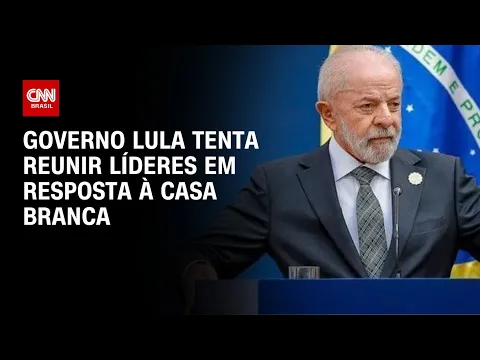
In light of the impasse, Lula’s government is betting on strengthening relations with Brics countries and the so-called “global south” to expand markets and adopt a joint stance in defense of multilateralism.
Lula is attempting to organize a virtual meeting with international leaders to articulate a common response to American diplomacy.
So far, there is no official confirmation, and few heads of state have expressed willingness to publicly criticize Trump.
Resilience of Brazilian Agriculture
In trade, however, Brazilian agriculture has shown resilience.
According to the Ministry of Agriculture and Livestock, exports grew 1.5% in July 2024 compared to the same month of the previous year.
Among the highlights is coffee, which recorded a 25% increase in export value.
For José Kobori, the dispute over the dollar and global trade remains the central axis of tension between Brics and the United States.
He concluded that as long as the U.S. dollar sustains the financing of Washington’s foreign and military policy, the country will do everything possible to prevent blocks like Brics from gaining enough strength to change the rules of the game.
In light of this situation, the question remains: are we witnessing the beginning of the end of the dollar’s supremacy in the international system?








