Portuguese
  Spanish


BYD’s investment of US$ 100 million goes to a system that helps the grid absorb solar and wind energy. Today among the five largest brands in the country, the company will still decide in 90 days where to install the new line, and the goals depend on the coming years.
BYD is accelerating battery production in Brazil and is preparing to invest around R$ 510.4 million in energy storage systems for the national power grid, as part of a plan to reach 50% national content by 2027 and become the best-selling automaker in the country by 2030. The information comes from Alexandre Baldy, senior vice president of BYD Brazil, in an interview with Reuters on June 15.
The amount is equivalent to US$ 100 million and targets a concrete problem of the power grid. The investment goes to a new line of the Battery Energy Storage System, known by the acronym BESS, which stores electricity for the national system. The initiative adds to an already announced investment of R$ 5.5 billion in the company’s main factory in Camaçari, Bahia, and comes at a time when the Chinese brand is already among the five largest in the Brazilian market.
The investment of R$ 510.4 million in energy storage
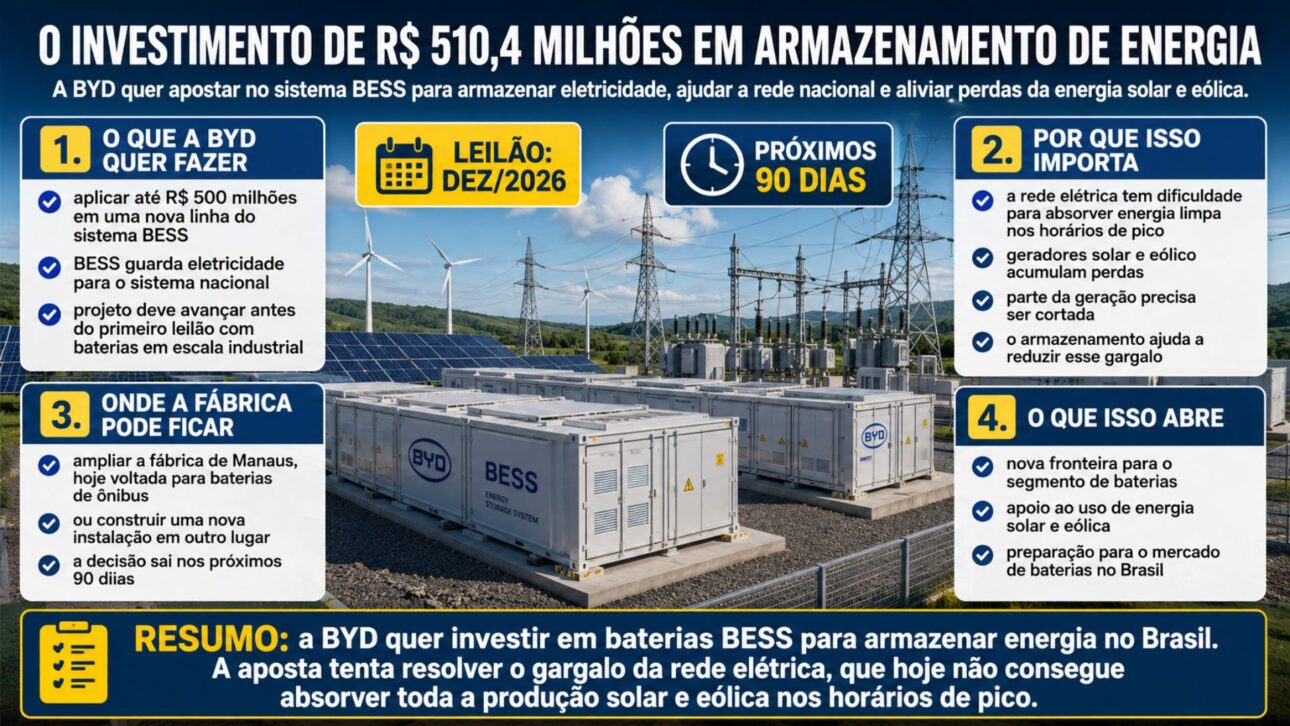
BYD’s bet on storage directly targets the national power grid. The company is preparing to apply up to R$ 500 million in a new production line of its BESS system, used to store electricity for the national system, which should be developed before the first auction to introduce batteries on an industrial scale in the country, scheduled for December 2026. “This really opens a new frontier for a new battery segment,” said Baldy.
-
Tesla injected an additional $250 million into the German factory, doubled the battery cell target, and opened its own production line for startups.

-
A 180-meter ship with a deck the size of a football field was christened to carry 25,000 tons of giant energy modules around the world.
-
To erect the “Baleia” building on the richest avenue in Brazil, he bought 35 houses, paying with trips to Disney, a truck, and even an apartment, waited over 20 years, and today the complex is valued at R$ 2.5 billion.
-
The land belonged to her great-great-grandfather and was worth R$ 25 per square meter during the pandemic; the couple sold 250,000 m² for the nearly R$ 30 billion project that is transforming the “neighbor of Jericoacoara,” and today a house in the region goes for R$ 4.2 million.


The sensitive point lies in the difficulty of the grid absorbing clean energy. Systems like the BESS are seen as essential to address a crisis between solar and wind energy generators in Brazil, sectors that have been accumulating losses and stalled investments because the national grid cannot absorb production during peak hours, forcing a cut in part of the generation. In the next 90 days, BYD will decide whether to add this line to the Manaus factory in Amazonas, currently focused on bus batteries, or to build a new facility elsewhere.
The goal of 50% national content by 2027
The move in energy is part of a larger nationalization plan. BYD aims to achieve 50% national content in cars produced in Brazil by early 2027 and, to meet government requirements and reduce tax burdens, has been increasing local supply. The goal is to stop relying on imported components and establish the brand as a genuinely Brazilian manufacturer.
Batteries are another piece in this strategy. The start of battery production for passenger cars is part of the already announced investment of R$ 5.5 billion in the Camaçari unit in Bahia, while another R$ 50 million to R$ 60 million is allocated to expand a battery line for buses. The battery is now treated as an important local component, rather than just an item brought from abroad.
Bahia as the production center and the aim for 2030
It is in Bahia that BYD concentrates its largest local production. The automaker aims to become the best-selling car brand in Brazil by 2030 and is already among the top five in the country. The leap from the current position to leadership is precisely the target guiding the expansion of factories and the search for more national supply.
The deepening of local manufacturing supports this ambition. From passenger car batteries to energy storage, the strategy ties the company’s growth to Brazilian factories and the needs of the electrical grid. However, the goals still depend on the coming years and decisions such as the location of the new storage line, which remains open.
Lithium out of plans for now
Even with an eye on the future, BYD has halted a move in lithium. Although the automaker has acquired mineral rights in areas of a lithium-rich region in Brazil, the company does not intend to develop these lands at the moment, due to the low price of the mineral used in battery manufacturing. The company’s own assessment is that it is not worth entering extraction now.
The declared focus is on consolidating what is already underway. Instead of advancing on lithium, the priority is to establish the passenger car factory and expand the production capacity of electric buses. The development of the deposits is presented as an off-the-table topic for now, with no room even in the company’s internal discussions.
BYD is preparing to invest around R$ 510.4 million, or US$ 100 million, in an energy storage battery line to strengthen the national power grid, ahead of the December 2026 auction that is expected to introduce these systems on an industrial scale, as part of a plan to achieve 50% national content by 2027 and become the best-selling automaker in Brazil by 2030.
The company, currently among the top five brands in the country, will decide within 90 days where to install the new line, maintains R$ 5.5 billion in investments in Camaçari, Bahia, and has set aside lithium for now, given the low price of the mineral. However, a good part of these numbers are still goals and plans that depend on the coming years.
And you, do you think BYD will really meet the nationalization and sales leadership goals in Brazil, or is there still much to prove? Is battery storage the way to unlock solar and wind energy in the country? Share your opinion and exchange ideas with other readers about the energy sector, with respect for different views.