






 Portuguese
  Spanish
  3 min of reading
  0 comments


Israeli Scientists Discover Giant Underwater Canyon in the Mediterranean Sea: Over 10 Km Wide, It Is a Landmark for Geology.
Researchers from the Geological Survey of Israel (GSI) made a remarkable discovery in the eastern Mediterranean Sea, using advanced geophysical analysis methods. They identified a massive underwater canyon that dates back approximately 6 million years, dating to the onset of the Messinian period. This discovery represents a significant advance in understanding the marine geology of the region.
The Mediterranean Sea, known for being the largest sea of the Atlantic Ocean, occupies a strategic geographic position, bordered by Europe, Asia, and Africa. Covering an area of approximately 2.55 million square kilometers, it extends from the Strait of Gibraltar to the western coast of the Middle East. This historic sea not only has crucial geographic importance, but it is also a treasure trove of biodiversity and geological phenomena, as evidenced by the recent discovery of the canyon. This underwater find not only enriches our knowledge of the geological history of the Mediterranean Sea but also opens new doors for future research on underwater dynamics and the natural history of this region.
Underwater Canyon Occupies an Area of About 10 Km Wide
The discovery was published in a recent article in the scientific journal Global and Planetary Change, and the Underwater Canyon of the Mediterranean Sea has been named Eratosthenes and occupies an area of about 10 km wide and 500 meters deep.
-
Scientists claim to have created a way to “store solar energy” in a liquid molecule and release that heat when needed.

-
NASA is advised to create a biocontainment facility on the Moon to prevent samples from Mars, the Moon, or other places in space from arriving directly on Earth with possible dangerous contaminants.

-
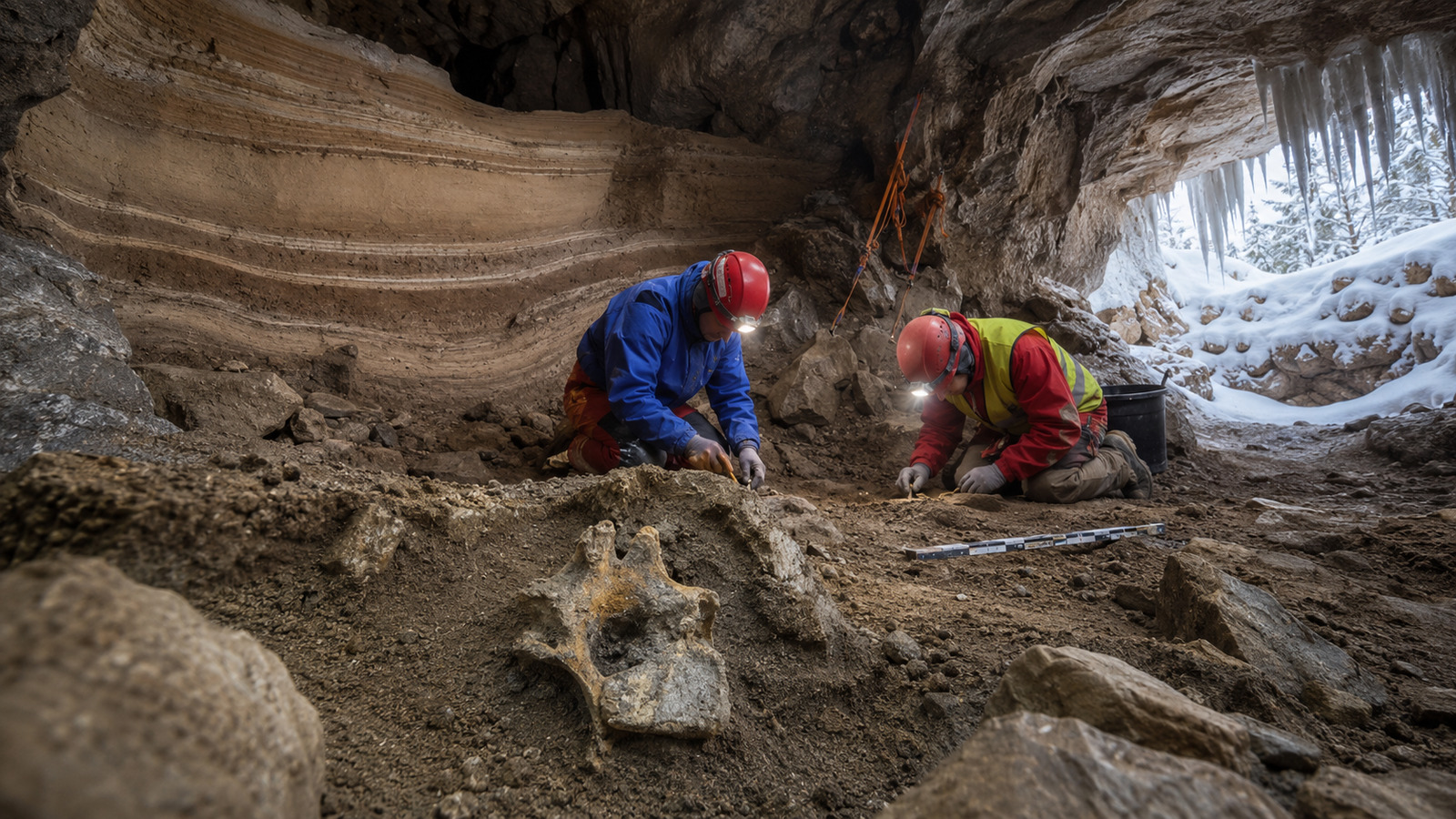
Scientists open lost cave in Norway and encounter a forgotten Arctic world with 46 species that existed 75,000 years ago.
-
Scientists were looking for a black hole in a galaxy 11 billion light-years away, but ALMA revealed a “factory” of neutrinos hidden by dust and powered by intense star formation.




More specifically, it is located in the Levant Basin, near the neighboring underwater mountain Eratosthenes, from which its name is derived.
The researchers estimate that it formed between 5.6 million and 6 million years ago, at the beginning of the Messinian period, when the Messinian salinity crisis occurred, a geological event that involved systems of the hydrosphere, biosphere, lithosphere, and atmosphere.
The underwater canyon formed on the floor of the Mediterranean Sea at the beginning of the Messinian period, before the deposition of salt, when sea levels fell and salinity increased. It turns out that due to tectonic plate movement, the connection between the Atlantic and the Mediterranean was closed, isolating the sea from the ocean. As a consequence, some parts of the Mediterranean dried up for about 700,000 years, leaving a vast expanse of salt behind, up to 3 km thick.
The Importance of the Discovery of the New Underwater Canyon
As sea levels decreased, increasingly salty currents advanced faster than the surrounding water and gradually eroded the seafloor, creating ravines several hundred meters deep along the steeper margins of the Mediterranean Sea, forming the colossal underwater canyon.
This discovery sheds light on a decades-old debate: whether the Messinian ravines and canyons formed above or below the sea surface. According to researchers, this new evidence strengthens the arguments that at least part of the erosion on continental margins occurred below water, just before the salt accumulated on the seafloor.
The scientists emphasize that the increase in salinity at the beginning of the crisis and a possible limited drop in sea levels would have triggered gravitational currents, destabilizing the continental margin and excavating the seafloor wherever it was steep enough.
In a broader context, the results of this research show the environmental conditions of higher salinity in the deep basins of the Mediterranean Sea prior to the climax of the Messinian salinity crisis.
What Is a Canyon?
Canyons exist on all continents, being beautiful yet dangerous landscapes, formed by deep valleys that can reach up to 5 km deep.
They are generally found in areas where there are rivers. These rivers carve the rocks over millions of years, and they may be visible or not, in which case leaving only a trace of where they pass.
The formation of a canyon is still a great mystery for geology, but there are some hypotheses. The depth of a canyon can be achieved through erosive processes that take hundreds of millions of years, being one of the wonders produced by geological time.




Be the first to react!