Portuguese
  Spanish


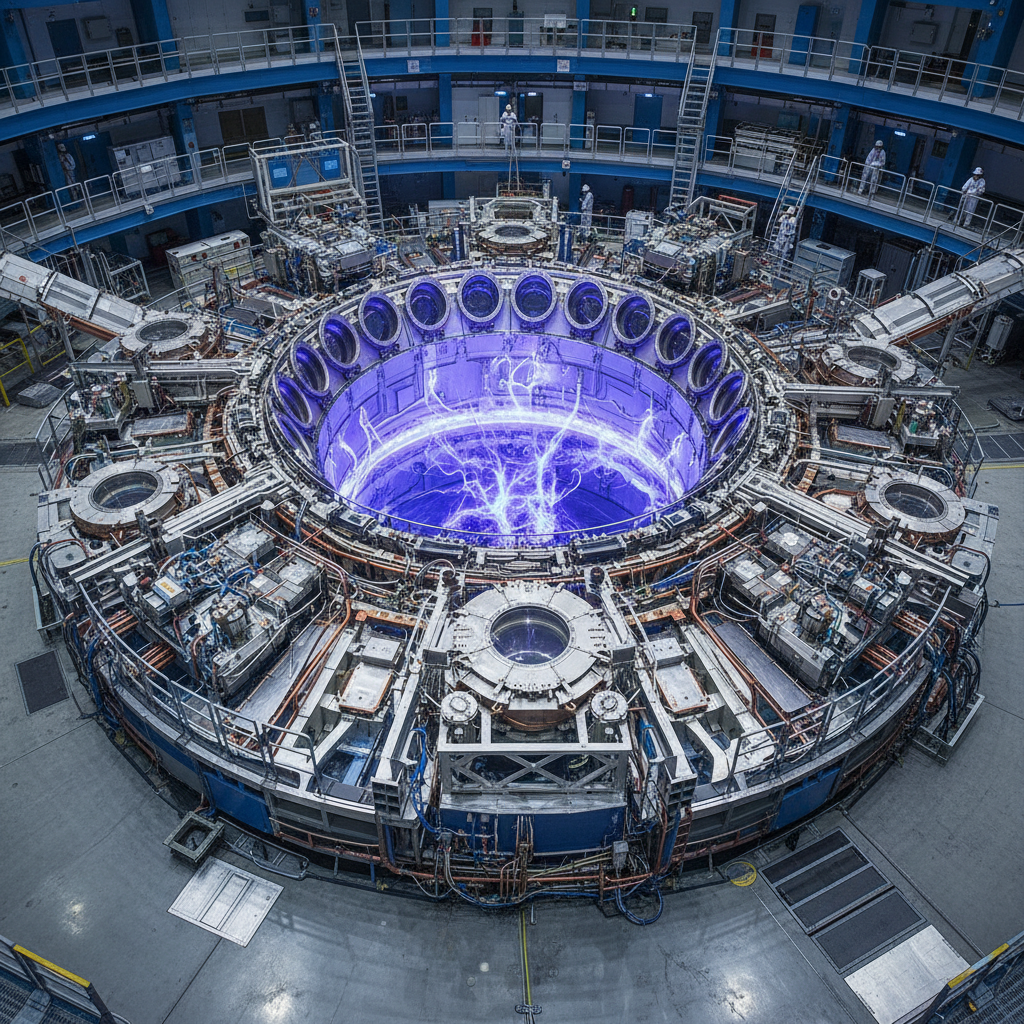


The EAST reactor team, China’s artificial sun, has managed to maintain stable plasma at densities exceeding the theoretical limit predicted by physics — a result scientists considered impossible and that could accelerate the arrival of unlimited fusion energy by years
There is a limit in plasma physics that every nuclear physicist learns in their early years of study.
It’s called the Greenwald limit — a theoretical barrier that defines the maximum plasma density a fusion reactor can maintain before losing control and stability.
China’s EAST (Experimental Advanced Superconducting Tokamak) reactor has simply surpassed this limit.
-
She spent 73 years breathing inside an iron lung, survived the aftereffects of polio, and became the last woman in the United States dependent on the equipment before dying at 78 years old.

-
Brazilian students created a $1 filter using pine bark, cotton, and 3D-printed parts to clean cassava wastewater, reduce the toxicity of a hazardous waste, and transform contaminated water into biofertilizer.

-
Astronaut from Artemis II steps down after mission to the Moon and decision surprises after a record of 406,771 km, a historic 10-day journey, and an unprecedented achievement for Canada.

-
A fossil kept for years in a small museum in Montreal concealed 450-million-year-old soft tissue, a discovery that has only happened once before in history.


And the plasma remained stable.
According to ScienceDaily, EAST entered the so-called “density-free regime”, where stable operation was maintained even at densities exceeding empirical limits established by decades of research.
The result was confirmed by Live Science, which classified the breakthrough as “a step closer to near-limitless clean energy.”

What this means for nuclear fusion — layman’s explanation
To understand why this result is so important, consider the following:
Nuclear fusion works by forcing light atoms to fuse — the same process that makes the Sun shine and generate energy for 4.6 billion years.
For atoms to fuse, they need to be extremely hot (above 100 million degrees) and extremely dense (concentrated in a small space).
The Greenwald limit is one of the fundamental barriers preventing commercial fusion.
If you cannot increase the plasma density beyond a certain point, you cannot increase the fusion rate sufficiently.
And without a sufficient fusion rate, the reactor never produces more energy than it consumes.
Therefore, surpassing this limit with stable plasma is a concrete and measurable step towards viable fusion as an energy source for the world.
Furthermore, the result suggests that current theoretical models on plasma limits may be wrong or incomplete — opening space for more compact and efficient fusion reactors than previously thought possible.

EAST — an artificial sun in Hefei
EAST is located in Hefei, the capital of Anhui province, and is operated by the Chinese Academy of Sciences.
It is a tokamak — a giant “donut-shaped” (toroidal) device that uses extremely powerful superconducting magnetic fields to confine plasma at temperatures of over 100 million degrees Celsius.
To give you an idea: 100 million degrees is seven times hotter than the Sun’s core.
No known material can withstand this temperature — which is why the plasma needs to be suspended by magnetic fields, without touching the reactor walls.
EAST had already achieved 101 seconds of sustained plasma at fusion temperatures in previous experiments — the longest time recorded by any tokamak to date.
Now, by surpassing the Greenwald limit, EAST has added another record to its resume.

The global fusion race — who is ahead
The EAST result does not happen in a geopolitical vacuum.
South Korea maintained plasma at 100 million degrees for 48 seconds in the KSTAR tokamak in 2024, breaking its own previous record.
Helion Energy (USA), backed by Sam Altman with hundreds of millions of dollars, promises to commercialize nuclear fusion by 2028 and already has an energy sales contract with Microsoft.
ITER, in France, involves 35 countries and over US$ 22 billion to build the world’s largest experimental tokamak.
However, EAST is the only one that has demonstrated stable operation beyond the theoretical limits accepted by physics — a result no other reactor on the planet has achieved so far.
Direct impact on the ITER project
The data obtained by EAST is directly shared with the ITER project in France.
ITER aims to achieve a Q factor ≥10 — producing 10 times more fusion energy than the energy used to heat the plasma.
The fact that plasma can be maintained stable at densities above the Greenwald limit can directly influence the design and operational parameters of the world’s largest experimental reactor.
Thus, the Chinese result does not only benefit China — it benefits the entire global scientific community working on nuclear fusion.
Why fusion matters for the planet’s energy
If nuclear fusion is made commercially viable, it offers virtually unlimited energy using hydrogen as fuel — the most abundant element in the universe.
It produces no greenhouse gases during operation.
It generates no long-lived radioactive waste like conventional nuclear fission.
And it does not depend on weather conditions like solar and wind.
A single gram of fusion fuel produces as much energy as 8 tons of oil.
Therefore, whoever masters fusion first will hold the definitive energy source for human civilization.

Caveats
EAST is an experimental reactor — it does not generate electricity for the Chinese power grid.
Maintaining stable plasma at high density for very long periods (continuous minutes or hours) is still a challenge not completely resolved.
Plasma instability is a persistent problem in all tokamaks worldwide — even the most advanced ones suffer from disruptions that can damage the reactor.
From experimental fusion to commercial fusion generating electricity on a large scale, there is still a path of decades, not years.
Still, proving that the Greenwald limit can be surpassed with stability is a paradigm shift in plasma physics that could accelerate commercial fusion by years — and China, with EAST, is leading this race that could redefine the energy future of all humanity.