






 Portuguese
  Spanish


The new capacitor transforms nanoscale confined water into an active electrolyte and paves the way for safer and more sustainable energy devices
A scientific discovery developed at the Hamburg University of Technology in Germany gained attention by showing that pure water can be used to store electricity. The study, led by Vasily Artemov and published in 2026 in the journal Nature Communications, demonstrated that water, when confined in nanometric channels within clay minerals, can efficiently transport electrical charges. The device was named the blue capacitor because it uses water as the central element of energy storage. The technology combines water, clay, and carbon, dispensing with salts, acids, and other common chemical electrolytes in traditional batteries and supercapacitors.
Technical research reveals new use of water in supercapacitors
The device’s operation is based on an essential difference between batteries and capacitors. While batteries store energy through internal chemical reactions, capacitors accumulate opposite charges on conductive surfaces separated by insulating material. Supercapacitors follow the same physical principle but expand the storage area by using porous materials. In this new system, the innovation lies in the use of pure water as an electrolyte, without chemical additives. The proposal aims to develop safer, more sustainable energy storage technologies based on abundant materials, as Vasily Artemov explained when presenting the research results.
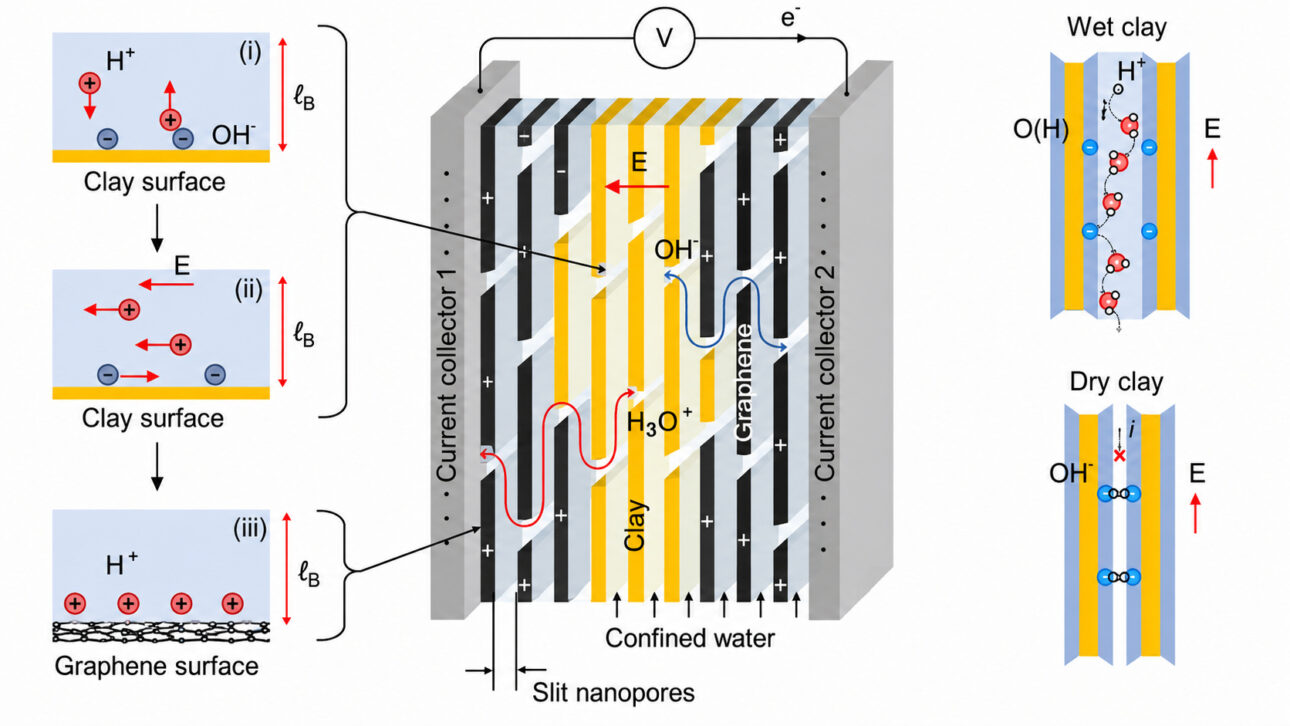
Nanometric channels change water behavior
The key to the technology lies in channels about one nanometer wide, approximately 100,000 times thinner than a human hair. Within these tiny spaces, water begins to exhibit properties different from those observed in its common liquid state. This condition allows electric charges to move efficiently through the structure. To harness this effect, researchers combined clay minerals with graphene sheets, a highly conductive form of carbon. The layers formed by these materials create millions of small channels, which are filled with water and start to function as the base of the blue capacitor.
-
Australia Plans to Export Desert Solar Energy to Singapore via 4,300 km Undersea Cable in a $35 Billion Project

-
Archaeologists Discover 9,000-Year-Old Stone Hammer with Perfect Hole During Routine Inspection for Norwegian Bike Path

-
New Regulations in Brazil Require Dedicated Circuit and Safety Measures for Electric Car Chargers in Condos, Highlighting Hidden Risks of Overnight Charging

-
Argentinian Students Transform Cigarette Butts into Eco-Friendly Bricks, Cutting Cement Use by Over 50% and Halving Costs


Stable performance reinforces the potential of the technology
The blue capacitor maintained stable operation for more than 60,000 charge and discharge cycles. The device also operated at voltages of up to 1.6 volts, a value considered high for a water-based energy storage system. This mark surpasses the 1.5 volts of a common battery, which reinforces the technical relevance of the experiment. For the researchers, this performance shows that nanoconfined water can act as an active electrolyte in a practical device. The result also indicates that little-explored properties of water at the nanoscale can be applied in real electrical storage solutions.
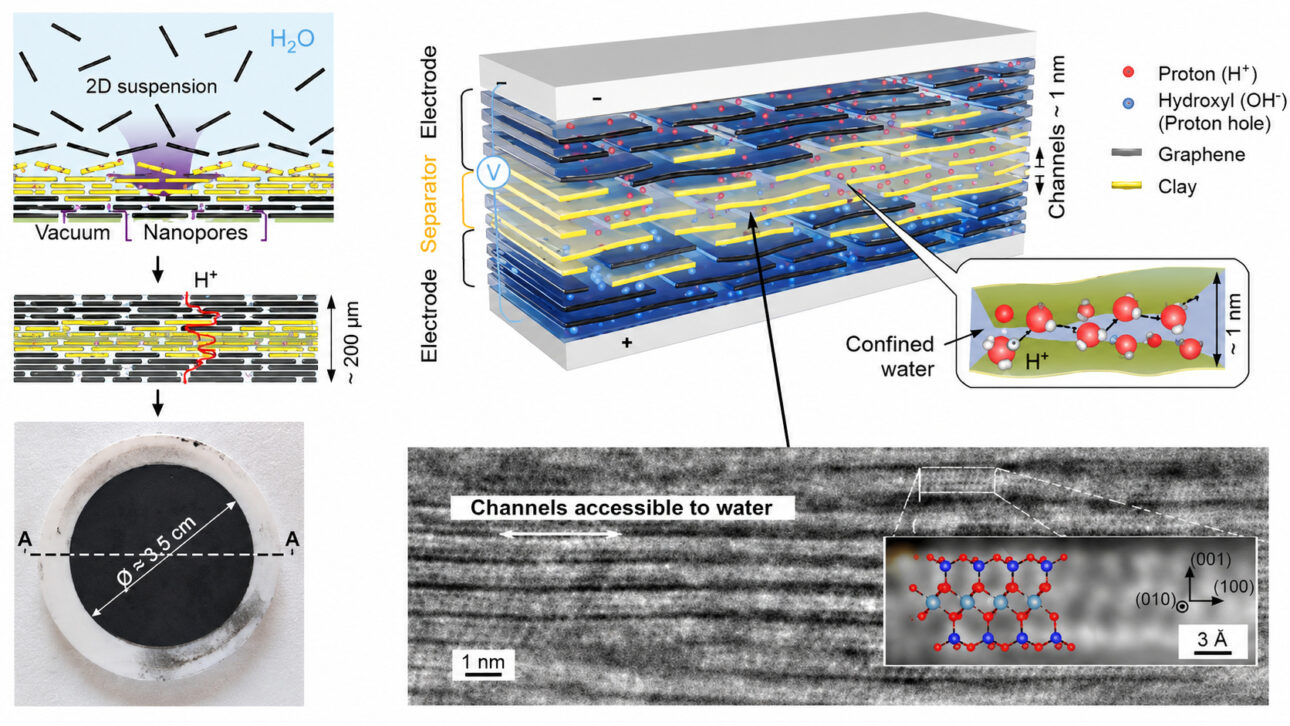
Future applications involve solar and wind energy
The demonstration still represents an initial stage, but the team believes the concept can evolve for future applications. Systems based on this technology could help in storing renewable energy produced by solar and wind sources. Electrical grids could also benefit from devices capable of withstanding frequent charge and discharge cycles. The use of natural and abundant materials increases interest in such solutions, especially in a scenario seeking more sustainable alternatives for storing electricity.
Discovery expands research on water at the nanoscale
The study can also inspire new technologies based on the properties of water confined in extremely small spaces. Sensors, bio-inspired systems, and even applications in neuromorphic computing are among the future possibilities pointed out by the researchers. The practical demonstration made by the Hamburg University of Technology reinforces that water, when analyzed on a nanometric scale, can present very different functions from those known in everyday life. This advancement broadens the understanding of natural materials and creates new research fronts for energy devices.

The future of energy storage with water
The technology still needs to undergo further developments before reaching commercial applications. Even so, the results obtained by Vasily Artemov and his team show that water, clay, and carbon can form the basis of an efficient and stable supercapacitor. The absence of complex chemical electrolytes and performance superior to tens of thousands of cycles strengthen the potential of the blue capacitor.
Do you believe that water-based technologies could become a viable alternative for storing renewable energy in the coming years?


