






 Portuguese
  Spanish
  9 min of reading
  0 comments


With capacities ranging from 35 to 250 tons, cargo planes move goods, vaccines, industrial parts, and special cargo, supporting global supply chains, military operations, and urgent deliveries to remote regions
Cargo planes can transport from 35 to over 250 tons and support an essential part of global logistics by quickly moving goods, supplies, vaccines, industrial parts, and special cargo between countries, factories, and remote regions.

What defines a cargo plane
Cargo planes are fixed-wing aircraft designed or adapted to exclusively transport goods and supplies.
-
With 100 discarded pallets and simple tools, the project creates a 23 m² shelter, recycles wood used in the transport of humanitarian aid, and transforms temporary housing for refugees.

-
Scotland creates a brick made with over 95% recycled debris, eliminates kiln firing, and attempts to reinvent a piece used in construction for almost a thousand years.
-
In Taipei, 1.5 million recycled plastic bottles were saved from becoming waste, turned into building blocks, and formed a nine-story pavilion for an international exhibition.
-
Slums in India painted roofs white to cope with 46°C heat, cool down stuffy homes, improve sleep, reduce energy consumption, and even ease the burden on refrigerators.




They prioritize payload, internal space, and structural strength, setting aside elements focused on passenger comfort.
Unlike common commercial airplanes, these machines do not need rows of seats, wide windows, overhead baggage compartments, or internal amenities.
The central objective is to create space, support weight, and allow for efficient movement of varied volumes.
The history of this type of aircraft began with airmail in 1911. From 1920 onwards, more dedicated designs for goods transport emerged, initiating an evolution that led to today’s large cargo planes.
Today, there are models capable of taking off with hundreds of tons. Some serve long-distance commercial routes, while others were made for military missions, unpaved runways, isolated regions, and operations requiring extreme speed.
This combination explains their presence in commercial routes, military missions, and humanitarian operations.
Structure made for heavy cargo
The main difference of cargo planes lies in the enlarged fuselage, created to better utilize internal space.
The wider and taller cross-section allows for accommodating intermodal containers, industrial parts, and large-volume goods.
The absence of restrooms, seats, and overhead baggage compartments creates a continuous and functional area.
This unobstructed space facilitates the storage, organization, and securing of volumes during flight.
Doors also play a decisive role. Many cargo planes feature large openings in the nose, tail, or sides. These entrances allow for direct loading of vehicles, machinery, pallets, and long items.
On the Boeing 747, the front door opens upwards from the cockpit. This solution facilitates the entry of long loads, which might face limitations with conventional side doors.
Another common characteristic is the high wing. In many designs, the wing is positioned at the top of the fuselage, leaving the cargo compartment lower and closer to the ground.
This configuration simplifies the handling of goods and reduces dependence on external lifting equipment.
In locations with limited infrastructure, this detail can be crucial for keeping the operation running.
The floor receives reinforced metal beams to withstand extreme pressures and concentrated weight. This structure prevents damage during the transport of armored vehicles, industrial exploration pipes, and other heavy items.
In many models, rails and rollers are integrated into the floor. They allow pallets and cargo to be moved to locking positions with more control, reducing manual effort and operation time.
The landing gear is also more robust. Strategic cargo planes use multiple wheels, distributed on high-strength axles, to distribute weight and allow landings on unpaved runways.
The elevated tail completes the typical design of many modern cargo planes. It allows for the installation of hydraulic ramps, facilitating direct access to the aircraft’s interior during loading and unloading.
The Brazilian KC-390 follows this pattern, with access from the rear. This solution speeds up ground movement and improves the flow of goods in and out.
Converted models and dedicated civil aircraft
Not every cargo plane is born a cargo plane. Many models in operation were originally passenger planes, later modified to transport freight for more years on logistics routes.
In these conversions, seats and windows are removed or adapted. The aircraft receives larger side doors, a reinforced floor, and structural adjustments to support the additional weight of the goods.
Models like the Boeing 737 can be transformed for this type of operation. The conversion extends the aircraft’s lifespan and creates an alternative for companies that need regional or intermediate capacity.
There are also civil aircraft designed from the outset for freight. These machines are designed with a focus on storage, rapid loading, and utilization of internal volume.
In this group, engineering prioritizes efficient cargo systems and fuselages suitable for intermodal containers. The elimination of human comfort items helps reduce weight and operational costs.
Military cargo planes and regional operations
Armed forces use powerful cargo planes to move troops, armored vehicles, supplies, and equipment to hard-to-reach areas. These models prioritize strength, versatility, and operation in extreme scenarios.
They usually have rear ramps, reinforced landing gear, and the ability to land on unpaved runways.
This combination allows heavy material to be transported to locations where commercial planes could not operate.
The Lockheed C-5 Galaxy and the Boeing C-17 Globemaster III are important examples of this category. Both were made for strategic transport and are used in large military and humanitarian movements.
Regional cargo aviation, in turn, uses smaller models to connect internal logistics centers to larger airports. This segment is essential for accelerating deliveries to distant areas.
Turboprops like the ATR 72-600F can take off from short runways and transport unit load devices. Their function is to carry packages and goods to regions that cannot accommodate large cargo jets.
These models complete the logistics network by bringing smaller centers closer to global routes. Without them, many remote areas would depend on slower and less flexible transport.
What the interior of a cargo plane is like
Inside, a cargo plane has a spacious, clean, and functional appearance. The main compartment is unobstructed, without seats, cabin decor, or overhead compartments intended for passengers.
The reinforced floor is one of the most important parts. It needs to support high weight without compromising the main structure, especially when receiving concentrated loads at a few points.
Rails and rollers help move volumes inside. These systems allow loads to slide to specific positions, where they are secured to maintain stability during flight.
Smoke detectors and specific drains are also part of the configuration. They help preserve the integrity of the goods and increase operational safety during transport.
Capacity reaches 250 tons
The capacity of cargo planes varies greatly depending on the model. There are aircraft capable of carrying about 35 tons, while the largest projects have transported 250 metric tons.
The Boeing 747-8F is one of the largest commercial cargo jets. It can take off with approximately 140 tons of goods, serving large-scale commercial operations.
The Brazilian KC-390 is in another capacity range. It was optimized to transport about 35 total tons on board, focusing on versatility and varied missions.
The Antonov AN-124 Ruslan is at the top among the giants in global operation, with a capacity to transport 150 tons. It handles colossal industrial loads on international routes.
The historical record belongs to the Antonov AN-225 Mriya. This aircraft took off with a payload of 250 metric tons, a mark that consolidated its place among the largest projects in cargo aviation.
The world’s largest cargo planes
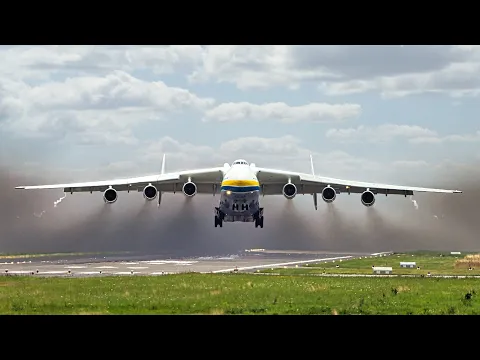
The Antonov An-225 Mriya was the largest aircraft ever built. With six turbofan engines, a capacity of 250 tons, and monumental dimensions, it became a global benchmark for indivisible and heavy loads.
The model was originally designed to transport the Soviet Buran space shuttle. Later, it began to act as a unique solution for loads that other aircraft could not carry.
The An-225 had a wingspan of 88 meters and a length of 84 meters. Its internal compartment allowed it to easily accommodate hydroelectric turbines and entire locomotives.
The only existing unit was destroyed in 2022. Even so, the Mriya maintained its legacy as the greatest symbol of extreme capacity in air transport of special cargo.
The Boeing 747-8 Freighter represents another stage in cargo aviation. It is the most modern cargo version of the Jumbo family and can take off with a total of 447 tons.
Its front door in the nose, opening above the cockpit, facilitates the loading of long objects. The elevated cockpit leaves the main hold clear from front to back.
The aircraft carries about 140 tons of goods and has lower fuel consumption than its predecessors. Therefore, it has become an important option in heavy commercial transport.
The Lockheed C-5 Galaxy is one of the largest military cargo planes in existence. It transports up to 130 tons, enough volume to carry two Abrams tanks or five Apache helicopters.
The nose and tail can be opened, creating a continuous flow of entry and exit. The landing gear has 28 wheels, distributing the weight on airfields with limited infrastructure.
The Boeing 747 Dreamlifter was modified to transport parts of the Boeing 787. Its very wide fuselage and bulbous appearance were created to accommodate large structural components.
There are only four Dreamlifter units. All are dedicated to Boeing’s internal logistics, reducing component transport from weeks to a few hours of flight.
The Airbus Beluga XL performs a similar function in Europe. Based on the Airbus A330, it has an expanded upper fuselage and 30% more volumetric capacity than the original model.
The Beluga XL carries wings and fuselage sections between Airbus production and final assembly units. Its front door is above the cockpit and allows direct loading at floor level.
The Antonov An-22 Antei remains the largest turboprop aircraft ever built. With four turboprop engines and counter-rotating propellers, it carries 80 tons and operates on unpaved and short runways.
The Boeing 777 Freighter combines long range, efficiency, and a capacity of 103 tons. As a twin-engine aircraft, it is valued by express parcel companies that connect Asia and America without intermediate technical stops.
The Boeing C-17 Globemaster III carries 77 tons and lands on dirt runways as short as 1,000 meters. The rear ramp allows for the deployment of cargo and paratroopers in flight.
The Ilyushin Il-76 was created for severe climates and irregular runways. It transports between 50 and 60 tons, has a glass front fuselage, and also gained versions for firefighting and zero gravity.
Role in international trade
The importance of cargo planes in international trade first appears in speed. Perishable foods, flowers, biological products, and medical supplies depend on rapid movements to maintain quality and utility.
In health crises, air cargo transport plays a social role. Vaccines, sensitive medicines, and protective equipment need to cross great distances with time and temperature control.
Aircraft equipped with thermal control systems help preserve the effectiveness of these items. This role reinforces the humanitarian relevance of the sector for maintaining public health.
Industry also depends on cargo planes to maintain just-in-time supply chains. Automakers and technology companies need to receive components with precision to avoid excessive inventories.
When land or sea logistics fail, air shipment can prevent factory shutdowns and millions in losses. This speed keeps production lines running even in the face of delays in other modes.
High-value-added cargo also finds air transport a safer option. Semiconductors, jewelry, works of art, and sensitive technologies require environmental control, monitoring, and less exposure to risks.
Reduced transit time decreases the possibility of damage and claims. Companies transporting luxury goods or industrial secrets prioritize this mode to protect assets and strategic information.
A sector shaped by speed and capacity
Cargo planes combine structural engineering, power, and logistical adaptation. They exist to transport more weight, in less time, with access to places where other means may be slow or limited.
From regional logistics with turboprops to giants capable of moving locomotives, the sector shows how each model meets a specific need. The size of the aircraft matches the type of mission.
Converted planes leverage existing structures, while dedicated civil projects seek efficiency from the initial design.
Military ones prioritize access to difficult runways, strategic mobility, and transport of heavy equipment.
Aircraft like the An-225, 747-8F, C-5 Galaxy, Dreamlifter, and Beluga XL show the diversity of this universe. Each represents a technical response to transport special, urgent, or voluminous cargo.
With capacities ranging from 35 to over 250 tons, cargo planes support part of the global economy.
They connect industries, save production chains, accelerate deliveries, and keep essential goods circulating worldwide.
With information from Remessa Online.









Be the first to react!