Portuguese
  Spanish


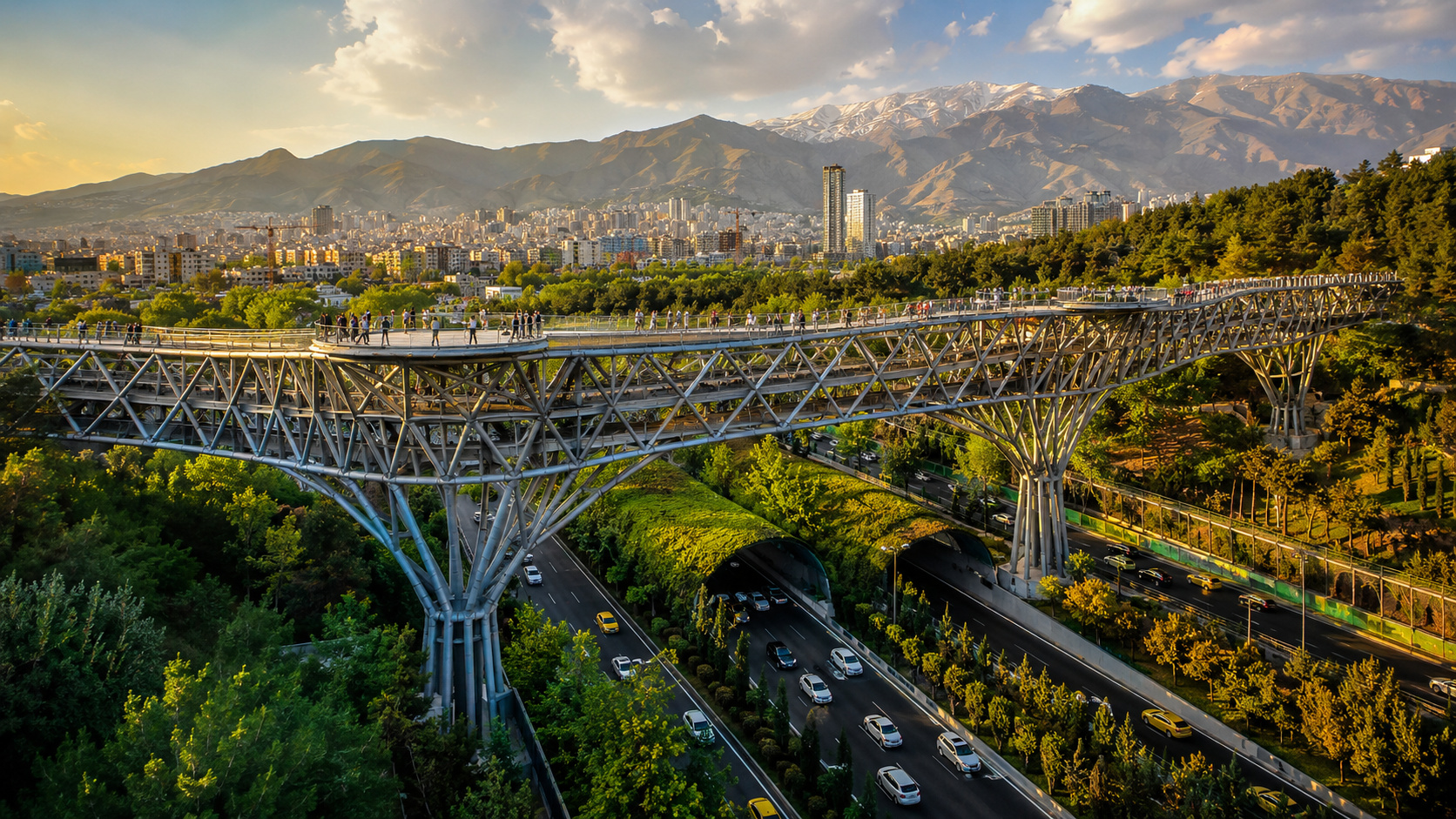

In Tehran, the Tabiat Bridge shows how a pedestrian bridge can connect parks, cross a highway, and become a suspended public space for walking, stopping, observing the city, and staying
The Tabiat Bridge in Tehran, Iran, transformed a pedestrian crossing into a 270-meter suspended plaza over the Modarres Highway. Instead of being just a path over cars, it creates an urban space for walking, meeting people, and observing the city.
The information was released by Diba Tensile Architecture, the firm responsible for the architecture and engineering of the project. The bridge connects two public parks, Abo Atash Park and Taleghani Park, precisely where the highway interrupted the direct connection between them.
The project draws attention because it changes the common idea of a bridge. The structure does not just provide passage. It offers three levels, areas for staying, views of the urban landscape, and pillars that resemble trees.
-
Santa Catarina Launches $1.4 Billion, 145-Kilometer Highway Project with Six Lanes and Speeds Up to 120 km/h

-
Couple Transforms 1913 School into 370 m² Home with Four Bedrooms After $175,000 Purchase and Three Years of Renovation

-
Bamboo Houses Built in 7 Days for the Price of a Smartphone: 26 Survived Intact in Myanmar’s 7.7 Earthquake
-
Prefabricated Home Assembled in Days Offers Cleaner, More Efficient Construction with Factory-Made Panels, Requires Technical Design to Prevent Moisture Issues




The Tabiat Bridge was not designed just to cross a highway
Many urban walkways have a simple function. A person goes up, crosses, and goes down. The Tabiat Bridge breaks this logic by transforming the crossing into a place for staying.


The path does not function like a narrow corridor. The bridge has more open areas, curves, and spaces that invite the pedestrian to walk leisurely. This brings the structure closer to the idea of a plaza.
This difference is important for cities cut by avenues and highways. When the path for pedestrians becomes just an obligation, the city loses life. When the crossing also allows for social interaction, it gains real use.
The three levels create a different experience for those walking on the bridge
The presence of three levels makes the Tabiat Bridge seem more like an elevated plaza than a common walkway. The pedestrian finds layered paths, with stopping points and new ways to see the city.
Two levels are continuous, allowing circulation along the structure. At specific points, the third level enhances the experience and creates areas connected to the main supports of the bridge.
In practice, this changes the use of the space. A person can simply cross, but can also stay, watch the movement below, and use the bridge as part of the walk between the parks.
The tree-shaped pillars connect engineering and urban landscape
One of the strongest elements of the Tabiat bridge is the pillars. They open like branches and resemble trees, creating a visual connection with the parks connected by the structure.
This solution reduces the feeling of weight of the work. Instead of appearing just as a piece of concrete and metal over the highway, the bridge creates an image closer to the surrounding nature.
The choice also helps to make the project memorable. For the lay public, the bridge is easy to understand: a large urban crossing supported by tree-like forms creating a plaza at the top.
The three-dimensional truss structure supports the bridge and also forms the public space
The Tabiat bridge uses a three-dimensional truss, a structure composed of pieces connected in various directions. In simple words, it works like a large framework that helps distribute the weight.
This system allows for the creation of spans, curves, and circulation areas on different levels. The engineering, in this case, is not hidden. It appears in the design and is part of the experience of those who cross the bridge.
Diba Tensile Architecture, the firm responsible for the architecture and engineering of the project, detailed that the bridge has two continuous levels, three tree-shaped pillars, and was completed in October 2014.
The Aga Khan Award placed the Tabiat bridge among outstanding urban works
The Tabiat bridge received the Aga Khan Award for Architecture in 2016. This recognition reinforced the importance of the project in the debate about cities, public spaces, and pedestrian crossings.

The most interesting point lies in the urban function of the work. It not only resolves the movement between two sides of a highway. It creates a new place for people within the city.
The bridge shows that infrastructure can also care for the human experience. The crossing ceases to be just a necessity and becomes part of the stroll, the landscape, and the meeting.
The example of Tehran converses with Brazilian cities cut by avenues
The Tabiat Bridge has the strength to draw attention in Brazil because many Brazilian cities are also cut by wide avenues and high-traffic roads. These spaces often separate neighborhoods, parks, and social areas.
The Tehran project shows that a crossing can be more than a quick solution for pedestrians. It can restore connections and create public space over a road barrier.
This idea is simple and powerful. Where cars create separation, a well-designed bridge can create a meeting. Where the city seems divided, architecture can restore continuity.
The Tabiat Bridge shows how a structure of 270 meters can transform a highway into part of the urban experience. With three levels, tree-shaped pillars, and a connection between two parks, it changes the role of a pedestrian bridge.
The case of Tehran helps to imagine new solutions for cities that still treat pedestrians as a detail. If a highway can become the base for a suspended plaza, what other forgotten spaces could be returned to people?