






 Portuguese
  Spanish


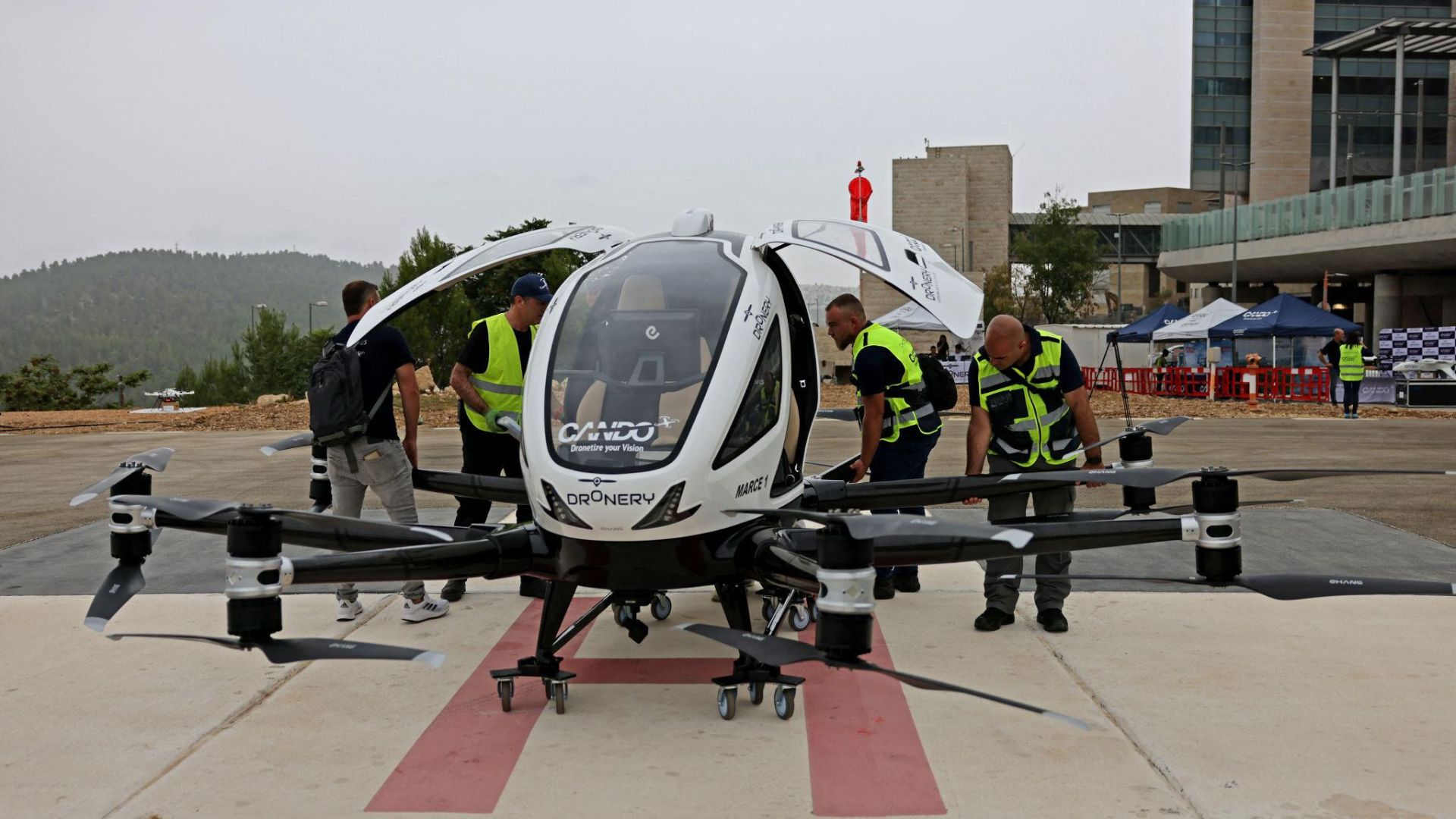

Unprecedented infrastructure in Israel combines real tests, hospital use, and a concrete plan for electric urban air taxis, putting Tel Aviv in the global race for urban air mobility with an initial focus on medical logistics and gradual expansion to passenger transport.
Tel Aviv announced the implementation of the first vertiport in Israel at Atidim Park, in the north of the city, in a project aimed at receiving electric vertical takeoff and landing aircraft, the eVTOLs, with operational debut focused on medical logistics and the prospect of advancing to passenger transport in about three years.
The proposal was presented this year and gained relevance by combining physical infrastructure, practical demonstration, and a public expansion timeline, something still uncommon in urban air mobility initiatives that, in many cases, remain restricted to prototypes, technical presentations, or announcements without defined implementation.
Initial use with medical deliveries in hospital
In the initial phase, the ATIDIM Vertiport is expected to operate as a center for aerial medical deliveries, focusing on the transport of medications, equipment, supplies, and laboratory samples to serve the Medica Raphael Hospital, located within the business and technology complex where the project will be built.
-
China Develops Custom 140-Ton Electric Mining Truck with 770 kWh Swappable Battery, Deploys 290 Units in Xinjiang’s Largest Zinc Mine

-
Meta to Launch Arena, a New Prediction App Targeting 3.56 Billion Users, Competing with Polymarket and Kalshi

-
Scientist Challenges Famous Human Evolution Theory, Argues Homo Sapiens Evolved Gradually Over Thousands of Years
-
15-Year-Old American Builds Ocean Generator with PVC Pipe and 3D-Printed Propeller for $12, Wins National Prize, Presents at White House, and Makes Forbes 30 Under 30 List




This point helps explain the strategy adopted by those responsible for the initiative.

Before opening up to passengers, the system must be tested in more limited operations, linked to a concrete and sensitive demand, with direct application in hospital routines and the possibility of a quicker response in emergency situations.
In the days leading up to the announcement, a preliminary demonstration had already been conducted on-site, with a flight between a temporary platform in the park and another installed at the hospital.
The operation was planned and approved by the Israeli Civil Aviation Authority and executed by Dronery, a company specialized in autonomous drone deliveries in urban areas.
Vertiport infrastructure takes center stage
The advancement in Tel Aviv shifts part of the debate on urban air mobility to a less visible topic to the public, but crucial for the operation of the sector.
The novelty is not just in the electric aircraft itself, but in the creation of the necessary ground infrastructure for landings, takeoffs, operational integration, and regulatory coordination.
In practice, a vertiport functions as the ground base for this new model of transportation, bringing together landing areas, support procedures, and connections with existing services.
Without this type of structure, the expansion of eVTOLs tends to remain in the experimental field, lacking sufficient scale to transform into a regular urban service.
By associating the project with a hospital function from the outset, the organizers also bring the innovation closer to a public utility of immediate understanding.
The idea of air taxis often attracts attention due to its futuristic appeal, but the transportation of medical supplies translates the technology into logistical efficiency and response to urgent demands.
Strategic location at Atidim Park in Tel Aviv

The choice of Atidim Park was not by chance.
The complex brings together offices, technology companies, services, and a constant flow of people, which favors the installation of infrastructure designed for high connectivity and future integration with urban transportation in one of the densest areas of the Tel Aviv metropolitan region.
Instead of emerging in a remote area, disconnected from the city’s economic network, the vertiport was positioned in a hub with intense daily activity.
This means that the project is treated less as a technological showcase and more as a piece planned to gradually enter the operational routine of the metropolis.
The initiative’s leaders claim that urban air transportation could reduce travel times by 60% to 80% compared to the use of private cars, in a scenario of chronic congestion in the region.
This data is part of the project’s projections and appears as one of the main arguments to justify the investment in the new infrastructure.
Plan foresees electric air taxis for passengers
The implementation of the plan is linked to Atidim Park Tel Aviv through ATI, which stands for Air Taxi Israel, a company that operates in infrastructure for vertiports, regulation, training, and implementation related to the advanced air mobility ecosystem.
This institutional design helps to give the announcement a weight that goes beyond the purely technological field.
In statements reproduced by the international press, the CEO of Atidim Tel Aviv, Eyal Zahavi, stated that the expectation is for public commercial service in about three years.
The timeline, although conditioned on regulatory and operational development, places the proposal in an intermediate range between initial testing and effective deployment.

Although the schedule depends on certifications and the consolidation of rules for this type of operation, the project is already born with a more explicit growth path than observed in many initiatives in the sector.
First come the medical deliveries; then, the intention is to expand the use for flights with passengers.
This phased approach reduces the gap between the discourse of innovation and the reality of deployment.
Instead of presenting so-called flying cars as a generic promise, the plan in Tel Aviv was structured with a defined location, clear initial purpose, identified actors, and a demonstration that sought to show how the operation could function in a real environment.
Tel Aviv enters the global race for air mobility
The movement also places Israel more clearly on the international map of urban air mobility, a race in which different cities are trying to get ahead not only in the development of aircraft but in creating the regulatory, logistical, and urban bases essential to transform tests into ongoing service.
In this context, the ATIDIM Vertiport draws attention for bringing together three elements that rarely appear at the same time: a facility announced as permanent infrastructure, a preliminary test authorized by the aviation authority, and a public transition plan for passenger operations.
This combination explains the international impact of the project.
The case of Tel Aviv suggests that the discussion about eVTOLs has entered a more pragmatic stage, where the focus is no longer solely on the aircraft or the futuristic imagination of the sector.
Attention shifts to each city’s ability to assemble the minimum necessary infrastructure for the service to operate regularly and with real utility.





