






 Portuguese
  Spanish


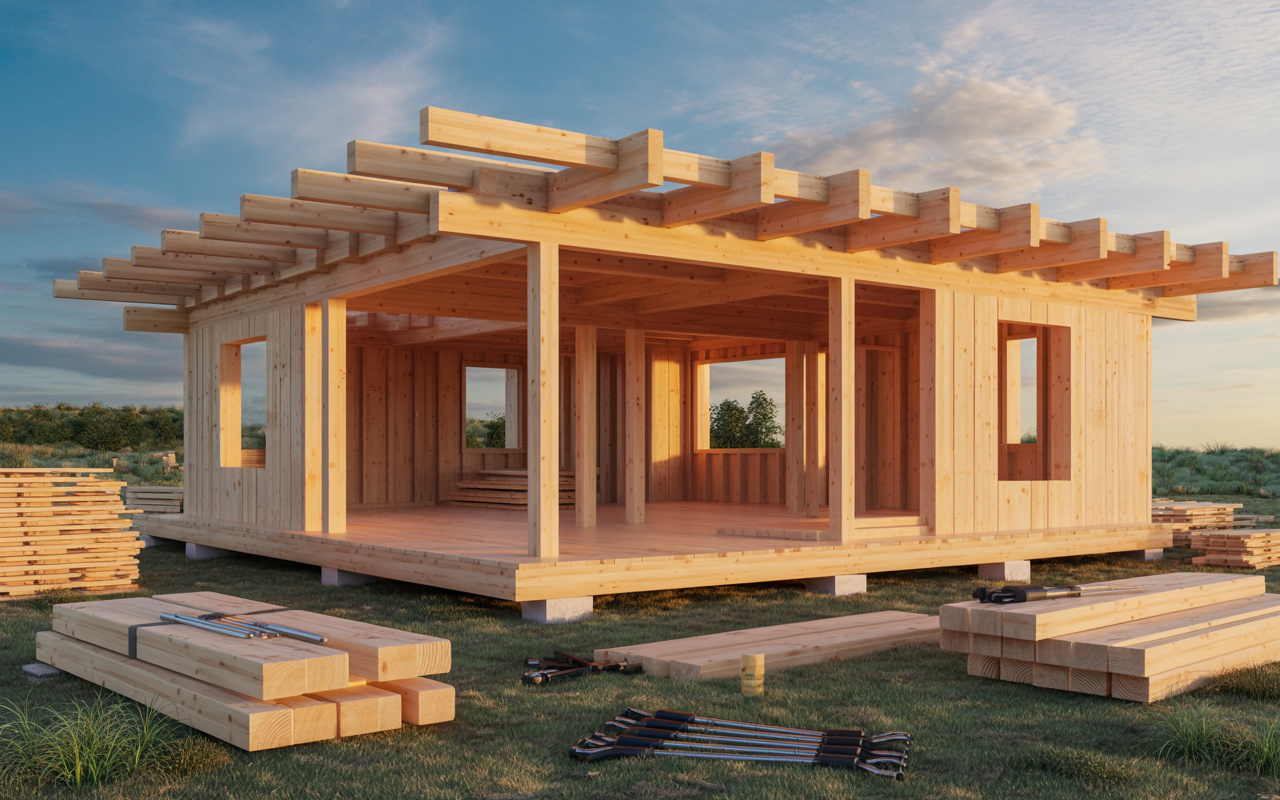


Timbered Houses Gain Space in Brazil. See How Much It Costs to Build 40 m² with a Lightweight, Fast, Sustainable Structure That Is Cheaper than Brick.
In recent years, timber construction from reforestation has gained momentum in Brazil, especially in compact projects of 30 to 40 m². The combination of competitive pricing, speed of assembly, sustainability, and thermal performance above traditional masonry standards has made this system a real alternative for those seeking affordable housing, ancillary units, studio apartments, or quick rental units.
With the expansion of planted forests of pine and eucalyptus in the South and Southeast, the supply of treated wood has become more stable, allowing for more standardized, durable, and resilient constructions. Autoclave treatment technologies, kiln-dried timber, and structural section standardization have transformed the old “simple timber house” into a modern, competitive, and technically robust construction system.
In 2024 and 2025, several companies from Paraná, Santa Catarina, Rio Grande do Sul, and Minas Gerais began offering complete houses with delivery in just a few days, creating a new ecosystem of lightweight and industrialized construction aligned with global trends of sustainability and clean building.
-
Workers renovating a playground in northern England uncover 176 World War II bombs buried underground; training artifacts still contained explosives.

-
Brazilian Architect Transforms Waste into Sustainable Homes with Solar Power and Rainwater Systems for 40 Years

-
Security Guard Becomes Doctor at Louisiana Hospital Where He Once Worked, Studied Chemistry Between Shifts

-
Woman Rescued from Luxury Complex in Brazil Worked Without Pay for 55 Years, May Be Entitled to Over $300,000




How Much Does It Cost to Build a 40 m² Timber House in 2025
Prices vary by region, company, type of wood, wall thickness, foundation type, and desired finish. But based on the projects practiced in Brazil, it is possible to estimate reliable and realistic values:
1. Complete Structure in Timber (Walls + Columns + Beams + Lightweight Roof)
Average price: BRL 45,000 to BRL 65,000 includes:
- wall panels with boards of 20 to 25 mm,
- structure with columns and beams of 6×12 or 6×14,
- structural joints,
- simple doors and windows,
- fibercement roof or lightweight metal tiles.
This is the most basic package, easily assembled in 5 to 10 days.
2. Intermediate Version (Better Insulation and More Thickness)
Average price: BRL 60,000 to BRL 85,000 includes significant improvements:
- thicker wood,
- thermal insulation with mineral wool or EPS,
- windows with superior sealing,
- expanded eaves,
- enhanced waterproofing.
This is the most sought-after standard in Brazil, as it offers evident thermal comfort.
3. Premium Version (High Performance and Eco-Friendly Finish)
Average price: BRL 90,000 to BRL 130,000 includes:
- kiln-dried wood,
- internal coating in OSB, plaster, or paneling,
- aluminum or solid wood frames,
- acoustic sealing,
- humidity control system,
- minimalist design.
This line attracts those seeking rustic-modern aesthetics and greater durability.

Foundation
The advantage of wood is its lightness:
A simple foundation with concrete blocks or a lightweight slab costs, on average:
BRL 4,000 to BRL 12,000, depending on the land.
Electrical, Plumbing, and Finishing Installations
As with masonry, these items vary according to quality level. For a complete standard:
BRL 20,000 to BRL 35,000, considering:
- embedded electrical,
- complete plumbing,
- finished bathroom,
- vinyl flooring,
- protective painting,
- basic lighting fixtures.
Estimated Total Cost of the 40 m² Timber House
Adding everything, the final value ranges between:
BRL 70,000 and BRL 150,000
The extremes depend mainly on:
- the region,
- the type of wood,
- the finishing level,
- and the logistics of transporting the crew.
Why Reforested Wood Reduces Construction Costs So Much
Timber construction is not limited to rustic aesthetics: it is affordable because it eliminates several costly masonry steps, such as:
- deep foundations,
- internal and external plastering,
- plaster and finishing compound,
- curing concrete,
- plumb and leveling masonry,
- block cutting,
- excessive transport of heavy materials,
- time-consuming wet stages.
The wood arrives cut, treated, and sized — practically a structured kit.
This reduces time, labor, and waste.
The Unmatched Thermal Performance of Timber
A well-built timber house offers natural thermal comfort. The material:
- does not heat up like exposed ceramic blocks in the sun,
- reduces internal temperature fluctuations,
- keeps the house cooler in summer,
- retains heat in winter efficiently.
Brazil, with high thermal variations, benefits greatly from this physical behavior — which is why wood dominates cold regions in the South and in Nordic countries.
Durability: How Long Does a Timber House Last?
With wood treated in autoclaves and minimal maintenance, the actual lifespan reaches:
40 to 60 years, potentially exceeding that if there is:
- reapplication of stain every 3–5 years,
- infiltration control,
- protection against direct soil contact,
- sufficient ventilation of the ceiling and walls.
Common mistakes — such as using untreated wood or building directly on the ground — have damaged the system’s reputation in past decades. But today, with industrialized wood, the problem has been overcome in reputable companies.
The Speed of Construction Is the Main Factor That Attracts Buyers
While a brick house of 40 m² takes:
- 60 to 120 days to be completed,
a modular timber house can be delivered in:
- 5 to 20 days, depending on the model and climate.
This agility reduces indirect costs such as:
- rent during construction,
- monthly crew payments,
- waste,
- ongoing transport of materials.
Is It True That Timber Houses Are Cheaper Than Brick Houses?
Yes — and the numbers prove it:
Traditional Masonry (40 m²)
- BRL 130,000 to BRL 190,000, depending on the region and finishes.
Timber (40 m²)
- BRL 70,000 to BRL 150,000, depending on the type of wood and finish.
The difference can exceed BRL 40,000 to BRL 60,000, especially when choosing minimalist finishes and lightweight structures.
Why the Demand for Timber Houses Is Growing So Much in Brazil
In the last two years, several factors have driven this trend:
- the search for faster and cheaper housing;
- growing interest in sustainability;
- influence from minimalist architectures;
- increased small lots;
- expansion of Airbnb and constructions for rent;
- scarcity of specialized labor in masonry;
- rising prices of cement, bricks, and sand.
Today, timber houses are used for:
- ancillary units,
- rental studios,
- tourism chalets,
- permanent residences,
- expansion of homes,
- constructions in sites and small farms.
The aesthetics also contribute: the appearance of exposed wood, combined with straight lines and large windows, has become a trend on social media.
The Future of Timber Construction in Brazil
The expectation for the coming years is rapid growth. Trends point to:
- greater industrialization of kits,
- use of engineered wood (CLT and MLC),
- national standardization,
- hybrid works (wood + steel frame),
- increased specialized companies.
With competitive costs, fast construction, and sustainability, the timber house is consolidating itself as one of the most attractive alternatives in the Brazilian market for compact housing.


Posta o marketing p/ metade, endereço, telefone e essencial numa propaganda.
S/ postar o de contatar a empresa fica difícil né.
Tem alguma foto da casa pronta para morar