






 Portuguese
  Spanish
  3 min of reading
  0 comments


System That Replaces Mortar With Internal Concrete Structure Promises Agility, But Experts Warn That Lack Of Professional Preparation Can Nullify Savings And Generate Losses.
The promise of building a house with the same ease as assembling a toy has seduced the Brazilian market for years. The so-called “eco-bricks” or modular interlocking blocks have earned the popular nickname of “Lego-like” due to their appearance, promising clean and quick construction. However, behind the marketing of simplicity lies a demanding technical reality: the viability of the system drastically depends on the qualification of the workforce involved in the process.
Unlike conventional masonry, where small imperfections are corrected with layers of mortar, the modular system does not tolerate errors. According to technical analyses from specialized portals like AECweb, although the block itself is often normatively classified as “non-structural”, it acts as the form for the true structure of the house. If the team doesn’t know how to handle these pieces with millimeter precision, the dream of a quick house can turn into a logistical nightmare.
The Paradox Of Savings: Why Does It Cost Less?
One of the most common doubts among those who wish to build is how a block, whose unit price often exceeds that of traditional ceramic bricks, can generate an overall savings of up to 40% in the construction. The answer lies not in the price per thousand, but in eliminating entire stages of construction.
-
Between Egypt and Sudan, Bir Tawil is no man’s land that neither country wants on paper, but in practice has gold mining, nomadic tribes, and even fake “kings.”

-
Swimming champion Shavarsh Karapetyan dove about 40 times into a frozen lake in Armenia to rescue a sunken bus, saved 20 lives, and lost his career because of it.
-
Júlia Pimentel, an 11-year-old from Minas Gerais, independently invented a new formula to calculate the square root using simple addition and multiplication, and her method was published in one of the most important mathematical scientific journals in Brazil.
-
New portable bathroom is ready in 90 seconds, measures 2.18 meters, fits in the car when closed, and offers privacy for showering and changing clothes.


Studies on economic viability, including data compiled on academic platforms like ResearchGate, validate this cost reduction in the “finished square meter”. The savings arise because the system eliminates the need for wood for formwork (molds for columns and beams), removes the need for roughcast and thick plaster, and drastically reduces the volume of debris. The block comes with a final finish, requiring only a waterproofing agent or a thin layer of plaster, if desired.
The Structural Truth: The Myth Of “Mason-Free Construction”
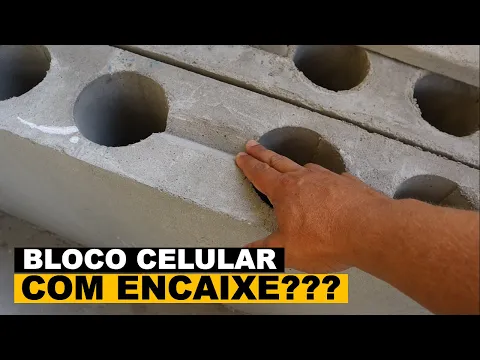

It is technically true that the system dispenses with “setting mortar” between the rows of blocks. However, calling this a “dry construction” can be misleading. The actual structure of the building is made of reinforced concrete, which remains concealed within the walls.
As detailed by technical sources in the sector, the resistance does not come from the interlocking of the blocks, but from the grout (a type of fluid micro-concrete with high strength) and steel rebar inserted into the vertical holes of the blocks. These points form “microcolumns” internally, tied together by horizontal concrete bands. Therefore, the construction continues to use cement, sand, and gravel, but in a surgical and structural manner, rather than just using them to “glue” bricks.
The Human Factor: The Fragility Of The Joint
The most critical point of the system, often overlooked in sales pitches, is the logistical fragility. Practical reports from builders and even former manufacturers (available in field analyses on YouTube) indicate that the protrusions that allow the “male-female” fit break easily during transportation and improper handling on site.
When a joint breaks, the piece loses its alignment function, potentially compromising the aesthetics of the wall or requiring disposals that increase costs. This is where trained workforce becomes the game changer: a team without experience tends to have a high breakage and rework rate, nullifying the advantage of speed and savings promised by the system.
Would you trust the structure of your house to this innovative construction model or do you prefer the traditional method? Have you had experience with this type of construction? Share your thoughts in the comments below.




-

-

-

5 people reacted to this.