






 Portuguese
  Spanish
  3 min of reading
  0 comments


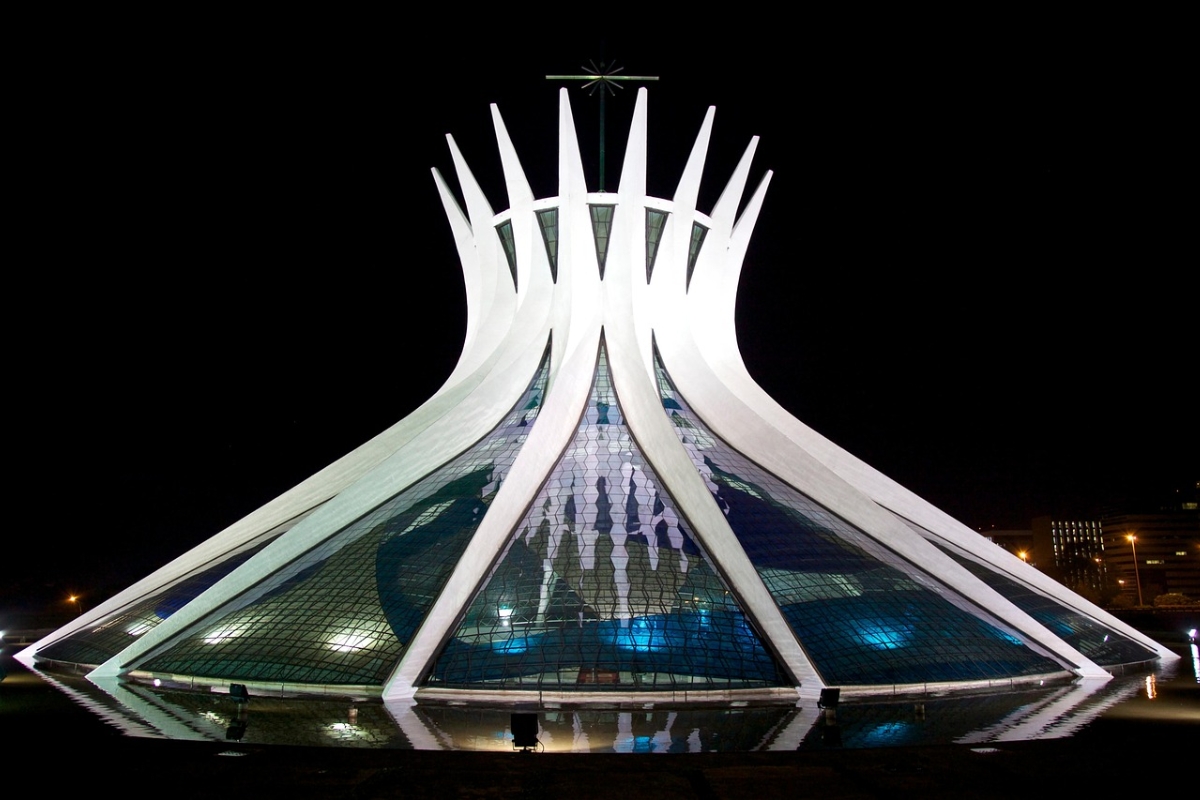
In The Heart Of The Capital, The Modernist Structure Turned A Religious, Tourist, And Architectural Landmark Recognized Worldwide
Brasília was conceived to represent a national project, and the Metropolitan Cathedral stands out as one of the constructions that best translate this intention. The work signed by Oscar Niemeyer gained fame for breaking away from the traditional format of churches, betting on a geometry that draws attention even from a distance.
The cathedral was designed to interact with the Monumental Axis and with the idea of a modern capital, where public buildings would also be part of the artistic landscape. Over time, the temple became a fixed point on visitor itineraries and a reference in architecture.
The 16 Columns That Define The Form And The Visual Impact
One of the most well-known elements of the cathedral is the sequence of 16 concrete columns that make up the main design. The arrangement of these pieces, in a curved shape, creates the sensation of a set that opens up to the sky, an effect that became the trademark of the project.
-
Without a mansion, without high investment, and without a traditional classroom, a teacher living in a 22 m² house taught students to build a 9 m² studio apartment with the equivalent of R$10,000.

-
Largest bridge in São Paulo reaches 75% completion and is expected to strengthen strategic connection in the interior of São Paulo.

-
Without her own home and pressured by rent, a 25-year-old bought a small 15-meter boat, gradually renovated the interior by herself, transformed the interior with paint, new flooring, a larger bathroom, and started living on the canals, paying much less per month.
-
Tired of seeing families sleeping on the street, São Paulo delivered 18 m² furnished microhouses and took 888 people off the streets: Vila Reencontro became the model social housing for the homeless population.


The structure plays with the contrast between mass and transparency. From the outside, the concrete defines the outline and gives it a monumental scale. On the interior, the glass amplifies the entrance of light and reinforces the contemplative character of the space.

This interplay between form and lighting helps explain why the building is a recurring topic. The impact does not depend on heavy decoration but on design decisions that shape the experience of those who enter.
Architecture And Engineering Walking Together
The Brasília Cathedral is often recalled as a case where the architectural language requires precise technical decisions. The chosen geometry, with repeated and connected elements, depends on structural calculation and careful execution to maintain stability and uniformity.
At the same time, the work shows how common materials can gain extraordinary effect when combined with scale and proportion. Concrete and glass, used in countless constructions, acquire their own identity there, associated with the narrative of modernity that Brasília carries.

Natural light is a central part of this result. Instead of treating glass merely as a closure, the design uses transparency to create environment and a sense of spaciousness, something that contributes to the visitation experience and to the identity of the space.
The Cultural And Tourist Role In The Federal Capital
In addition to its religious function, the Metropolitan Cathedral of Brasília has become a meeting point with cultural value. It is situated in an area of intense visitation and is often included in architectural tourism itineraries, alongside other symbolic buildings.
This constant flow drives services and reinforces the idea of Brasília as a destination that goes beyond politics. It also keeps the cathedral in the spotlight, serving as a recurring backdrop for photos, events, and official records.
As it is in a region with a high volume of traffic, visits are often combined with civic and cultural tours. This reinforces the perception that the capital is simultaneously an administrative center and a city with architectural heritage that attracts a diverse audience.

What Continues To Draw Attention In The Current Debate
The preservation of modern heritage has gained space, and the cathedral naturally enters this conversation. Concrete and glass structures require constant maintenance, and the topic resurfaces when there are interventions or improvements.
Niemeyer’s work continues to be revisited, praised, and debated, and the cathedral serves as a direct example of how architecture can create national symbols without repeating traditional models. It is this combination of faith, engineering, and urban identity that keeps the building relevant and contemporary.






-

1 person reacted to this.