






 Portuguese
  Spanish
  4 min of reading
  0 comments


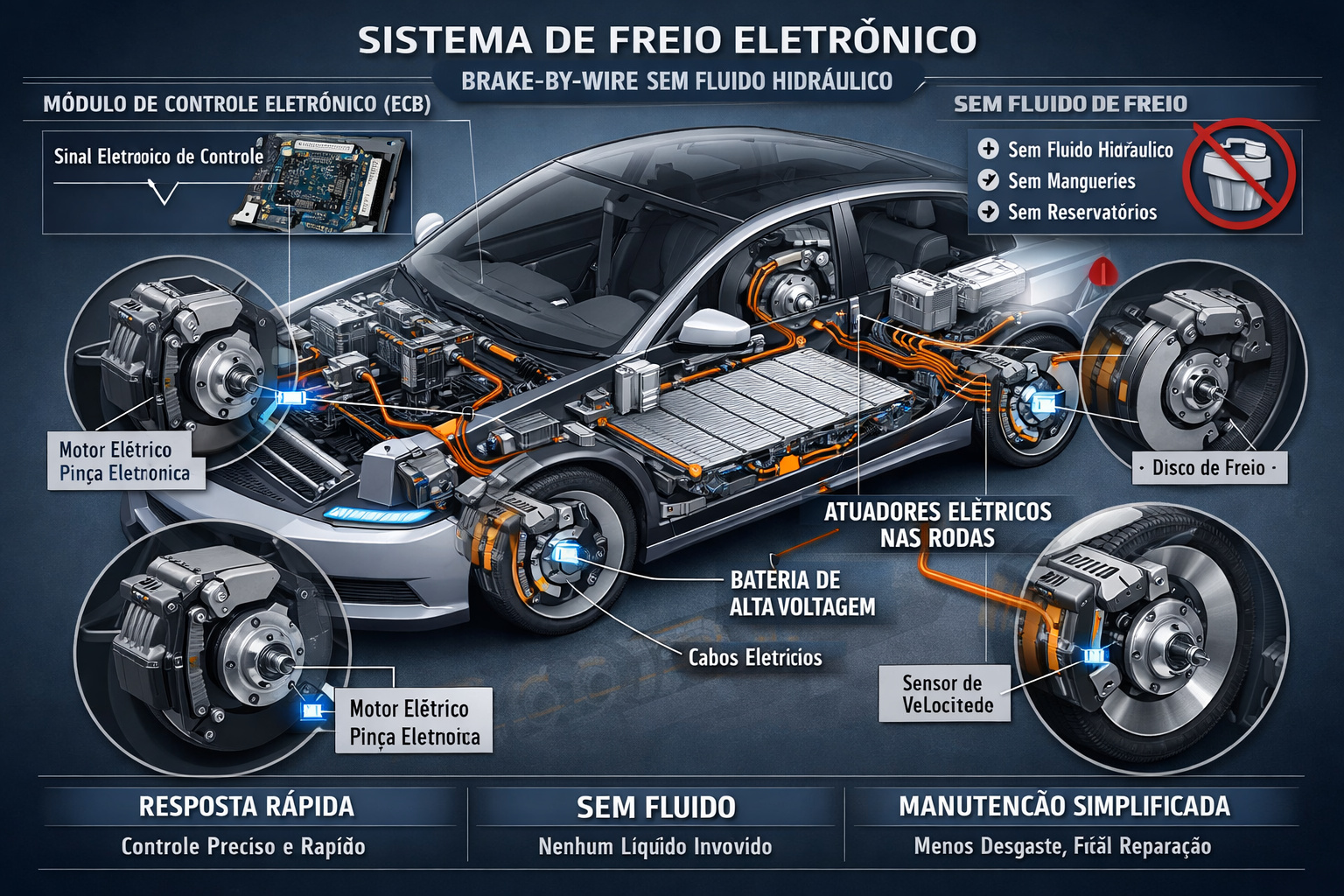
With New Mandatory Standard and Manufacturers Already in Production, EMB System Eliminates Brake Fluid, Bets on Advanced Software, and Ushers in a New Era of Fully Electric Braking
While many drivers are still trying to adapt to electrification and connectivity, Chinese engineering is already taking a step further. Instead of just improving existing systems, the country is now aiming for a complete break: replacing the traditional hydraulic brake with a fully electronic system.
In this scenario, the Electronic Mechanical Braking (EMB) stands out. It is the most advanced form of brake-by-wire, as it completely eliminates the hydraulic circuit. In other words, brake fluid, pressurized hoses, and conventional mechanical transmission disappear.
Thus, all braking force is generated by electric actuators controlled by sophisticated software.
-
Bolivian Female Construction Workers Form Association to Combat Discrimination and 38% Pay Gap in the Industry

-
Near Amsterdam, residents buy land and discover they must also build streets, manage drainage, handle waste, and grow food on half their plot.
-
Without a mansion, without high investment, and without a traditional classroom, a teacher living in a 22 m² house taught students to build a 9 m² studio apartment with the equivalent of R$10,000.
-
Without her own home and pressured by rent, a 25-year-old bought a small 15-meter boat, gradually renovated the interior by herself, transformed the interior with paint, new flooring, a larger bathroom, and started living on the canals, paying much less per month.


The information was released by “Research and Markets,” based on data from the Chinese automotive industry, which indicates a structural change already underway.
What Changes with EMB and Why It Represents a Historic Break
Generally, brake-by-wire systems already use electronic signals to activate braking. However, the EMB goes beyond this initial logic.
While hybrid systems still partially depend on hydraulic components, the EMB completely removes that dependency. In other words, physical action on the wheels is now done exclusively by dedicated electric motors.
Furthermore, this technology integrates perfectly with new Chinese platforms, which evolve into software-defined architectures. Consequently, the brake system stops being just a mechanical component and becomes part of the vehicle’s digital core.
For this reason, experts consider EMB a decisive step in the consolidation of the so-called “code-defined chassis.”
Standard GB21670-2025 Accelerates Adoption and Provides Legal Security for the Sector

The change gained momentum in May 2025. At that time, China published the mandatory standard GB21670-2025, which redefines technical criteria for braking systems in passenger cars.
From this regulation, the “electrically transmitted braking system” became officially recognized.
In addition to formalizing the concept, the standard establishes:
- Minimum redundancy levels
- Strict reliability criteria
- Specific testing methods
- Safety validation protocols
Thus, a clear roadmap for industrial approval was created.
As a result, suppliers and manufacturers stopped treating EMB as an experimental technology. Instead, they began to see it as a viable solution for small-scale production by 2026.
Manufacturers Advance Rapidly to Production
Shortly after the standard was published, the industry accelerated.
For example, Orient-Motion Technology structured dedicated lines for EMB and entered agreements with Dongfeng Liuzhou Motor and Geely’s Farizon division.
At the same time, Jiongji Electronic Technology completed durability tests and obtained ISO 26262 certification for functional safety for its fully dry systems.
Meanwhile, Motion Technology validated its line for mass production. Watson Rally has entered the final calibration phase, as reported by Research and Markets.
Models That Are Set to Debut the New Technology
Among the automakers, the Exeed EX7, a premium brand linked to Chery, emerges as the first model officially announced with EMB.
In addition to it, the Chery ET Series family has already undergone the tests required by GB21670-2025. Thus, it becomes a strong candidate for versions with the system starting in 2026.
For its part, Kaiyi Automobile is also developing projects with this technology. In this context, the company has partnered with U Power and Beijing West Industries to integrate dual-motor systems with independently controlled electronic control on all four wheels.
Although there is no official confirmation yet, industry sources mention the Li Auto L9 Livis as a possible future candidate.
The Global Impact and What Lies Ahead
While China consolidates the regulations, global suppliers are studying hybrid and fully electronic brake-by-wire versions.
However, no market has advanced as much in standardization as the Chinese.
Additionally, EMB facilitates integration with advanced driver assistance systems, autonomous driving, and dynamic chassis control. In this way, braking begins to communicate directly with the vehicle’s central software.
Consequently, the brake ceases to be just a mechanical system and assumes a strategic role in smart mobility.
If adoption scales up, hydraulic brakes could follow the same fate as carburetors. In other words, they might become a thing of the past in just a few years.
Would you trust a car without brake fluid, completely controlled by software? Or do you still prefer the traditional hydraulic system?








-

1 person reacted to this.