






 Portuguese
  Spanish


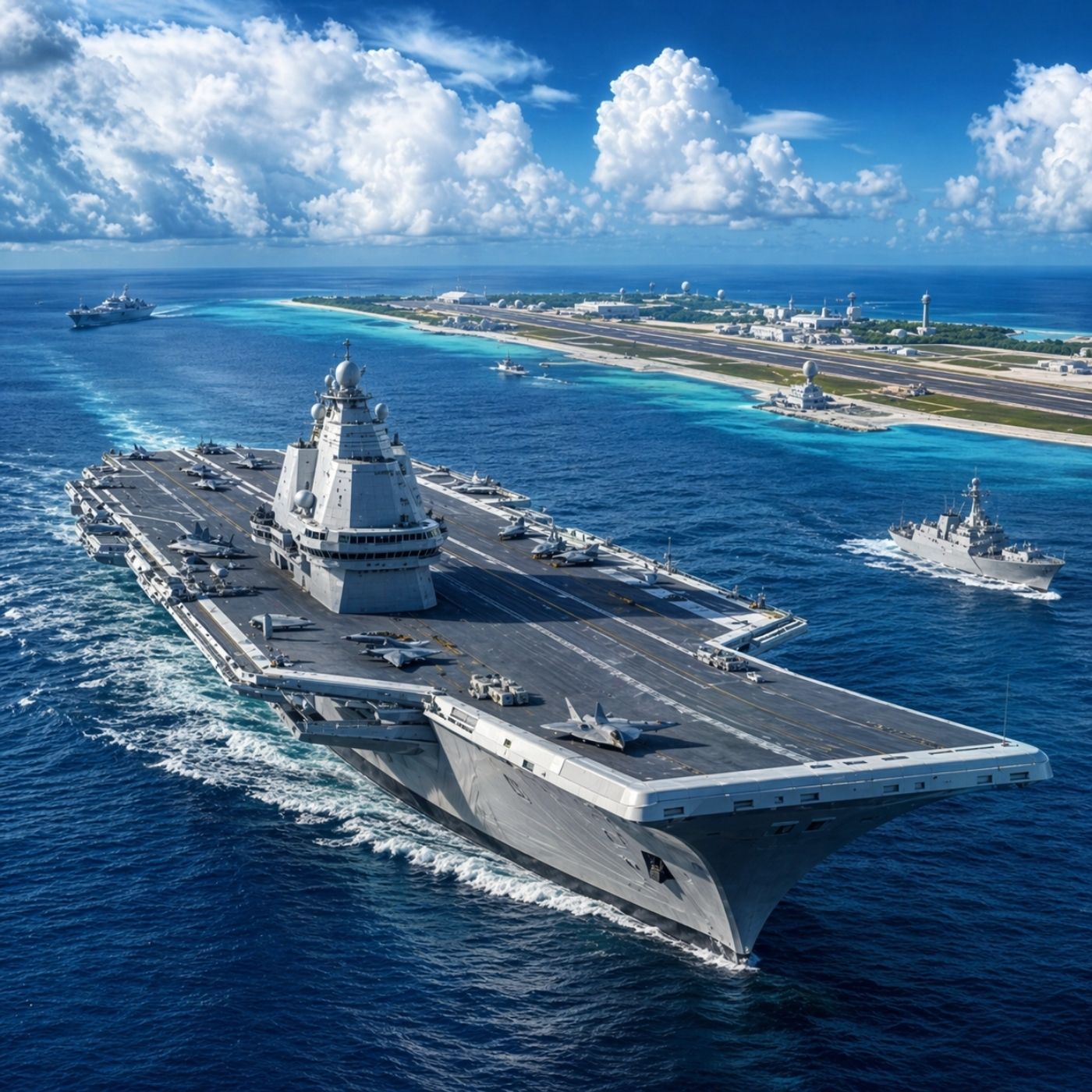

Aircraft carrier appears as a sign of a new phase in China’s naval strategy in video released on the 77th anniversary of the People’s Liberation Army Navy, while Beijing defends expanding islands, strengthening presence at sea, and sustaining territorial claims in increasingly sensitive areas of Asia
The possible new aircraft carrier of China came into the spotlight after the People’s Liberation Army Navy released a video that fueled speculation about a fourth vessel of its kind, possibly the first with nuclear propulsion. The recording was published on the eve of the 77th anniversary of the Chinese naval force and suggested, through symbolic references, that Beijing may be preparing for a new leap in its maritime capability.
The movement draws attention because it did not come alone. At the same time it hinted at a new aircraft carrier, China also advocated for the expansion of its islands and reinforced the discourse of strengthening maritime power, resource security, and territorial claims. In a region already marked by tension around Taiwan and the clash in the South China Sea, the combination of a new vessel and the expansion of island bases amplifies the strategic weight of the Chinese message.
What the video suggests about China’s new aircraft carrier
The video released by the Chinese Navy featured fictional officers with names that phonetically refer to the three aircraft carriers already commissioned by the country — Liaoning, Shandong, and Fujian. The point that drew the most attention, however, was the appearance of a new 19-year-old recruit named “He Jian,” a name that, in Mandarin, sounds like an expression associated with “nuclear ship” and ended up fueling speculation about a possible fourth aircraft carrier of China with this type of propulsion. The original material can be seen in this video published on the Bilibili platform.
-
James Webb Telescope Uncovers Unexpected Clues on Mysterious Moon, Potentially Redefining Planetary Origins

-
$1.5 Billion Sleipnir Vessel Transforms Ocean into Floating Construction Site with 12 Hybrid Engines and Capacity to Lift 20,000 Tons

-
23 Years After Tragedy, Brazil’s Alcântara Space Center to Launch New Suborbital Rocket in 2026 with South Korean SEBIT Project Targeting Near-Space Tests
-
Entrepreneur Turns Neighbor’s Coffee Grounds Waste into Eco-Friendly Pellets, Earning Up to $40,000 Monthly in Brazil


This visual and symbolic construction triggered public speculation about a fourth aircraft carrier, which could be the first in China powered by nuclear energy. As the three vessels currently in service use conventional propulsion and follow the sequence of numbers 16, 17, and 18, the reference to the 19 years of the character was interpreted as a possible hint about the continuity of this pattern.
Why this possible aircraft carrier would be a milestone for the Chinese Navy
If the interpretation raised around the video is correct, China may be signaling an important change in its naval strength. An aircraft carrier with nuclear propulsion would expand the operational autonomy of the vessel and reinforce China’s ambition to sustain a blue-water navy, capable of projecting power far beyond its coast.
This goal has been pursued by Beijing for years. According to the provided base, China has been spending billions of dollars to build a “bluewater navy,” a term used to describe a naval force capable of operating far from national territory. The plan connects to a strategy developed since 2012, when Xi Jinping took over the leadership of the Chinese Communist Party.
The numbers that explain the size of China’s maritime ambition
The very composition of the fleet helps to understand the scale of the project. China already has three aircraft carriers in service, all powered by conventional propulsion. The vessels carry the numbers 16, 17, and 18, which helped reinforce the interpretation that the new character in the video, at 19 years old, could represent a fourth ship.
Another relevant number appears on the map of islands claimed by Beijing. China claims to have more than 11,000 islands, most located up to 100 kilometers from the coast. According to the official count cited in the base, nearly 60% of them are in the East China Sea, about 30% in the South China Sea, and the remainder in the Bohai and Yellow Seas.
How Taiwan appeared in the political message of the video
The content released by the Chinese Navy was not limited to showcasing military exercises and attack scenes in the Pacific. The video also brought a message directed at Taiwan. In one of the passages, an officer talks to his son named “Xiao Wan,” a name seen as a direct allusion to the island.
In the scene, the boy says he doesn’t want to go home yet and wants to play a little longer. The father replies that the mother is waiting at home and asks him to come back. The dialogue was interpreted as a political message from China about Taiwan, a territory that Beijing considers part of the country, although Taipei rejects this position.
What the promise to expand artificial islands means

In addition to the topic of the aircraft carrier, China reinforced its intention to enhance the protection and development of the islands it claims. In an article published in the People’s Daily, the Ministry of Natural Resources called for more efforts to “protect” these areas, giving new impetus to the policy of consolidating Chinese presence at sea.
In practice, this connects to the history of building artificial islands, runways, and military facilities in disputed waters in the South China Sea. Over the years, these structures have functioned as support points for enforcement vessels, military ships, and maritime militias, expanding China’s capacity to patrol areas far from its coast.
Why the South China Sea remains at the center of the dispute
The South China Sea continues to be one of the most sensitive areas of Asian geopolitics. The region is a route for maritime trade exceeding US$ 3 trillion per year, which alone explains part of its strategic importance. Additionally, the area concentrates territorial disputes, energy interests, and an increasing military presence from different countries.
According to the base, the Chinese presence in the area includes artificial islands and facilities that allow daily patrolling in waters of neighboring countries up to 1,000 nautical miles from the Chinese coast. Nevertheless, analysts point out that Beijing has not been able to halt energy projects, refueling missions, or works carried out by Southeast Asian countries in the past four years.
What changed with Scarborough Shoal and the new Chinese initiatives
In September of last year, Beijing declared a national nature reserve in the disputed Scarborough Shoal, a move seen as yet another attempt to reinforce its claim over the atoll, a historical focus of tension with the Philippines. The measure showed that the regional dispute is not limited to direct military presence but also includes administrative and legal mechanisms for territorial assertion.
This type of strategy broadens the context in which the possible new aircraft carrier emerges. It does not appear as an isolated project but as part of a broader policy involving naval expansion, strengthening infrastructure on islands, controlling maritime areas, and diplomatic and military pressure on disputed territories.
How the US, Philippines, and partners fit into this scenario
The Chinese movements occur simultaneously as the Philippines, United States, and partner countries conduct military exercises in the Philippine archipelago, including maritime operations. These maneuvers project a multinational front against China precisely in an area where regional friction has intensified.
The base also highlights that the Chinese presence in the South China Sea did not prevent a rare visit from a senior Taiwanese official to Itu Aba island, controlled by Taipei and located in the disputed Spratly Islands. The island has a runway capable of receiving military refueling flights and a new dock inaugurated in 2023 suitable for a 4,000-ton patrol vessel.
What this movement reveals about China’s strategy at sea
The video about the possible new aircraft carrier and the defense of expanding islands show that China wants to reinforce its maritime strategy on multiple fronts simultaneously. On one hand, it seeks to enhance its naval capacity with more sophisticated means. On the other, it deepens the infrastructure that supports continuous presence in disputed areas.
This combination reinforces the objective of projecting power, protecting routes, ensuring access to resources, and sustaining long-term territorial claims. By doing this amid disputes with Taiwan and tensions in the South China Sea, Beijing also sends a clear political message to rivals and neighbors.
The next steps that could further increase tension in the region
So far, the Chinese Ministry of Defense has not immediately responded to requests for comment on the video. This means that the clues about the new aircraft carrier remain in the realm of insinuation and public interpretation. Nevertheless, the mere release of the material has already been enough to place the topic at the center of the regional strategic debate.
In the coming months, attention should turn to two points. The first is to see if more concrete signs will emerge regarding a fourth Chinese aircraft carrier and its possible nuclear propulsion. The second is to monitor how far Beijing will go in fulfilling its promise to reinforce islands and expand its military presence in increasingly sensitive areas of Asia.
In your opinion, does the hint of a new nuclear aircraft carrier and the expansion of artificial islands indicate only a show of force or a real step to further harden the dispute around Taiwan and in the South China Sea?


