






 Portuguese
  Spanish
  4 min of reading
  0 comments


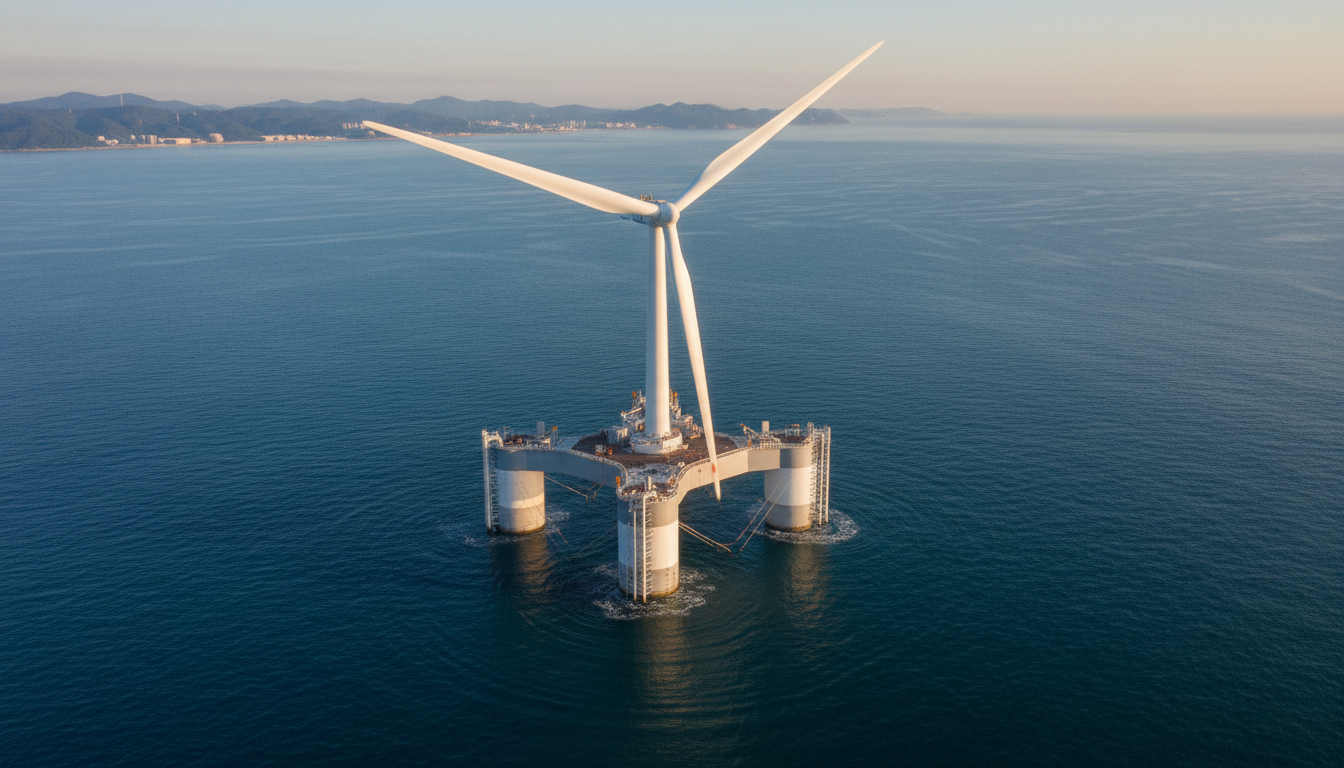
China Three Gorges installs Sanxia Linghang platform 70 km off the coast of Yangjiang on May 2, 2026
China has installed the world’s largest floating wind turbine offshore. The operation was completed on May 2, 2026, 70 km off the coast of Yangjiang, Guangdong.
The equipment has a capacity of 16 MW. The rotor has a diameter of 252 meters, and the area swept by the blades is equivalent to 7 football fields.
According to OffshoreWIND.biz, the Sanxia Linghang (“Three Gorges Pilot”) platform operates in deep waters. The local depth exceeds 50 meters.
-
Brazilian scientists are simultaneously advancing two research projects on clean hydrogen and driving solutions that could transform the energy matrix, enhance industrial competitiveness, and accelerate large-scale emission reduction targets.

-
Advancement in renewable energy: A R$ 150 million project launched by Petrobras and Finep aims to create state-of-the-art electrolyzers for green hydrogen, strengthening national research and preparing Brazil to compete in a billion-dollar energy market.
-
Illiterate or semi-literate grandmothers were trained to repair solar systems, open rural workshops, and light up homes that still depended on kerosene.
-
The world has bet on green hydrogen as the fuel of the future, but now faces the side effect: producing 1 kilogram requires about 9 liters of ultrapure water, and the largest projects on the planet are precisely in the driest regions of the Earth, where water is already scarce for people.



In fact, the structure is semi-submersible. According to Wind Tech International, it displaces 24,100 tons and maintains stability in open sea.
According to the developer China Three Gorges Corporation, the initial operation will generate 44.65 GWh of energy per year. This volume supplies 24,000 households.
Therefore, the Chinese floating wind turbine ranks as the world’s Top 1. It replaces the previous Mingyang 18 MW as the reference for floating offshore unit capacity.

How the 16 MW Chinese floating wind turbine works
The floating wind turbine is different from fixed structures. Instead of anchoring pillars to the seabed, it uses a floating platform anchored by cables.
Therefore, it is the only solution for deep waters. Above 60 meters depth, fixed engineering becomes economically unviable.
The semi-submersible platform used is the preferred design. According to Interesting Engineering, three or more columns distribute loads to reduce oscillations.
In parallel, the tower has a total height above 270 meters. The blade tip height surpasses 80-story buildings.
According to Offshore Wind Industry, the turbine was transported from Tieshan Port in Beihai. The tow crossed the Qiongzhou Strait.
In fact, it was one of the largest naval transport operations in history. The convoy took 5 days to reach its destination.

Dimensions of the world’s largest floating wind turbine
The scale of the Chinese floating wind turbine is hard to imagine. Each blade is over 123 meters in individual length.
According to official data from TGS, the rotor diameter is 252 meters. The area swept by the blades during one rotation is equivalent to 7 American football fields.
Therefore, even an average wind generates a lot of energy. The capacity factor of this turbine class is between 40% and 50%.
In parallel, the entire structure weighs 24,100 tons. This weight is distributed by the semi-submersed columns that serve as buoys.
- Capacity: 16 MW
- Rotor diameter: 252 meters
- Total height (tip): more than 270 meters
- Swept area: equivalent to 7 American football fields
- Platform weight: 24,100 tons
- Distance from the coast: more than 70 km
- Annual generation: 44.65 GWh (24,000 households)
- Installation date: May 2, 2026
What this floating wind turbine means in the global context
China consolidates leadership in offshore wind with the 16 MW floating wind turbine. According to Dialogue Earth, the country installed half of the world’s offshore wind capacity in 2025.
Therefore, the European sector falls behind. Germany and the United Kingdom have similar projects but are in the licensing phase.
In parallel, China’s updated target in the September 2025 NDC foresees 3,600 GW of solar and wind by 2035. It is 6 times the level of 2020.
According to analysis by the German Aerospace Center (DLR), “China leads in offshore wind, and Germany and the EU fall behind.”
In fact, the Chinese turbine went into operation 6 months after the UK installed 14 MW turbines in East Anglia. The leap is directly from 14 to 16 MW.
Thus, Western manufacturers — Vestas, Siemens Gamesa, GE Vernova — lose competitiveness. Chinese Mingyang and Dongfang dominate the technological frontier.

Impact for Brazil and Petrobras in offshore wind
Brazil does not yet have any commercial floating wind turbine projects. Petrobras is studying an 18 MW pilot in partnership with Enauta.
According to OffshoreWIND.biz, Fugro was contracted in April 2026 for offshore geotechnical studies in Brazil.
Therefore, Brazil is racing against time. China developed a complete industrial chain for the floating offshore sector in 4 years.
In parallel, the Brazilian oil and gas sector can leverage accumulated know-how. FPSO platforms and pre-salt submarine cable infrastructure are adaptable.
According to OffshoreWIND.biz, Brazil approved offshore wind guidelines in April 2026. The first phase auction is scheduled for 2027.
For more on the Brazilian energy sector, it is worth reading the Click Petróleo e Gás coverage on the global LNG market.
For another related Chinese mega-project, check out the Click Petróleo e Gás coverage on strategic nuclear fleet.
Environmental and market implications of the floating wind turbine
The Chinese floating wind turbine avoids 1.15 million tons of CO₂eq per year. This volume is equivalent to removing 250,000 gasoline vehicles from the roads for 12 months.
Therefore, the floating offshore sector becomes the main bet of the energy transition. An estimated 25 billion dollars in the global market by 2031.
In parallel, there are bottlenecks. According to analysis by GlobeNewswire, specialized installation vessels are scarce in the market.
In fact, China, South Korea, and Japan dominate the world’s offshore heavy lift fleet. Brazil and Europe pay inflated prices for contracts.
It is worth noting that the Chinese turbine is still undergoing long-term tests. The first 12 months will reveal real reliability in typhoon conditions.
Despite this, today’s step has already changed the global sector map. China consolidated in May 2026 its position as the absolute leader in floating offshore wind.








Be the first to react!