






 Portuguese
  Spanish


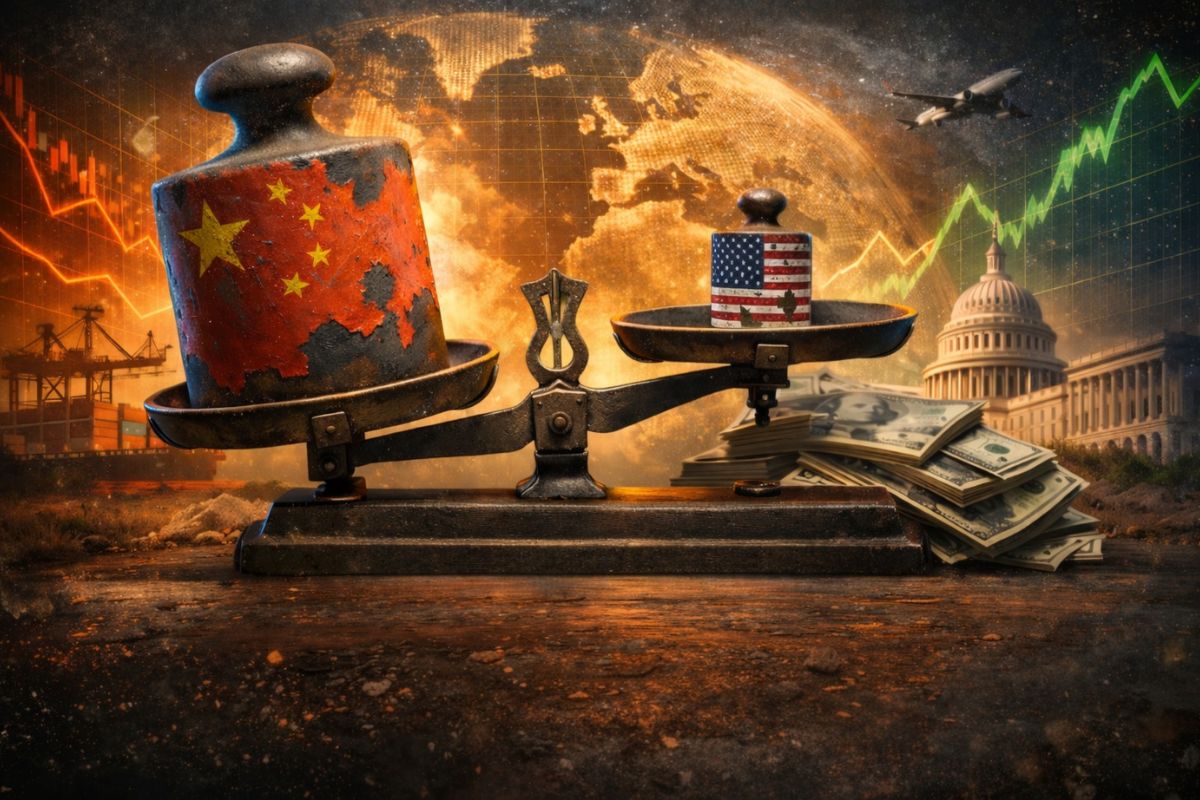

With Trump’s tariffs and warnings from the G7, Bank of England, and IMF, the world pressures for rebalancing, while China admits that the export-led model has become unsustainable
Trump has become the most visible face of a change that has been building for decades: China’s export model has generated persistent surpluses and pushed deficits onto other economies, mainly the United States. The problem is that, with China already being the second largest economy in the world, the rest of the world has less capacity to absorb excess production without distortions.
The consequence is a possible new “paradigm” in the global economy. The movement associated with Trump seeks to reduce imbalances, but the necessary adjustment involves exchange rates, domestic consumption, capital flows, and balance of payments. And, if rebalancing progresses, the transition could become an inflationary force over the next few years, also affecting Brazil.
Why China’s export model has reached its limit
The starting point is simple: China needs to rebalance its own economy because there is little domestic consumption and excess savings and investment, which manifests as strong trade surpluses. Meanwhile, other countries, especially the United States, are dealing with deep and persistent trade deficits.
-
Brazil to Issue “Panda Bonds” in China, Aiming to Raise Up to 5 Billion Yuan at Lower Interest Rates Than Dollar Debt
-
NATO Faces Internal Tensions as U.S. Pushes for Increased Defense Spending, Targeting 5% of GDP by 2035, with Warnings for Countries Near 2% Level

-
Brazil to Introduce B16 Diesel with Increased Soybean Oil Content for Trucks by 2026
-
Brazil’s July Bolsa Família Payments May Include Extra $150 and $50 for Families with Children, Pregnant Women, and Updated CadÚnico Registration


As China tightly controls the financial account and capital flows, it can externalize part of the domestic imbalance to the rest of the world.
In practice, the world absorbs the excess Chinese production, but this “safety valve” has an increasing cost and loses viability as the scale of China increases.
Trump and the “tariff” as a symptom of a larger problem
In the base content, U.S. Treasury Secretary Scott Bessent is quoted saying that China would be the most unbalanced economy in financial history.
In this context, Trump appears as the leader trying to “force” correction through tariffs, but with an important detail: Trump and Bessent are treated more as symptoms of the scenario than as the original cause.
The argument is that Chinese imbalances are part of global imbalances, with very surplus countries on one side and very deficit countries on the other. The world, therefore, is approaching the exhaustion of this arrangement.
The warning from the G7, Bank of England, and IMF and the message that also came from China
The theme has ceased to be an isolated debate. The base content mentions that, in recent weeks, economists from the G7, the Bank of England, and the International Monetary Fund have published materials on the return and intensification of global imbalances.
At the same time, there is mention of news in the Chinese press and internal signals that China has recognized the problem, advocating for concrete measures to balance imports and exports.
The idea described is that promoting a more balanced development in foreign trade has become a political priority for the next five years, within the scope of the 15th five-year plan (2026 to 2030).
The logic of the balance of payments and why persistent deficits “take a toll”
To explain in a didactic way, the base content uses the analogy of a family: if someone consumes more than they produce, someone needs to finance the deficit.
If this prolongs, the debt grows to the point where financing can dry up. The way out then involves producing more, reducing consumption, selling assets, or reorganizing the budget.
In countries, the logic appears in the balance of payments. A current account deficit means, in simplified terms, consumption above production in relation to the outside, requiring financing via the financial account or via reserves. When financing is insufficient, the currency tends to depreciate or the country may face external rupture.
The “dollar privilege” and why the US sustains deficits for decades
The base content highlights the exception: the country that issues the reserve currency. As the United States issues the dollar, widely accepted in the settlement of international payments, the current account deficit can persist for much longer.
In this structure, countries with surpluses, like China, can accumulate dollars and recycle them by purchasing American assets, such as government debt and corporate bonds. The flip side of this coin is the accumulation of external liabilities of the US over time.
The base content mentions that the US would be the largest external debtor on the planet, with a negative net international position exceeding $28 trillion, close to 90% of the American GDP.
Undervalued yuan and the “artificial competitiveness” that distorts prices
A central point of the argument is the exchange rate. The base content states that China has maintained a strict control of the exchange rate for years, accumulating international reserves and preventing the currency from appreciating as it would in a more free regime.
To illustrate the undervaluation, the Big Mac Index appears. The presented reading indicates the yuan is about 40.2% undervalued against the dollar in the cited metric, comparing the prices of a Big Mac in China and the United States and an implied exchange rate lower than the mentioned market rate.
Other purchasing power parity windows are also mentioned, with estimates that would place the exchange rate at levels such as 5.26, 5.76, or 5.46 yuan per dollar, below the market rates mentioned in the content.
The economic effect of this scenario is direct: with the exchange rate “out of place,” Chinese products become more competitive in the world, which supports high exports and increases surpluses. The base text emphasizes that it is not just about the exchange rate; there is technology and quality, but the exchange rate would be a relevant advantage component.
What would change if China appreciated its currency and increased internal consumption


If the yuan appreciated, the base content describes two simultaneous forces:
- export less, because part of the price competitiveness decreases
- import more, because internal purchasing power rises and more items from abroad become accessible
The rebalancing, however, would not be trivial. The scenario presented as more plausible is for China to gradually open the financial account and allow for a freer float, rather than abruptly abandoning controls.
The goal would be to increase domestic consumption, reduce excess savings and production, and decrease the need to “export imbalance.”
Where Trump fits in the next phase and why this could generate global inflation
The view presented is that Trump is trying to accelerate this rebalancing: pressuring China to adjust the model and reduce the outsourcing of the consumption problem.
And there is a second axis mentioned as part of the plan: weakening the dollar or strengthening other currencies, alluding to the Plaza Accord of 1985, with the observation that a similar agreement today would require China at the table.
The described macro risk is that the appreciation of the yuan could become an inflationary force for the rest of the world while the process lasts.
The logic is the mirror of the past: China’s insertion into global trade, productivity gains, and suppressed exchange rates would have acted as a disinflationary force; the opposite movement could push prices up over the years, although not as an abrupt shock.
What this could mean for Brazil
The baseline content emphasizes that this transition impacts the entire world, including Brazil. In a scenario of more pressured global inflation and trade realignment, the effect may appear in imported prices, industrial chain, and exchange rate dynamics, in addition to altering the relationship between global supply and the cost of goods that depend on China.
In the end, the point is not to “cheer” for Trump or against Trump. The point is to understand that Trump acts as a political catalyst for an adjustment that the system has already been calling for.
Do you think that Trump’s tariff push really forces China to change its export model, or will the rebalancing happen more due to internal necessity than external pressure?







