






 Portuguese
  Spanish
  5 min of reading
  0 comments


During the COP30 works, at the New Dock in the Reduto neighborhood, in Belém, workers found the bow of a 19th-century iron ship, buried by the city itself. It is one of the archaeological finds of the capital of Pará, which also revealed underground galleries and indigenous ceramics over 500 years old.
Those who were digging the ground in Belém to prepare the city for COP30 ended up stumbling upon the past. During the renovation of the Dock waterfront, in the Reduto neighborhood, workers came across the structure of a huge 19th-century ship, made of iron, hidden underground for over a hundred years. The case was detailed by the Portal Tela, which gathered the main archaeological finds that emerged from the construction sites in the capital of Pará.
The timing is what makes the story irresistible. Just when Belém was becoming the center of the world’s attention for hosting the climate conference, the COP30 works opened a portal to the city’s forgotten history. Instead of just asphalt and piping, the underground delivered an entire ship, secret galleries, and ancient indigenous artifacts.
A 19th-century iron ship buried under the Dock
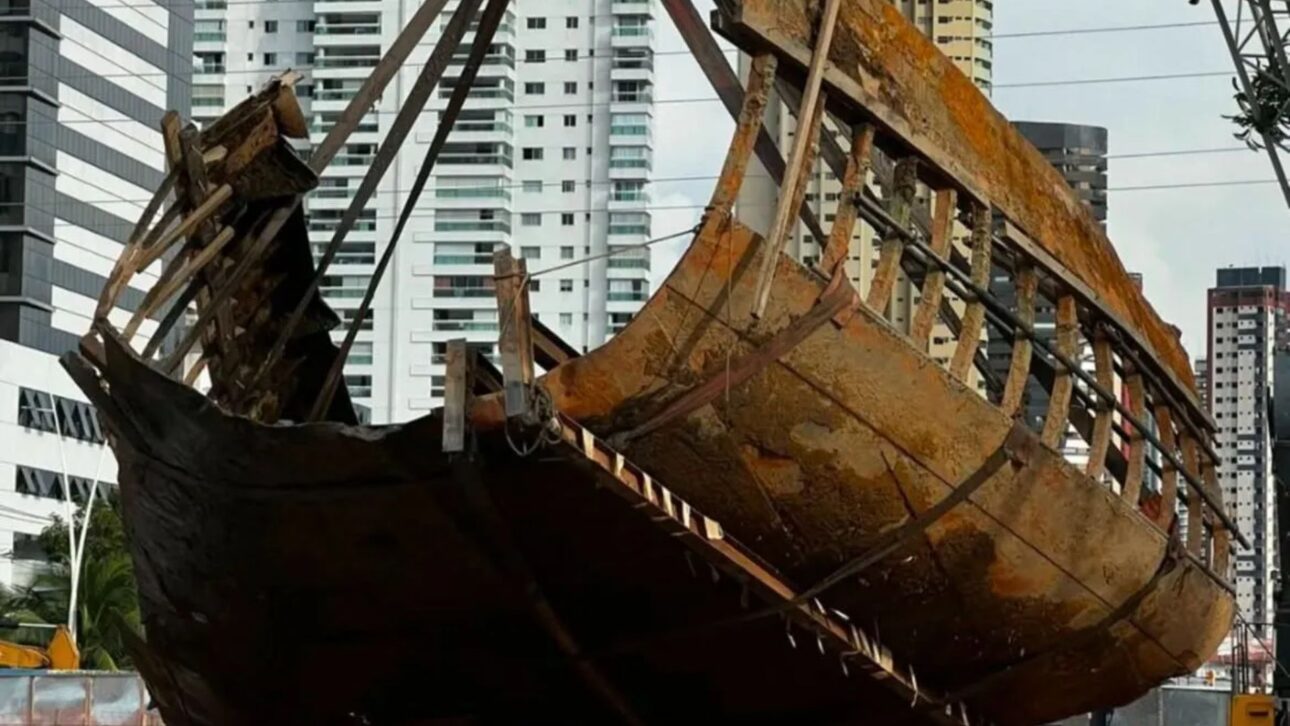
According to Portal Tela, it is a 19th-century ship about 20 meters long and 8 meters wide, made of iron and possibly steam-powered. It was not a shipwreck at the bottom of the sea, but rather a cargo ship abandoned and gradually buried by the expansion of Belém, until it disappeared beneath the Doca avenue, in the Reduto neighborhood.
-
Brazilian Innovator Marcelo Loureiro Sets Guinness World Record with 12,000 km Robotic Surgery from Brazil to Kuwait

-
Chinese robots trained for two weeks to row a dragon boat at the Sichuan Festival in China, took full control when humans stopped rowing, and even made rice dumplings in one of the most unusual tests ever conducted with humanoids.
-
Public school students in Sergipe create an early autism screening kit for vulnerable communities without a doctor, in the year Brazil won 8 awards at the world’s largest science fair.
-
Engineering students create a low-cost 3D-printed wheelchair for dogs and help the paralyzed dog Bili, who was born without legs, walk again for R$ 448.


The removal was a delicate operation. The bow of the vessel was removed on the night of January 13, 2025, in a coordinated effort by the National Institute of Historic and Artistic Heritage, Iphan, along with the State Secretariat of Public Works of Pará, Seop, according to CNN Brasil. The works at the site had begun in 2024, and it was during this back-and-forth of machinery that the 19th-century ship came back to light.
The piece’s destiny is to become an attraction. Also according to CNN Brasil, the vessel is undergoing restoration to be displayed at the Amazon Navigation Memorial, in Mangal das Garças, one of the landmarks of Belém. What was a nuisance in the middle of the construction is set to become a monument, telling the public about navigation in the Amazon of that time.
It wasn’t just the ship: galleries, ceramics, and treasures beneath Belém
The surprise did not stop at the hull. The COP30 works scattered throughout the city revealed a set of archaeological finds that change what was known about the capital’s underground. Near the Ver-o-Peso Market, for example, underground galleries from the 18th and 19th centuries appeared, built with brick in an arch shape, according to Portal Tela.
These galleries serve more than one function. Besides helping the city deal with high tides, they may have served as passageways in historical conflicts, such as the Cabanagem of 1835, one of Brazil’s largest popular revolts. It’s a piece of ancient engineering that remained hidden under the pavement for almost two centuries, in the heart of Belém.
And there’s the oldest chapter of all. The excavations also brought to light indigenous ceramics at least 500 years old, used in daily life and rituals, as well as an 18th-century retaining wall and port materials like pulleys and crane wheels, reported Portal Tela. Each of these archaeological finds is a different layer of the city’s long history, stacked beneath our feet.
The science behind the rescue of archaeological finds
So much material required specialized hands. The rescue of the archaeological finds was accompanied by Iphan professionals, who treat each piece as a historical document, not as construction debris. The interpretation of these objects helps to reconstruct the daily life of a Belém that few know.
The significance goes beyond curiosity. “These finds retell a frequently forgotten history,” said archaeologist Augusto Miranda, from Iphan, to Portal Tela. The phrase sums up the value of what appeared: it’s not just a 19th-century ship beautiful to see, it’s the memory of indigenous peoples, workers, and residents who built the city long before the COP30 works.
The care continues in the laboratories. The conservator Tainá Arruda is among the professionals handling the cleaning process of the pieces, according to Portal Tela, and part of the indigenous ceramics and other artifacts should be preserved in the Museum of the State of Pará. It’s the silent work that transforms a scare in the work into heritage for future generations.
Why the COP30 works became a time machine
The case of Belém shows a curious effect of large works. When an ancient city digs up the soil on a large scale, especially in central areas and near water, it is almost inevitable to stumble upon what has been buried over the centuries. The COP30 works, by altering the waterfront and the historic center, functioned as a giant and involuntary archaeological excavation.
Belém has plenty of reasons to hold treasures beneath the ground. A port city in the Amazon, it experienced intense economic cycles that filled its rivers and docks with ships, goods, and people. A 19th-century ship buried under an avenue is, in this sense, less of a coincidence and more of a faithful portrait of what the capital of Pará once was.
In the end, the climate conference ended up giving something unexpected back to the city: its own history. While the world looked at Belém because of the planet’s future, the archaeological finds of the COP30 works reminded that there, under the asphalt, lies a rich past, from the 19th-century ship to the indigenous ceramics half a millennium old.
The image is too symbolic to go unnoticed. To host the largest climate summit on the planet, Belém dug into its own ground and found a 19th-century ship, secret galleries, and ancient indigenous ceramics, a reminder that every city holds buried worlds. The archaeological finds of the COP30 works turned an urban renovation into one of the greatest history lessons of the capital of Pará.
And you, can you imagine what else might be buried beneath your city waiting for a construction to appear? Tell us in the comments which of these finds in Belém surprised you the most.





Be the first to react!