






 Portuguese
  Spanish
  5 min of reading
  0 comments


In September 2025, Brazilian doctors performed a robotic telesurgery between Kuwait and Curitiba, at a distance of 12,034.92 km. The feat, conceived by Marcelo Loureiro, entered the Guinness as the world record for the greatest distance between doctor and patient in an inguinal hernia surgery.
A patient was operated on in Curitiba by a surgeon who was more than 12 thousand kilometers away, in Kuwait, and the result became a historic milestone. The robotic telesurgery performed on September 23, 2025 entered the Guinness World Records as the world record for the greatest distance between doctor and patient, according to the Government of Paraná. The official endorsement was issued on October 3, 2025.
The mastermind behind the operation is Brazilian. The initiative was conceived and coordinated by Marcelo Loureiro, a digestive system surgeon and founder of the Scolla Surgical Training Center, in the Curitiba region. He was the one who orchestrated the collaboration between hospitals, technology, and teams on two continents to prove that operating on someone from the other side of the world is no longer science fiction.
The record: 12 thousand km between the doctor and the patient
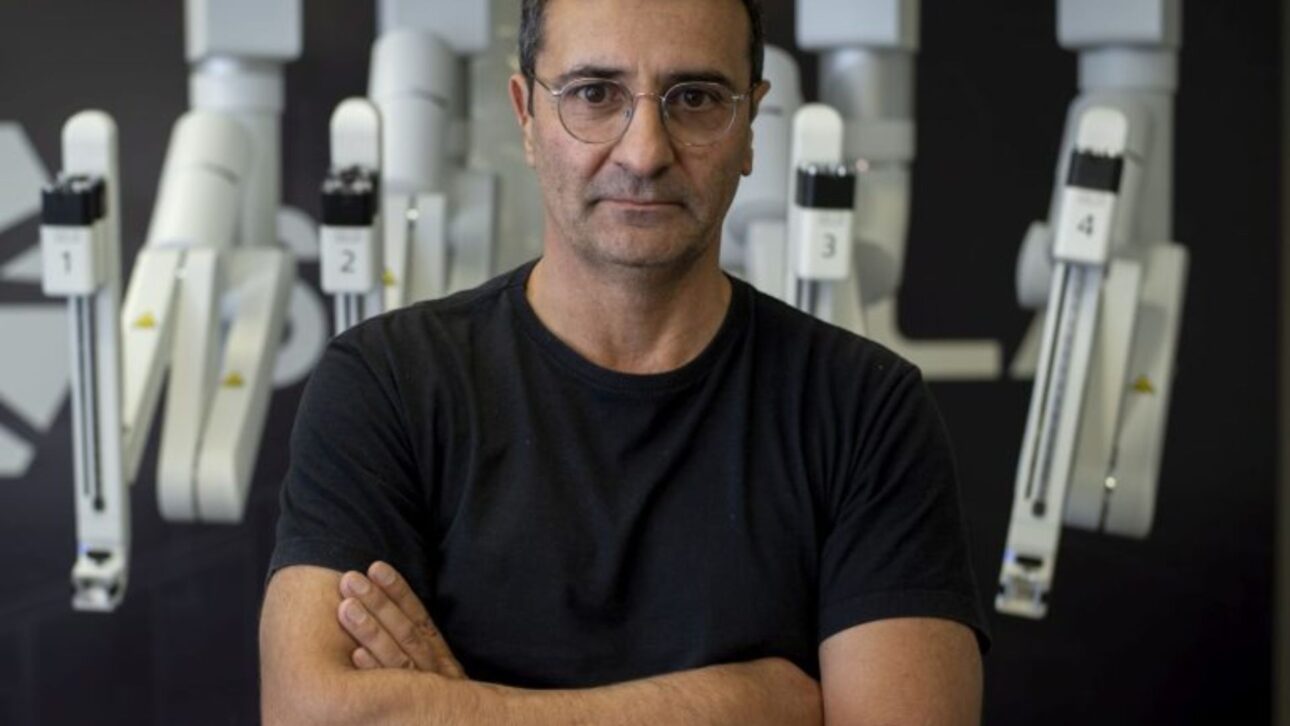
The number that stamped the world record is precise: 12,034.92 kilometers separated the surgeon from the patient. The operation was led by Professor Leandro Totti Cavazzola, from the Hospital de Clínicas de Porto Alegre, from the Jaber Al-Ahmad Hospital in Kuwait, according to the Government of Paraná. On the other end of the line, the patient was at the Red Cross Hospital in Curitiba.
-
Workers Discover 19th-Century Iron Ship and Indigenous Artifacts During COP30 Construction in the Brazilian Amazon

-
Chinese robots trained for two weeks to row a dragon boat at the Sichuan Festival in China, took full control when humans stopped rowing, and even made rice dumplings in one of the most unusual tests ever conducted with humanoids.
-
Public school students in Sergipe create an early autism screening kit for vulnerable communities without a doctor, in the year Brazil won 8 awards at the world’s largest science fair.
-
Engineering students create a low-cost 3D-printed wheelchair for dogs and help the paralyzed dog Bili, who was born without legs, walk again for R$ 448.


The chosen surgery was not by chance. It was a correction of inguinal hernia, one of the most common and standardized procedures in general surgery, which helps to isolate what was really being tested: the ability to operate safely at a distance never before achieved. Even being a routine inguinal hernia, the robotic telesurgery turned the act into a global milestone.
The approval came from abroad. The Guinness World Records audited and confirmed the world record on October 3, 2025, officially recognizing the distance as the largest ever recorded between a doctor and their patient in remote robotic surgery. For Brazil, it is an international seal that the robotic telesurgery done here is at the forefront of medicine.
The mind behind: the Curitiban Marcelo Loureiro
Behind the achievement is Marcelo Loureiro‘s obsession with advancing Brazilian surgery. At 55, he is a reference in minimally invasive procedures and saw in robotic telesurgery a way to shorten the distances that always separated patients from the best specialists. It was not a random test; it was a project designed to show a path.
The coordinator himself makes a point of highlighting the novelty of what was done. “For the first time, sequential procedures were performed in both directions, Kuwait-Brazil and Brazil-Kuwait, demonstrating reproducibility,” stated Marcelo Loureiro to CNN Brasil. The word reproducibility is key: it was not a one-time stroke of luck.
This care in proving that the method repeats is what separates a trick from a real advance. By placing Brazil and Marcelo Loureiro in the Guinness, the initiative signals that robotic telesurgery can become routine, and not just a headline. The world record, in this sense, is less about the number and more about what it opens up in terms of possibilities.
A two-way surgery, unprecedented in the world
The most impressive detail is not even the distance, it’s the two-way nature. On the same day, while the patient in Curitiba was operated on from Kuwait, a medical team sent from Kuwait to Curitiba operated on a patient who was in the Asian country, according to the Government of Paraná. It was the world’s first experience of two-way robotic telesurgery.
Operating in both directions proves an important point. It’s not about a rich country exporting technology to a poor country, but a real exchange, where Brazil and Kuwait acted as equal partners. The inguinal hernia corrected at each end became a symbol of borderless medicine.
The significance for the future is great. “This project opens new perspectives. In the future, a surgeon will be able to support, remotely, colleagues in highly complex cases,” said Leandro Totti Cavazzola, quoted by CNN Brasil. It is the idea that the best specialist in the world can be, virtually, in any operating room.
The technology that made the impossible possible
None of this would work without a robust technical base. The operation used the MP1000 surgical robot, from Edge Medical, with connectivity provided by Ligga Telecom, according to the Government of Paraná. In a robotic telesurgery, the biggest enemy is signal delay, because every millisecond between the doctor’s command and the robot’s movement can matter.
Overcoming the distance of 12,000 km required a stable and fast enough connection for the surgeon in Kuwait to feel like they were next to the patient in Curitiba. This is the Achilles’ heel of any remote surgery, and it was exactly the bottleneck that the initiative needed to overcome to ensure the world record.
When the technology works, the result appears on the table. The correction of inguinal hernia was successfully completed on both ends, without the distance compromising safety. It is proof that robotic telesurgery is mature enough to leave the laboratory and reach real patients.
Why this matters for Brazilian medicine
The record is not just vanity of a plaque on the wall. In a country with continental dimensions like Brazil, robotic telesurgery can mean that a resident from the countryside has access to a specialist from a major center without needing to travel thousands of kilometers. What was tested between Curitiba and Kuwait points to this scenario.
There is also a gain in the training of doctors. “Paraná is taking a leap in the training of future doctors,” said Aldo Bona, Secretary of Science, Technology and Higher Education of the state, to the Government of Paraná. For Alexandre Webber, rector of Unioeste, “our Medicine courses are advancing to a new level,” reinforcing that the world record has a direct effect on education.
In the end, the achievement puts Brazil on the map of future medicine. The initiative of Marcelo Loureiro showed that an inguinal hernia operated at 12,000 km can pave the way for fairer medical assistance, where distance is no longer a sentence. This is the true magnitude of the world record.
What happened between Curitiba and the Kuwait is more than a curiosity of the Guinness. It was the proof, devised by Marcelo Loureiro, that Brazilian robotic telesurgery has reached the global frontier, operating an inguinal hernia 12,034.92 km away and even in both directions. The world record is the stamp, but the legacy is the promise of medicine without geographical barriers.
And you, would you trust being operated on by a surgeon who is on the other side of the planet, controlling a robot 12,000 km away? Tell us in the comments what you think about this future of medicine.





Be the first to react!