Portuguese
  Spanish


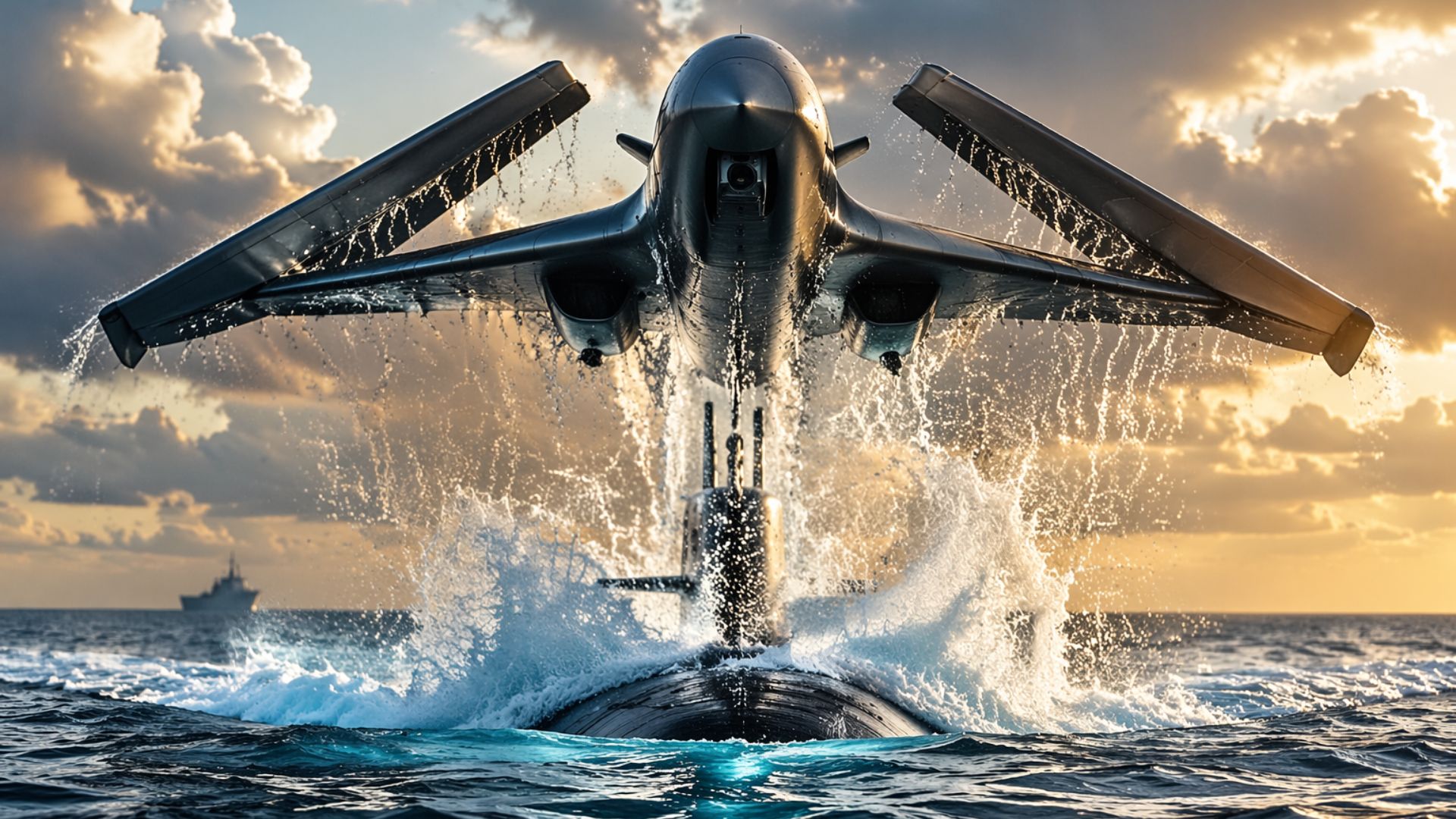

China’s hybrid military technology draws global attention by combining air and submarine operations in a single drone capable of transiting between different environments with a focus on strategic naval missions and reducing human exposure in risk areas.
China has unveiled the Feiyi, an unmanned system designed to operate underwater, on the surface, and in the air within the same architecture, in a move that has placed the search for vehicles capable of traversing more than one environment in the same mission back at the center of naval competition.
According to the researchers involved, the device can be launched from the water by a submarine, take flight, repeat the transition between sea and sky, and, at the end of the operation, return to the original platform.
Feiyi Drone: hybrid technology that operates in the air and sea
The project was developed by teams from Northwestern Polytechnical University and the China Aerodynamics Research and Development Centre, Chinese institutions linked to aeronautical research and advanced systems.
-
How to Prevent Brown Recluse Spider Bites: Common Hiding Spots and Free Tips to Reduce Risks

-
Natto: The Unusual Japanese Superfood Gaining Popularity on Social Media and Driving Record Exports
-
Brazilian Mayor Goes Undercover as Homeless for 24 Hours to Assess Public Services

-
15-Year-Old Entrepreneur Malu Lira Publishes 20 Children’s Books on Financial Education, Earns $500,000, and Expands Her Project to the Amazon Rainforest




In an article cited by the international press, the authors state that the Feiyi was designed to cross the boundary between water and air multiple times during a single journey, a feature presented as a gain in concealment and survival in a maritime environment.
What differentiates the Feiyi drone from other military systems
The most striking point was not just the ability to fly after emerging, but the attempt to combine, in a single platform, functions that are normally separated between aerial drones, surface vehicles, and underwater systems.
In practice, this alters the logic of employment, because the same vector can move discreetly in the aquatic environment and, when necessary, quickly assume an aerial profile.
According to the description released, the Feiyi uses a configuration with foldable parts to reduce resistance during submerged navigation and then adapt its shape for aerial movement.
This design seeks to address a known problem in hybrid projects: equipment that attempts to operate in two extreme mediums often loses efficiency when not originally designed for very different propulsion, stability, and control requirements.
The technical relevance of the system lies precisely in this repeated transition between domains.
Instead of functioning solely as a water-resistant drone or as an underwater vehicle with limited emerging capability, the Feiyi has been presented as a platform for hybrid operation, capable of using the sea, the surface, and the air as integrated parts of the same tactical route.
This promise helps explain why the announcement resonated beyond strictly military coverage.
Military applications and impact on modern naval warfare
The interest surrounding the Feiyi has grown because it appeared at a sensitive moment in the maritime competition between major powers.
Naval forces have been investing in unmanned systems to enhance surveillance, reconnaissance, and potential strike capabilities without directly exposing ships, aircraft, and human crews in contested areas, especially in coastal scenarios and higher operational risk zones.
In this context, a system that can emerge from the water, fly, return to the submerged environment, and be recovered by a submarine offers, at least in theory, advantages of discretion and flexibility.
In conventional operations, aerial and underwater assets usually follow distinct chains of launch, command, and recovery; when these functions coexist on a single platform, it opens up opportunities for new formats of infiltration, observation, and tactical approach.
The developers themselves have attributed to the Feiyi potential applications in maritime reconnaissance, surveillance, strike, and attack, a formulation that helps to understand the immediate attention received by the project.
By combining mobility and concealment, the system has been included in the discussion on how to expand the presence of sensors and vectors in areas where the exposure of manned assets may represent a greater political and military cost.
Technological dispute between China and the US drives interest
The repercussions have also been driven by the comparative environment between China and the United States in the field of unmanned systems.
The report from the South China Morning Post linked China’s advancement to military debates in the US about using submarines to deploy swarms of drones underwater in a potential maritime conflict, an argument that gave the Feiyi additional political weight beyond the purely technical aspect.
As a result, the system has come to be viewed not only as an engineering curiosity but also as a demonstration of applied research capability, industrial integration, and development speed.
In technological disputes of this kind, public narrative matters almost as much as the actual performance of the equipment, as it signals strategic priority, laboratory maturity, and the intention to transform prototypes into broader military-use solutions.
The name chosen by the researchers reinforces this symbolic dimension.
According to reports cited by the press, “fei” refers to flying, while “yi” recovers an ancient character associated with the image of a water bird spreading its wings to take off from the surface.
This choice condenses the project’s proposal by uniting, in a single reference, transition, thrust, and adaptation between water and air.
What is known about the Feiyi and what has not yet been revealed
So far, the publicly available information focuses on the general concept, the institutions involved, the operational logic of the system, and the applications pointed out by the authors.
The available coverage mentions the existence of a peer-reviewed article published on December 31, 2024 in the journal Acta Aeronautica et Astronautica Sinica, which provides academic backing to the presentation, but does not broadly clarify details such as range, autonomy, payload, onboard sensors, or the exact stage of maturity for potential operational use.
This limit is important because announcements of this nature often mix technological demonstration, cutting-edge research, and strategic signaling.
Still, the Feiyi has gained space in the international debate by visibly translating a broader trend: the attempt to break down the rigid boundary between aerial and underwater platforms in naval missions, reducing the predictability of the trajectory and expanding employment options in open sea or near the coast.
More than the image of a drone that “comes out of the water and flies,” what sustains the impact of the Feiyi is the ambition to create a vehicle capable of navigating, surfacing, taking off, repeating the transition, and returning to the launch point.
In a scenario of increasing competition at sea, this combination summarizes part of what today defines the race for technological superiority: autonomy, discretion, adaptability, and reduced human exposure in sensitive operations.