






 Portuguese
  Spanish


Study compares planted and natural forests in China and shows differences in growth, management, and carbon absorption, amidst the advancement of one of the largest reforestation programs in the world.
Trees planted in large reforestation projects in China are increasing their leaf area at a faster rate than observed in natural forests, according to a study published in 2026 in the scientific journal Geophysical Research Letters.
The research analyzed planted and natural forests in the country and attributes this difference to factors such as tree age, human management, selection of fast-growing species, and response to increased carbon dioxide in the atmosphere.
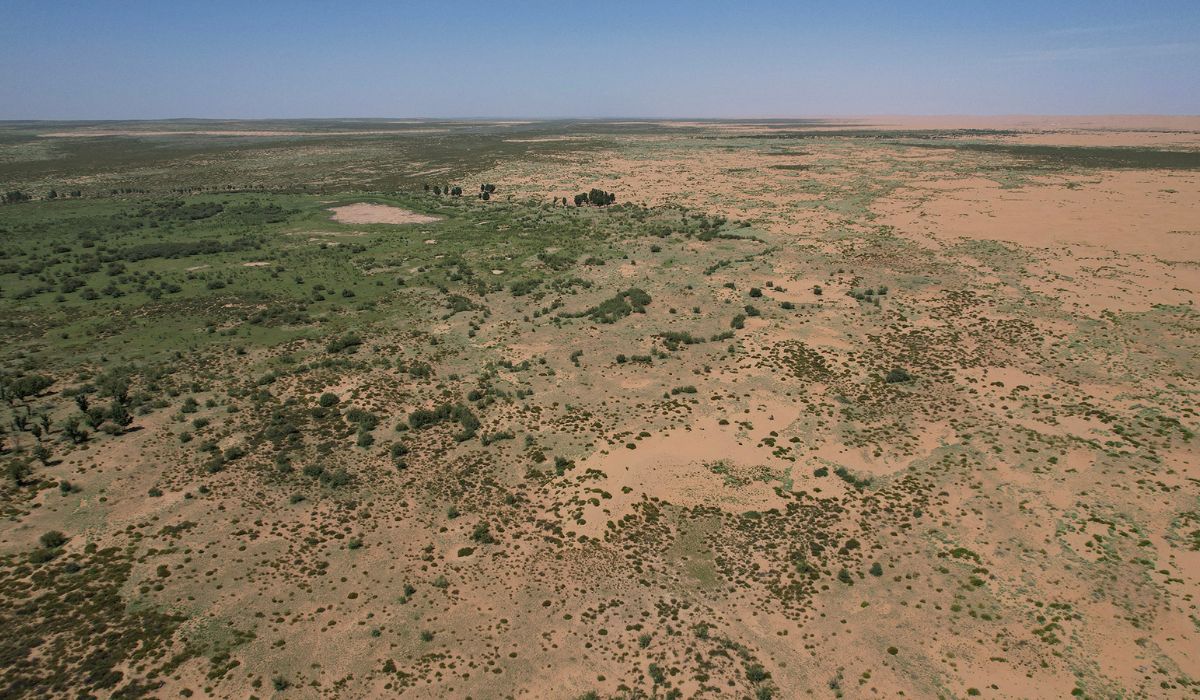
The topic gained attention for involving the so-called Great Green Wall, an initiative created by China to contain the expansion of the Gobi and Taklamakan deserts.
-
China to Launch World’s First Industrial-Scale Solid-State Battery in 2026, Doubling Energy Storage of Current Electric Car Batteries

-
Brazilian Steel Giant Donates 6 Million Tons of Waste to Pave Streets in 60 Cities, Tackling Infrastructure and Waste Challenges

-
BMW Demonstrates Real Value of Humanoid Robots: 30,000 Cars Assembled with Physical AI in European Production Line, Experiment Continues
-
Cut Plastic Bottles Become Electricity-Free Air Conditioners in Bangladesh, Cooling Metal Homes During Extreme Heat



According to the original report by Live Science, the country has already planted 66 billion trees since 1978 within the program and plans to add another 34 billion by the middle of this century.
Officially, the project is known as the Three-North Shelter Forest Program.
The initiative covers areas in northern, northeastern, and northwestern China and, according to the UN Sustainable Development Goals platform, was launched by the Chinese government to improve ecological conditions and expand forest coverage in 13 provinces, autonomous regions, or municipalities in the north of the country.
Reforestation in China and advancement of the Great Green Wall
The team led by Yuhang Luo, a landscape ecologist affiliated with Peking University in Shenzhen, used satellite data to track the leaf area index, a measure that indicates the density of tree canopies.
This indicator is used by scientists to estimate part of a forest’s capacity to absorb carbon, although it does not alone represent all the carbon accumulated in trunks, roots, bark, and soil.
In the comparison made by the researchers, the planted forests in China had a leaf area increase 66% faster than natural forests.
According to the study, a significant part of this difference is related to the fact that the reforested areas are, on average, younger.
Trees in early stages of development tend to grow faster than mature trees, especially when subjected to targeted management.
The difference, however, did not disappear when the authors compared forests of similar age and in similar environmental conditions.
In this context, the planted areas still showed 4.6% faster growth.
The effect was more evident in mixed and evergreen forests, according to the data presented in the research.
The authors also observed that the response to atmospheric CO₂ was greater in planted forests than in natural ones.
For the team, this behavior indicates that climate models may underestimate important differences between types of forests when calculating carbon absorption.
(Image credit: PEDRO PARDO via Getty Images)
Why Planted Trees Grow Faster
The advantage identified in planted forests was not attributed solely to climate or higher carbon concentration in the air.
According to the researchers, human management plays a significant role in the outcome.
In many cases, these areas use fast-growing species, such as eucalyptus and poplars, along with practices like removing competing vegetation and soil fertilization.
With less competition for light, water, and nutrients, planted trees can respond more intensely to the so-called CO₂ fertilization effect.
This process occurs when higher concentrations of the gas contribute to plant growth under certain environmental conditions.
The research, however, does not treat this effect as unlimited.
The authors emphasize that the response of trees depends on factors such as water availability, soil nutrients, temperature, species diversity, and forest age.
Without these conditions, the increase in CO₂ does not necessarily translate into greater plant growth.
The study also points out that the difference between planted and natural forests reaches its peak when the trees are between 30 and 40 years old.
After 40 years, the advantage decreases noticeably.
In natural forests, growth tends to be slower but can be sustained for longer periods.
In an interview with Live Science, Luo stated that planted forests can function as a short-term tool for carbon absorption.
The researcher, however, emphasized that this benefit is temporary and said that for long-term carbon storage and resilience, “natural forests remain irreplaceable.”

Carbon absorption and limits of the leaf area index
The research does not claim that planted forests are always more efficient than natural forests in combating climate change.
The study measures the increase in the leaf area index, not the total carbon stored by a forest.
This distinction is relevant because carbon can be retained in different parts of the ecosystem, including wood, roots, bark, and soil.
Kevin Dsouza, who worked with reforestation models during postdoctoral research at the University of Waterloo and did not participate in the study, told Live Science that the results make sense from a biological perspective.
According to him, broad canopies in young and fast-growing trees can favor greater carbon absorption.
The researcher also made a caveat about using the leaf area index as a measure of growth and carbon sequestration.
In his assessment, the indicator is useful but does not provide a complete view of carbon storage in a forest.
This caution appears in another study on Chinese forests, published in 2025 in the journal Communications Earth & Environment.
The research concluded that, at comparable ages, naturally regenerated young forests show higher rates of above-ground carbon accumulation than young planted forests, mainly due to differences in tree density.
The same survey observed that young planted forests can sequester more carbon in the present by occupying larger areas.
Still, the authors’ projections indicate that by 2060, the total above-ground carbon stock in these areas may be lower than that observed in young natural forests.
For this reason, the researchers advocated optimizing the structure of planted forests to enhance carbon storage.

Climate Models and Reforestation Policies
The results reinforce the need to differentiate between planted and natural forests in climate policies and carbon models, according to the authors of the study published in Geophysical Research Letters.
Planting trees can quickly expand vegetation in degraded areas, reduce erosion, and contribute to carbon capture, but the effects vary depending on forest age, species diversity, management, and maturation time.
Luo told Live Science that many global ecosystem models still do not adequately distinguish between planted and natural forests.
According to the researcher, there are also limitations in how these models represent changes associated with tree age, which can affect estimates used in reforestation policies and carbon accounting.
The Chinese case illustrates the scale of ecological engineering projects adopted to tackle desertification and land-use changes.
In November 2024, Reuters reported, based on Chinese state media, that China completed a green belt of about 3,000 kilometers around the Taklamakan Desert, as part of efforts initiated in 1978.
The same report noted that more than 30 million hectares of trees had been planted and that national forest coverage had surpassed 25% by the end of 2023.
These numbers were presented in the context of Chinese actions to expand vegetative barriers against desertification and sandstorms.
Projects of this type, however, also face technical challenges.
Among the points cited by researchers and specialists are seedling survival, use of water in arid regions, risk of monocultures, presence of pests, and real effectiveness in reducing sandstorms.
These factors make it insufficient to evaluate the success of a reforestation policy solely by the number of trees planted.
In the study led by Luo, the main implication pointed out by the authors is that tree planting can play a relevant role in carbon absorption in the short term, but it does not replace the conservation of natural forests.
For public policies, the difference between planting, restoring, and preserving changes the expected outcomes for carbon, biodiversity, and ecosystem stability.


