Portuguese
  Spanish


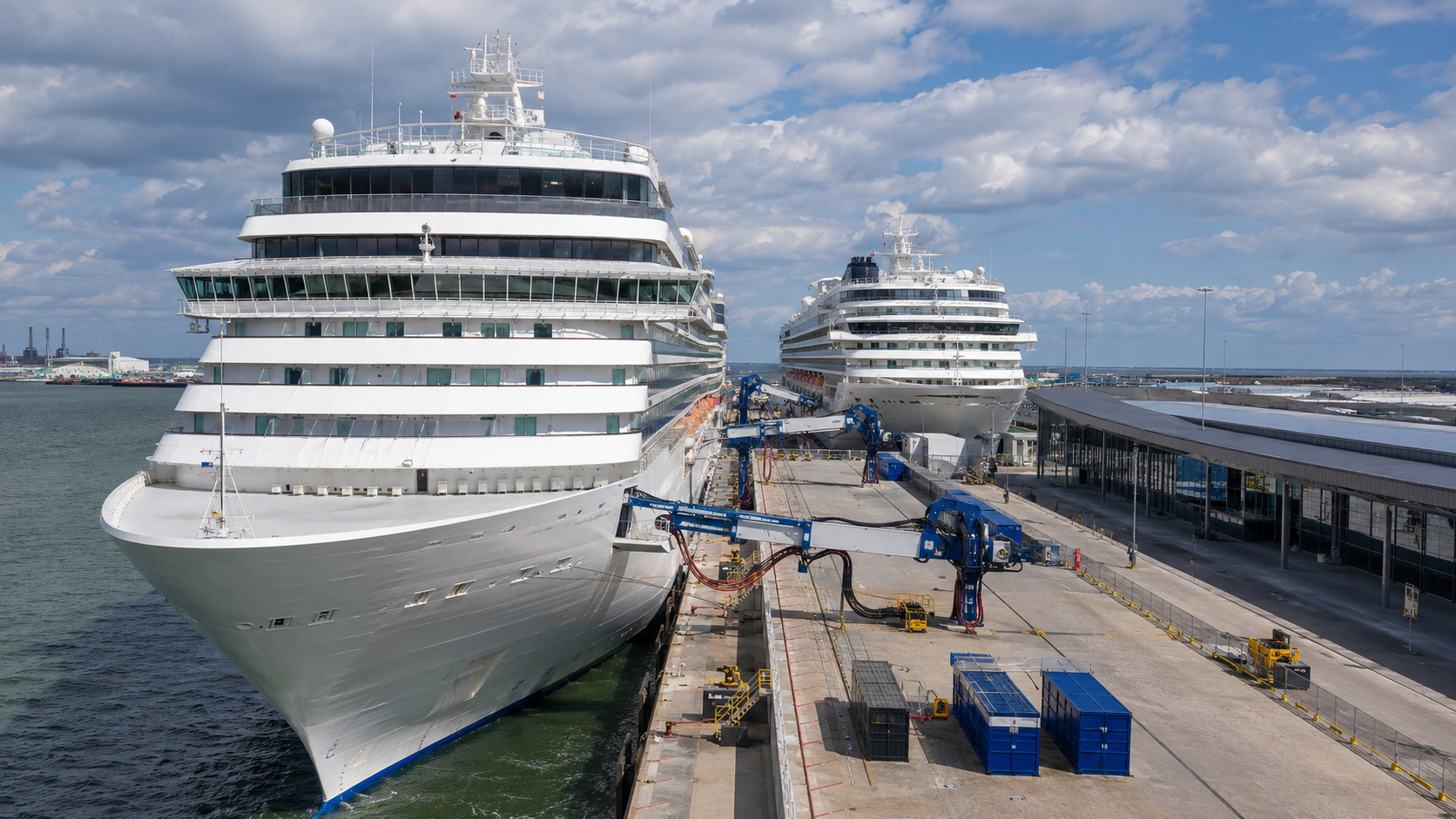
CMA CGM — the third largest container shipping company in the world — has received the delivery of the Notre Dame, a 24,212 TEU container ship with a length of 400 meters and a beam of 62 meters, powered by liquefied natural gas in a sector that still predominantly burns heavy fuel oil and accounts for about 2.5% of global CO₂ emissions.
The size that the Notre Dame represents in real numbers
24,212 TEUs is the capacity in 20-foot containers — the industry standard unit of measurement. For reference: a standard 20-foot container can fit two medium-sized cars side by side, or 25,000 bananas. The Notre Dame can carry more than 600,000 refrigerators, or the production of a Chinese electronics factory for entire months in a single trip.
400 meters in length places the Notre Dame in the same range as the largest ships ever built. For comparison, the Christ the Redeemer, if laid down, would be 38 meters. The Notre Dame has more than 10 Christs laid from bow to stern. In the crossing of the Suez Canal — which is 193 meters wide at its narrowest part — a ship of this size passes with calculated clearance in meters on each side.
62 meters in beam — the width — means that the Notre Dame does not fit in the docks of most ports in the world. It only operates in deep water terminals with berths designed for ultra-large container vessels (ULCV) — which includes the world’s largest transshipment hubs: Port Said, Singapore, Tanjung Pelepas, Algeciras, Rotterdam.
-
Norwegian Barge Transformed into Floating Structure in Copenhagen Highlights Technical Challenges of Retrofitting Vessels

-
At 28, a Female Shipbuilder Restores a 30-Meter Yacht from 1962, Highlighting Women’s Often Overlooked Contributions in Shipyards
-
Belgian Port to Install Shore Power for Cruise Ships by 2027, Cutting Dock Emissions by Up to 5% and Meeting EU Regulations
-
Post-Katrina Engineering System Uses Steel Frames, Floating Blocks, and Guide Posts to Elevate Homes During Floods



Why LNG and not diesel: what the Notre Dame represents for the transition
Heavy fuel oil (bunker fuel) is the dirtiest fuel of modern transportation. Rich in sulfur, it causes acid rain and emits ultrafine particles. The IMO (International Maritime Organization) approved a 0.5% sulfur limit for marine fuel in 2020 — but still allows the burning of fossil products.
LNG reduces sulfur emissions by up to 99% and CO₂ emissions by up to 20% compared to bunker fuel. For a ship the size of the Notre Dame, which consumes thousands of tons of fuel per trip, this reduction is enormous in absolute terms.
CMA CGM has one of the most ambitious LNG fleets in the sector: the company has ordered 30 LNG-powered ships in recent years. The Notre Dame is the largest of them and proves that ships with record capacity can operate with cleaner propulsion technology without sacrificing efficiency or capacity.
The paradox: the largest clean ship in a dirty ocean
The Notre Dame is the exception, not the rule. The global fleet of merchant ships is still overwhelmingly powered by heavy oil. The 60,000 large ships that sail the oceans collectively burn more than 250 million tons of bunker fuel per year.
LNG is an improvement — but it is still fossil. The path to zero emissions in maritime transport points to green methanol, green ammonia, or hydrogen, none of which are available at a commercially relevant scale for ships of this size. Engineers from Maersk and Hapag-Lloyd, who build methanol ships, state that the technology exists but the fuel is not available in sufficient quantity.
The IMO has set a target of a 40% reduction in the sector’s carbon emissions by 2030 and net-zero emissions by 2050. With fleets that have a lifespan of 25 to 30 years, the ships ordered today will burn fuel until 2055 — which makes every propulsion choice now a decades-long decision.
What the Notre Dame means for Brazil
Brazil is one of the world’s largest exporters of bulk and containerized cargo — soybeans, corn, sugar, meat, iron ore, manufactured products. Ships like the Notre Dame are the ones that carry a large part of this production to Europe and Asia.
The arrival of ULCV ships on Brazilian routes pressures ports to invest in dredging and quay infrastructure — which explains part of the investments we see in Santos, Itaqui, and Paranaguá. To receive the Notre Dame or equivalents on a regular scale, a port needs a depth of 16 meters or more, cranes with adequate reach, and container yards of enormous dimensions.
The Santos of 2026 meets some of these requirements — but modernization is continuous and expensive. The strategic question for Brazil is whether it will invest in the infrastructure that captures larger ships or continue exporting on the scale of smaller ships, paying more freight per unit.
A fundamental technical aspect of the Notre Dame that illustrates the challenges of maritime energy transition is the cryogenic LNG tank system. Liquefied natural gas needs to be kept at -162 degrees Celsius to remain in a liquid state, which requires specially insulated tanks that occupy significant space on the ship. This reduces, by a small margin, the cargo capacity compared to equivalent bunker fuel ships. At the same time, IMO emissions regulations will make untreated bunker fuel progressively more expensive as sulfur limits become stricter. On routes where LNG is available — and the Notre Dame was designed to operate exactly on these routes, with refueling points in the Mediterranean, Northern Europe, and the Persian Gulf — the operational cost is competitive, and the regulatory advantage grows each year. The Notre Dame is not just a large ship: it is a 20-year lifespan bet on the trajectory of international maritime environmental regulation.
When the largest container ship in the world already uses cleaner fuel, are Brazilian ports ready to receive the ships that will dominate trade in the coming decades?