Portuguese
  Spanish


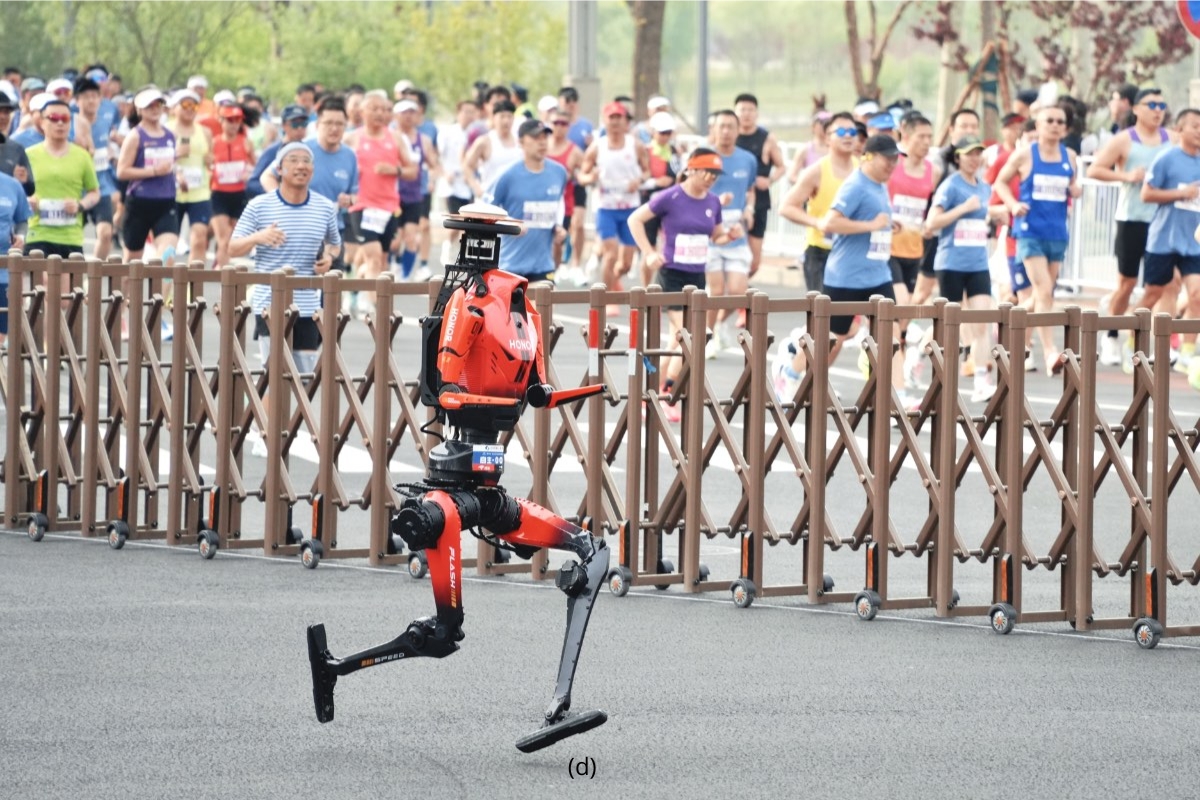

The future arrived running, and it arrived too fast for many people to keep up. A Chinese humanoid robot named “Lightning” has just become a global topic by completing a half marathon in an impressive 50 minutes and 26 seconds, a time lower than the human men’s world record for the distance.
The feat took place at the Beijing E-Town Humanoid Robot Half-Marathon 2026, in Beijing, and reignited a question that seems to have come out of a science fiction movie: are robots starting to surpass the physical limits of human beings?
The Chinese robot that put world athletics on alert
The protagonist of this story is Lightning, a humanoid robot developed by Honor, a Chinese company known worldwide for its work in the technology sector. According to the Xinhua agency, the robot won the humanoid race held in Beijing E-Town on April 19, 2026, recording a time of 50 min 26 s.
-
Astronauts Returning from Space Show Altered Gut Bacteria and Loss of Protective Microbes, Highlighting Potential Risks for Mars Missions

-
Electrolux Unveils Smart Washing Machine Line with 12kg Capacity, 45-Minute Cycle, Automatic Dosing, Dirt Sensors, Sanitizing Steam, App Control, and User-Guiding Display
-
Realme Launches Affordable 16x 5G Phone with Military Certification, 6,600 mAh Battery, 50 MP Camera, and 6.8-Inch Screen Starting at $320

-
Amazonian Fruit Bacuri: A Nutrient Powerhouse with Antioxidants, Vitamins, and Bioactive Compounds, Ideal for Sweets and Beverages




To understand the impact of this number, one only needs to remember that the human men’s world record for the half marathon is **57 min 20 s**, a mark associated with runner Jacob Kiplimo. In other words: **Lightning completed the 21.0975 km faster than any man officially recorded at that distance**.
But beware: this does not mean that the robot “took” the human record in official athletics. The comparison is powerful, shocking, and true in terms of time, but we are talking about completely different categories.
A half marathon that looked like a movie scene

The competition brought together humanoid robots in an environment designed to test speed, endurance, balance, and autonomy. The event was not just a race: it was a technological showcase from China to the world.
According to China Daily, more than 100 teams participated in the 2026 edition, showing a gigantic leap compared to the previous year. The podium was still dominated by Honor, with the top three places occupied by robots linked to the company.
The most dramatic moment came near the finish line. **Lightning reportedly collided with a barricade**, needed adjustments from the team, and still crossed the finish line in first place. A script worthy of a technological blockbuster.
The time that made the world look at China
The number **50 minutes and 26 seconds** is not just a sports statistic. It is a symbol. It shows that **Chinese humanoid robotics** is advancing at a frightening speed, especially when comparing the evolution between 2025 and 2026.
According to the iRunFar portal, in the previous edition only a few robots managed to complete the race, and the robotic winner of 2025 finished in about **2 hours and 40 minutes**. In just one year, the time dropped to **50:26**.
This difference is not small. It is a revolution. In practical terms, what seemed like an experimental curiosity turned into a brutal demonstration of **technological advancement, applied artificial intelligence, and high-performance mechanical engineering**.
Was “Lightning” autonomous or human-controlled?
One of the most important points of this story lies in the difference between **autonomous** robots and **remotely controlled** robots. The race featured different categories, and this is essential to understand the significance of the result.
As reported by The Verge, there were participants with remote control and also autonomous models. Lightning itself had a remotely controlled version that reportedly recorded an even faster time, but the official highlight went to the autonomous model within the competition’s evaluation system.
This makes the feat even more impressive. A robot capable of running long distances without fully relying on real-time human commands represents a direct advance in **robotic locomotion, sensors, balance algorithms, and decision-making in motion**.
The technology behind the running robot


The Lightning was designed for speed. Standing at approximately 1.69 m tall, the robot was described as a machine built for explosive power, stability, and efficient running.
Among the technical details released, the long legs, designed to mimic elite runners’ patterns, and the use of advanced cooling technologies stand out. This type of solution is crucial because a robot running for over 21 km needs to deal with heat, energy consumption, mechanical impact, and continuous motor control.
In other words: it’s not enough to “walk fast.” To complete a half marathon at this pace, the humanoid needs to combine resistant hardware, intelligent software, and precision engineering.
The title is sensational, but needs to be understood correctly
The headline “Chinese robot breaks human record” is strong, viral, and perfect for grabbing attention. However, technically, Lightning did not break an official World Athletics record, because robots do not compete in the same category as human athletes.
What happened was equally impactful: a humanoid robot recorded a time faster than the men’s human world record for the half marathon. This does not replace the human record, but it creates a new symbolic milestone for technology.
And perhaps that is precisely the most frightening point: the comparison doesn’t need to be official to impress. The clock marked 50:26, and that number was enough to shock the internet.
Why does this race matter so much?
This race isn’t just about sport. It shows China’s advancement in strategic areas such as humanoid robotics, artificial intelligence, automation, mobility, sensors, and high-efficiency batteries.
Robots capable of running long distances could, in the future, be used in rescues, industrial operations, logistics, security, exploration of dangerous areas, and even human assistance in extreme situations.
What today seems like a spectacle could tomorrow transform into technological infrastructure. And China knows this. By putting humanoid robots in a public half marathon, the country is not just entertaining the world: it is flexing its technological muscle.
Will the future of racing be human, robotic, or hybrid?
The image of a robot crossing the finish line in a time faster than the best human record stirs collective imagination. It provokes fascination, fear, and curiosity all at once.
We are still far from seeing robots replacing human athletes in traditional sports. The emotion of athletics comes from biological overcoming, from pain, training, physical and mental limits. But the existence of Lightning shows that a new category of competition may be emerging.
In the future, we may witness championships of racing between humanoid robots, with increasingly absurd records. And, if the leap from 2025 to 2026 serves as a sign, the next times could be even more unbelievable.
Conclusion: Lightning didn’t just run, it sent a message
The Chinese robot Lightning didn’t just make history by winning a race. It became a symbol of a new phase of global technology. By completing a half marathon in 50 minutes and 26 seconds, the humanoid showed that robotics is leaving laboratories and beginning to occupy spaces previously reserved exclusively for humans.
The time is not an official human record, but it is a powerful warning: the technological race has accelerated, and China seems determined to lead this pack.
The world saw a robot run. Now, the question is different: who will be able to keep up?