





A demonstration in a Chinese factory shows how humanoid robots are beginning to compete for space in sensitive stages of electronics production, with numbers that draw attention and require careful reading.
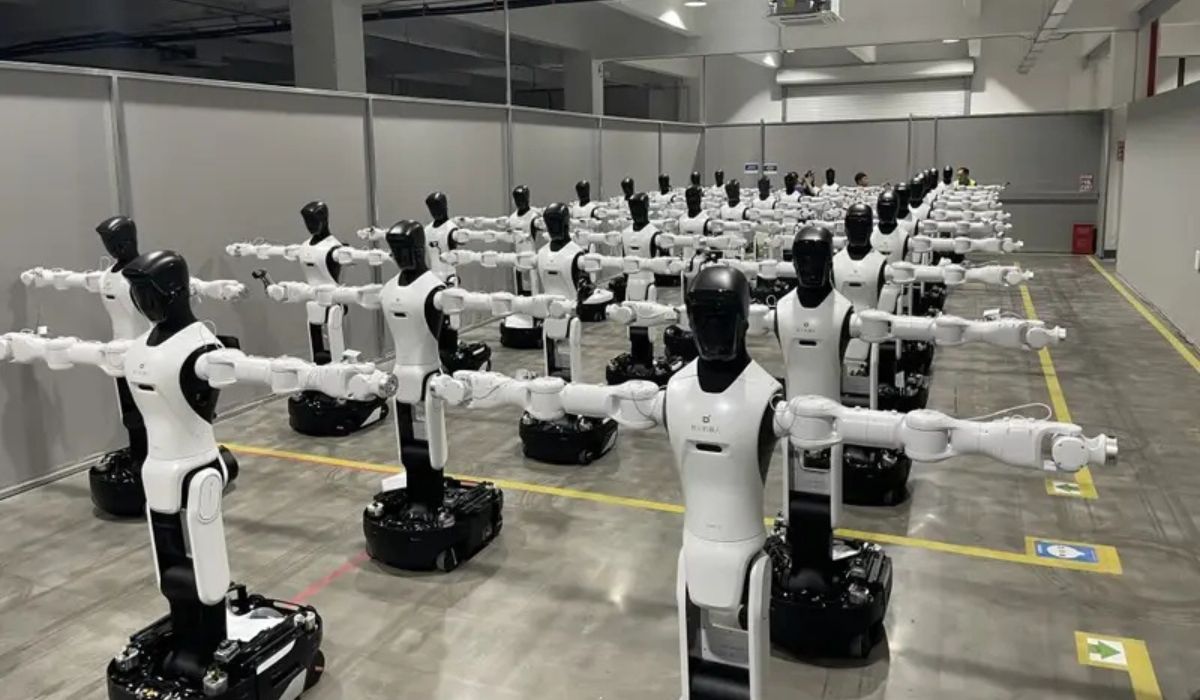
AgiBot deployed G2 humanoid robots to operate on a real tablet production line at Longcheer Technology in Nanchang, the capital of Jiangxi province, China.
According to the manufacturer, the equipment was integrated into testing and inspection stations in a consumer electronics production environment, working alongside human operators.
The demonstration was presented by the company as part of the industrial application of embedded intelligence systems, an area that combines sensor perception, decision-making, and physical manipulation in robots.
-
Chinese Humanoid Robots Transition from Labs to Real Factories to Assemble Tablets: AgiBot Deploys G2 Machines at Longcheer, Aiming for 100 Robots in Electronics, Cars, Chips, and Energy by 2026
-
College Dropout Turned Window Cleaner Builds $1 Million Cleaning Business with Subscription Model After 18 Years of Door-to-Door Work
-
Race for Data Centers in Brazil Intensifies Pressure on Critical Energy Resources

-
Melting Glaciers Uncover Ancient Tools, Preserved Mummies, and Strategic Minerals in the Arctic and European Mountains

According to AgiBot, the global broadcast of the operation was scheduled to occur between June 23 and 28 on the company’s official channels on X and YouTube.
The test involved a sensitive stage of electronics manufacturing.
On the production line, the robots needed to remove tablets from the conveyor belt, identify the position of the devices, place them in test fixtures, and separate approved or faulty units after verification.
Longcheer states that this process requires real-time communication with testing equipment and consistent movements to avoid damage to the products.
Humanoid robots enter the tablet line
Longcheer Technology reported that the public demonstration at the Nanchang factory took place on April 14, 2026, within the strategic partnership established with AgiBot in October 2025.
The company says it chose an open mass production line to test the robots under real industrial conditions, with repetitive cycles and high volume of parts.
In the statement, AgiBot claims that multiple units of the G2 were officially integrated into Longcheer’s tablet lines.
The operation is part of a joint project to bring embedded AI systems to core flows of consumer electronics manufacturing, instead of restricting the technology to laboratory demonstrations.
The indicators released by the company show an approximate production of 3,000 units per shift, a success rate above 99% in continuous operation, a cycle of 19 to 20 seconds per process, and a capacity of up to 310 units per hour.
AgiBot also reports that the line integration was completed in 36 hours and that the system accumulated more than 140 hours of continuous operation, with downtime loss of less than 4%.
In the public statements consulted, AgiBot and Longcheer report about 3,000 units per shift and a rate higher than 99%, without literal confirmation of 100% accuracy over 10 hours.
Tablet production requires precision from robots
In an electronics line, small deviations can affect fittings, delay stages, or damage the devices.
Therefore, AgiBot reports that the G2 operates in MMIT stations, an acronym used for multimedia integrated tests, where the robot positions each unit in the correct verification accessories.
Longcheer describes the system as a combination of sensors, dynamic planning, and actuators.
According to the company, the robots use real-time perception to detect misalignments, calculate trajectories, and adjust the handling of tablets during operation.
The comparison with conventional industrial automation appears in the companies’ own materials.
AgiBot claims that the system does not require customized tools for each process and can support production lines with different device models, which would reduce the need for physical reconfiguration at certain stages of the factory.
The company also says that the flexibility of the robots is one of the points sought in the project with Longcheer.
This argument is linked to the consumer electronics sector, where model changes and product cycles often require frequent adjustments in production lines.
AgiBot G2 uses NVIDIA Jetson Thor platform
Processing capacity is one of the technical components highlighted in the G2.
AgiBot announced that the robot will adopt the NVIDIA Jetson Thor platform as the main controller, focusing on embedded computing, real-time reasoning, and integration with NVIDIA’s robotics tools.
NVIDIA reports that the Jetson Thor family delivers up to 2,070 TFLOPS in sparse FP4 for AI performance.
According to the manufacturer, the platform was developed for physical robotics, autonomous systems, and applications that rely on local processing of sensors and artificial intelligence models.
In the statement about the G2, AgiBot claims that the use of Jetson Thor represents an increase of about 7.5 times in AI computing power compared to the previous generation.
The company also projects a gain of 10% to 15% in effective work autonomy, associated with the energy efficiency of the new platform.
AgiBot had already received international recognition in November 2025.
In that month, the humanoid robot AgiBot A2 registered in the Guinness World Records the longest distance traveled by a humanoid: 106,286 kilometers, in Shanghai, between November 10 and 13, 2025.


Humanoids advance in industrial tests
The operation at Longcheer shows that AgiBot has started testing humanoid robots in a commercial production line, with repetitive tasks, delicate products, and integration with existing industrial systems.
The evaluation of the results, however, depends on the data released by the companies involved, without independent audit identified in the consulted statements.
In the case of tablets, the application focuses on loading, unloading, inspection, and separation of units.
These functions appear in the statements as examples of stages where humanoid robots can be used to support manufacturing processes requiring precision and repeatability.
Longcheer states that, since March 16, the robot has been integrated into the main line, operating on average more than 10 hours a day and totaling over 200 hours of continuous operation, with a downtime loss of 4%.
The company also claims that the movement speed and stability exceeded the internal expectations of the project team.
Larger scale adoption still depends on factors such as cost, maintenance, safety, long-term reliability, and compatibility with already installed industrial systems.
These points were not detailed comparatively in the public statements, but are relevant aspects for any expansion of this type of technology in production lines.
AgiBot reports that it intends to expand the use to 100 robots by the third quarter of 2026 and accelerate applications in sectors such as automotive, semiconductors, and energy.
The company also states that, in March 2026, it announced the rollout of the 10,000th robot from its production line.


