Portuguese
  Spanish


The whale cemetery in the Indian Ocean, located in the Diamantina zone, gathers fossils in a submarine corridor at the ocean floor and shows how ancient carcasses sustain hidden life, rare organisms, and clues about millions of years of deep ecosystems still little understood by modern science in the most remote regions.
The whale cemetery discovered by Chinese researchers in the Indian Ocean was described as the largest ever recorded in the world. The find gathers fossils spread over a 1,200-kilometer submarine corridor in the Diamantina zone, west of Australia, with remains that can be up to 5.3 million years old.
According to IstoÉ, in a publication by AFP on June 10, 2026, updated on the same day, the study was published in the journal Nature and involved scientists who explored the area in 2023. The discovery shows how the ocean floor can hold natural archives of millions of years and, at the same time, sustain entire ecosystems.
Submarine corridor in the Indian Ocean surprised researchers
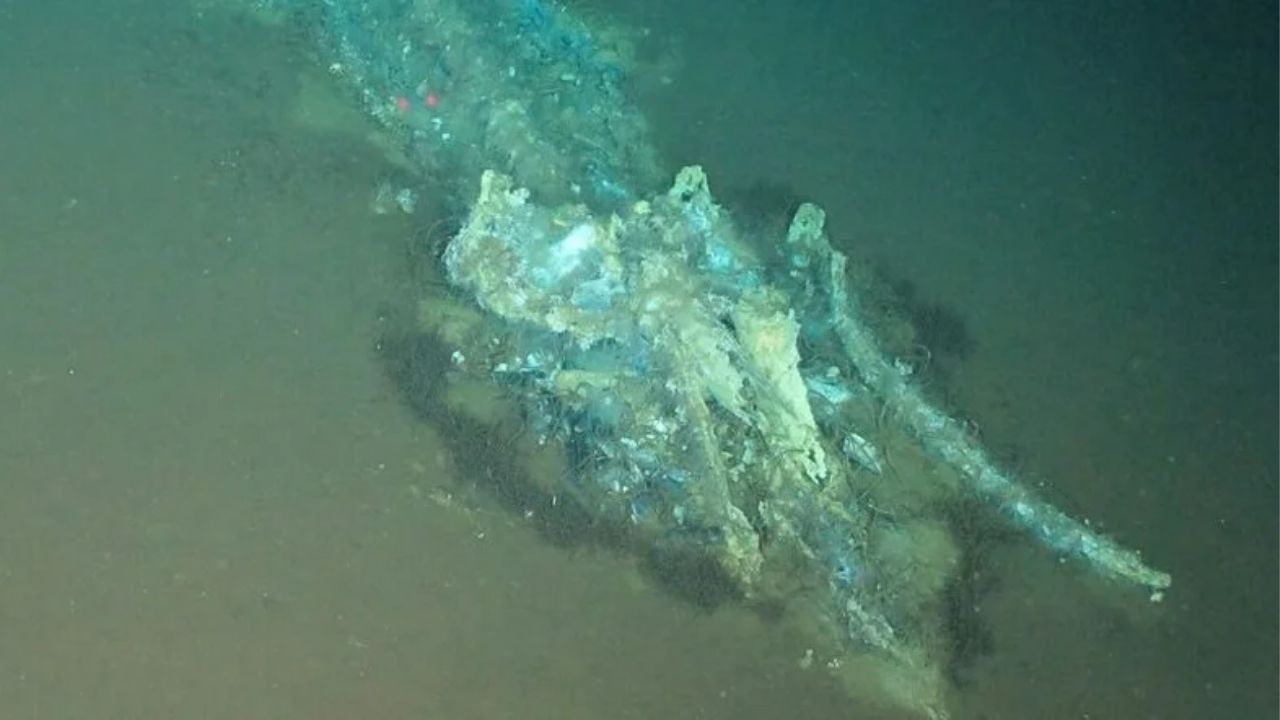
The whale cemetery was located in a deep area of the Indian Ocean known as Diamantina. In this region, researchers identified 485 cetacean fossils distributed over a 1,200-kilometer corridor, forming a rare concentration of marine remains at the ocean floor.
-
11-Year-Old Takes Truck, Crashes Into Pilgrimage in Thailand, Killing Eight Buddhist Monks

-
Archaeologists Uncover Ancient Ruins and Artifacts in Shiloh, Potentially Shedding Light on the Biblical Ark of the Covenant
-
Havaianas Covers Brazilian Landmark with 4,500 Flip-Flops to Create Visual Spectacle of National Flag
-
Ancient Wind Tower Cools Desert Homes Using Physics, Water, and Smart Architecture Without Electricity



What makes the find unusual is not just the number of skeletons, but the extent and continuity of the material found. The fossils indicate that this environment received carcasses for millions of years, transforming a remote area into a natural record of the relationship between death, depth, and underwater life.
V-shaped trench may have concentrated the carcasses
One of the scientists’ hypotheses is that the region functions as a kind of natural trap. The area would have a V-shaped trench, capable of channeling carcasses to the depths and concentrating the remains in the same underwater corridor, instead of leaving them scattered across the ocean.
Another explanation considered is that the location is an important feeding zone for large marine animals. With greater circulation in this area, more bodies could have sunk over time. Thus, the whale cemetery would have been formed by the combination of a constant presence of marine life and a favorable relief for the accumulation of fossils.
Millions of years old fossils became a natural archive
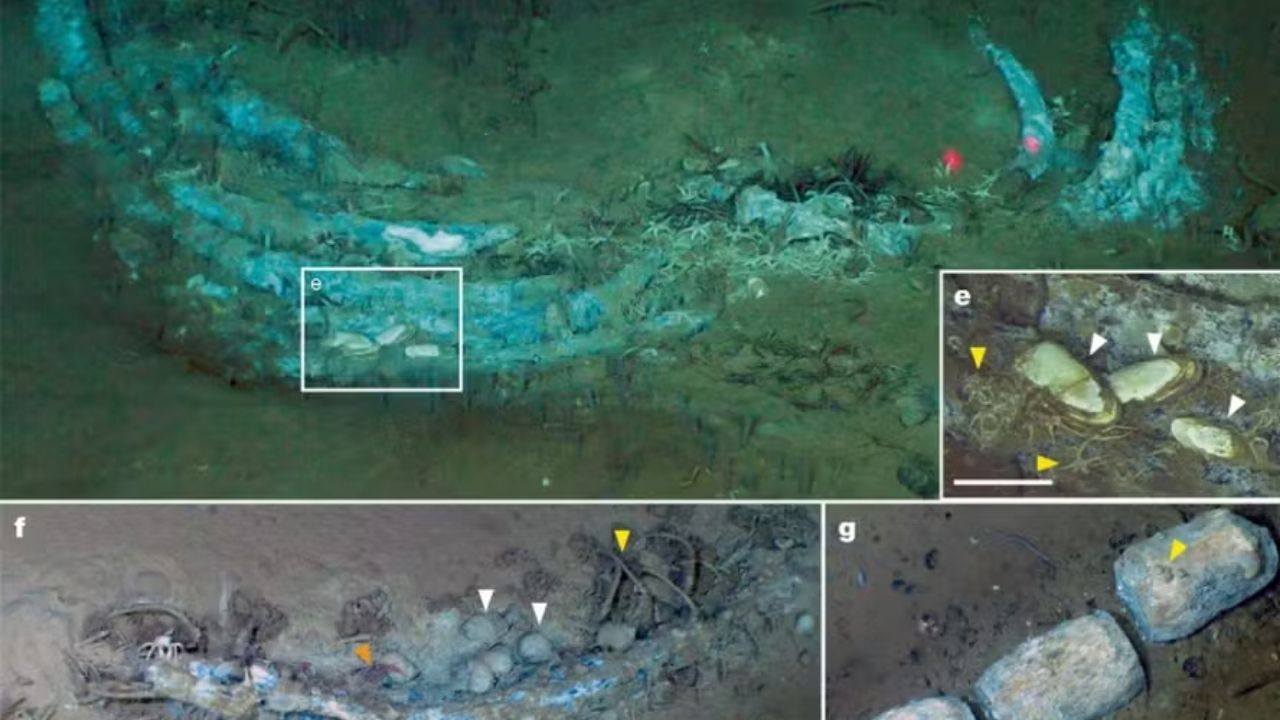
Some of the remains found in the whale cemetery were estimated to be up to 5.3 million years old. This data transforms the region into a kind of underwater archive, where fossils preserve clues about ancient cetacean populations, environmental changes, and deep ocean dynamics.
Paleontologist Stephen Godfrey highlighted that the records indicate a continuous accumulation of whale falls for at least five million years. This permanence makes the location important not only for the number of skeletons but for the possibility of reconstructing a long ecological history hidden at the bottom of the sea.
Death in the deep ocean sustains life where there is almost no food
When a whale dies, its body can sink to the deep regions of the ocean. This process is known as a whale fall. In places where sunlight does not reach and food is scarce, a large carcass becomes a concentrated source of energy for various organisms.
In the case of this whale cemetery, the process seems to have occurred repeatedly for millions of years. The death of the marine giants created food points at the ocean floor, allowing entire communities to develop around the skeletons in an extreme and inaccessible environment.
Hidden ecosystem appeared around the skeletons
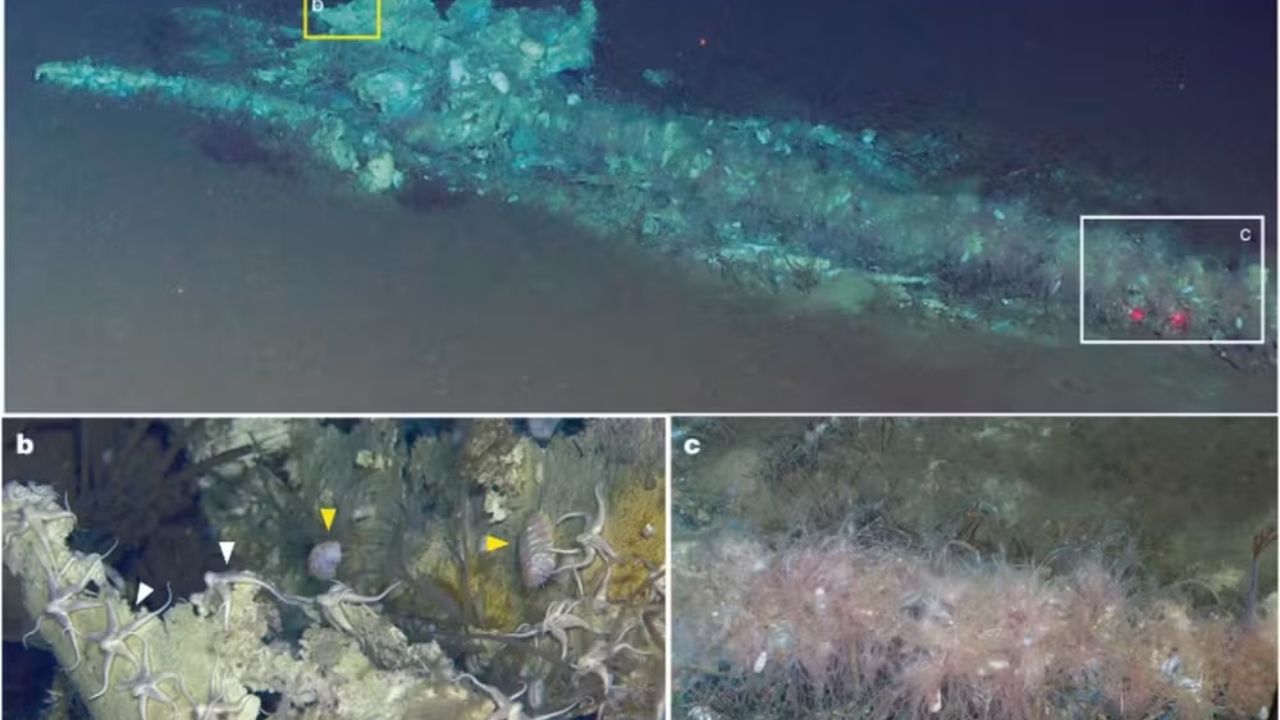
During the dives, researchers observed organisms living near the remains, including jellyfish, brittle stars, zombie worms, and bivalve mollusks. These beings take advantage of the organic matter released by the carcasses and help transform the skeletons into centers of biological activity in the depths.
This point changes the weight of the discovery. The whale cemetery is not just a collection of ancient bones in the Indian Ocean, but an ecological structure. Each carcass can function as an energy island in a dark, cold, and resource-poor region, attracting specialized and little-known organisms.
Chinese submersible revealed a rare landscape
The area exploration was carried out in 2023 with the Fendouzhe submersible, used by Chinese researchers in 32 dives in the Diamantina zone. The equipment allowed direct observation of the fossils on the ocean floor and recording the distribution of the skeletons along the submarine corridor.
The main author of the study, Xiaotong Peng, from the Chinese Academy of Sciences, told AFP that the team was surprised by the magnitude of the discovery. The area’s breadth, depth, and variety of fossil ages exceeded the researchers’ initial expectations.
Possible unknown species increases scientific value
Most of the 485 recorded fossils belong to the beaked whale family, a group of cetaceans associated with deep ocean areas and still little observed compared to other marine species. Therefore, the remains found can help expand knowledge about animals that are rarely seen up close.
Among the materials analyzed, the authors identified a previously unknown and now extinct species. This detail reinforces the scientific value of the whale cemetery, as the area may hold information about ancient lineages, vanished before being recorded by modern science.
Discovery was compared to hydrothermal vents
Stephen Godfrey compared the discovery to the impact caused by the identification of hydrothermal vents in 1977. At that time, scientists realized that the ocean floor could harbor abundant life even in environments without direct sunlight, changing the way science viewed the depths.
The comparison helps to size the whale cemetery. Just as hydrothermal vents revealed unexpected ecosystems, this fossil corridor shows that accumulated carcasses can sustain life for long periods and raise new questions about how organisms survive in extreme environments.
Estimate points to millions of hidden skeletons


Based on the recorded fossils, the authors estimate that more than 10 million skeletons may exist on the ocean floor in the Diamantina zone. The projection does not mean that all have been directly observed, but indicates that the area may be much broader than initial records show.
If this estimate is close to reality, the whale cemetery could represent one of the largest natural archives ever identified in the deep ocean. The Indian Ocean floor may hold clues about feeding, migration, death, evolution, and ecosystems that science still knows in a limited way.
What the ocean floor can still reveal
The discovery reinforces that the deep ocean remains little known. Even with advanced technologies, regions like Diamantina still hold biological landscapes and fossils that would hardly be imagined without direct exploration, submersibles, and long-term studies.
The whale cemetery also shows that life on the planet does not depend solely on visible environments on the surface. In a remote area, nearly 500 skeletons reveal a hidden energy chain, where ancient remains continue to be connected to living organisms and questions that science has not yet been able to answer.
Did you imagine that a whale cemetery on the ocean floor could reveal an entire ecosystem and even clues of unknown species? Share your opinion.