Portuguese
  Spanish


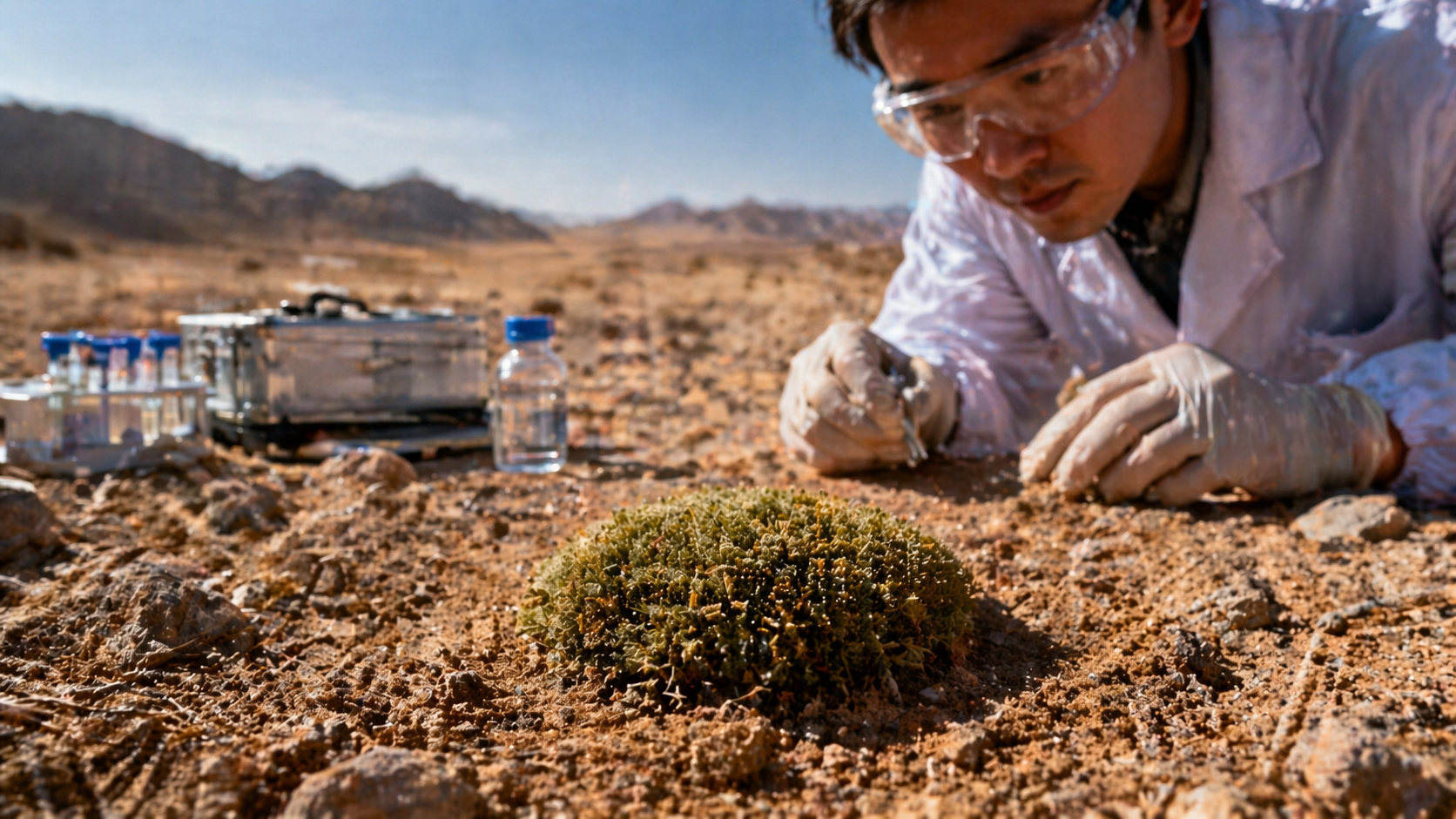


Desert moss withstood -196°C, lost more than 98% of its water, and still regenerated after tests under conditions similar to Mars.
In July 2024, Chinese researchers published in the journal The Innovation a study that placed a terrestrial plant in some of the most hostile environments ever simulated in the laboratory. The organism tested was the moss Syntrichia caninervis, a species common in desert and cold environments, which managed to survive freezing at -80°C for up to five years, exposure to -196°C for 30 days in liquid nitrogen and tests in an environment that mimicked important characteristics of Mars. The result drew attention because the moss not only withstood but also began to grow again when returned to favorable conditions.
The strongest data from the work is that the plant maintained regenerative capacity even after losing more than 98% of its cellular water, withstanding high doses of gamma radiation and undergoing a combination of low pressure, an atmosphere dominated by carbon dioxide, intense cold, and ultraviolet radiation, all factors used to simulate the Martian environment.
The authors of the study argue that this type of resistance places Syntrichia caninervis among the most promising candidates for research on extreme biology and future biological support systems for space exploration.
-
Artist’s 15-Meter Lighthouse in the Mojave Desert, 160 km from the Sea, Intrigues Visitors with 19 km Range After Years of Bureaucracy

-
Bluetti AC70 Solar-Powered Station: Powers Fridge and Wi-Fi During Blackouts, Delivers 1,000W, 3,000 Charge Cycles, Priced at $900

-
Enormous Black Hole Phoenix A* Challenges Scientific Understanding with Mass of 100 Billion Suns, Surpassing Famous TON 618 in One of the Largest Known Galaxy Clusters
-
Say Goodbye to Storing Wine in a Regular Fridge: Midea’s Climate-Controlled Cellar Holds 34 Bottles, Maintains 5-18°C, and Uses Only Half a kWh Daily


What is Syntrichia caninervis moss and why did this species attract the attention of astrobiology and extreme environment science
The Syntrichia caninervis is a moss associated with biological soil crusts in arid and semi-arid regions. It occurs in cold deserts, mountainous areas, and other environments of high water stress, where few plants can maintain regular biological activity.
This species was already known for its drought tolerance, but the Chinese study sought to evaluate how far this resistance could actually go when combined with extreme cold, radiation, and conditions similar to those found beyond Earth.


The scientific relevance lies in the fact that most previous work on survival in space or Martian conditions has focused on microorganisms, algae, and lichens. Multicellular terrestrial plants, especially bryophytes like mosses, have rarely demonstrated such robust performance in such severe tests.
This broadens interest in the group because a photosynthesizing and relatively simple organism may have more direct applications in future extraterrestrial bioengineering strategies than many isolated microorganisms.
How Chinese Researchers Tested Moss with Water Loss, Extreme Cold, Gamma Radiation, and Mars-Like Atmosphere
According to the article, the researchers subjected the moss to a sequence of tests that included desiccation, prolonged freezing, immersion in liquid nitrogen, exposure to gamma radiation, and tests in a planetary atmospheric simulation facility.
The logic of the experimental design was important: it was not just about seeing if the plant could withstand a single stress factor, but whether it could maintain viability after multiple physical and environmental shocks that, together, reproduce scenarios considered lethal for most terrestrial vegetation.
In the Mars-like environment tests, the researchers used conditions with 95% carbon dioxide, low atmospheric pressure, temperatures fluctuating approximately from -60°C to 20°C and high levels of ultraviolet radiation.

This combination does not reproduce Mars in all details, but rather a relevant set of environmental pressures capable of measuring whether the plant can maintain biological integrity after a simulated Martian scenario.
This is important because it avoids exaggeration: the study suggests potential for future research, but does not prove that moss could colonize Mars on its own, without additional support.
Loss of More Than 98% of Water Shows That Desert Moss Enters Extreme Tolerance State Without Dying
One of the central points of the study was the ability of Syntrichia caninervis to survive extreme desiccation. According to the researchers, the plant managed to lose more than 98% of cellular water and still recover quickly when rehydrated.
This type of behavior is linked to rare physiological mechanisms, in which metabolism enters a minimal state and cellular structures are protected against collapse during drying.
This result is especially relevant because water loss is often one of the most destructive factors for plant tissues. In less resilient organisms, intense desiccation compromises membranes, proteins, and essential biochemical processes.
In the studied moss, however, the resumption of green color and physiological activity occurred rapidly after rehydration, reinforcing the idea that it possesses a highly efficient biological system to “pause” and reactivate vital functions.
Freezing at -80°C for five years and exposure to -196°C for 30 days put the plant at a rare level of biological resistance
The thermal tests are perhaps the most impactful part of the agenda. The study reports that intact samples of the moss survived -80°C for up to five years in an ultra-low temperature freezer and also withstood -196°C for 30 days in a liquid nitrogen tank.
After these periods, the plant was returned to normal growth conditions and managed to regenerate new branches.

This finding is extraordinary because temperatures of -196°C approach cryogenic conditions used in laboratory preservation. In common plants, this level of cold would destroy tissues due to ice crystal formation and structural collapse of cells.
The performance of Syntrichia caninervis suggests that prior desiccation, combined with its own biochemical mechanisms, drastically reduces the damage associated with deep freezing.
Exposure to gamma radiation reinforces that the moss survives not only cold but also severe damage at the cellular level
The work also shows that the moss resisted intense doses of gamma radiation. The summary released in sources associated with the study indicates that about 500 Gy stimulated new growth, while higher doses still allowed survival and subsequent regeneration under suitable conditions.
Ionizing radiation is a critical factor in any discussion about Mars or deep space, as it can damage DNA, proteins, and cell membranes.
This point greatly enhances the strength of the agenda, as it eliminates the simplistic reading that the moss merely “handles cold”.
The experiment suggests a multifactorial tolerance, in which the plant withstands extreme drought, deep cold, low pressure, UV radiation, and also ionizing radiation at levels that far exceed what common agricultural plants could endure. For astrobiology, this is more valuable than a single isolated record.
Simulation of Martian environment does not prove colonization of Mars, but shows a rare candidate for biological support research off Earth
It is important to make a factual adjustment to keep the agenda rigorous. The study does not demonstrate that the moss is ready to “terraform Mars” nor that it would be able to grow freely on the actual Martian surface without any protection.
What the authors showed was that the plant survived and maintained regenerative capacity after exposure to a laboratory environment that mimicked some of the main Martian stresses.
Still, the progress is strong. In practice, Syntrichia caninervis has come to be treated as a promising model organism for studies on biological production in extraterrestrial habitats, closed ecosystems, and revegetation strategies in extreme stress environments.
This means it can serve as a starting piece of research for future lunar or Martian bases, especially in protected or partially controlled systems.
Why resistant mosses may be more useful than complex plants in space exploration projects and extraterrestrial habitats
Complex plants have high demands for water, nutrients, stable temperature, and protection from radiation. Mosses, on the other hand, have a simple architecture, the ability to enter states of low metabolic activity, and remarkable tolerance to environmental fluctuations.
This makes them interesting candidates for space missions, as they may require fewer resources in the early stages of biological colonization of inhospitable environments.
Furthermore, mosses participate in the formation of biological soil crusts, which help to stabilize particles, retain moisture, and modify microenvironments.
In an extraterrestrial context, although highly experimental, an organism with this profile may be more useful than a traditional agricultural plant for the early stages of building sustainable living systems. This is one of the reasons why the study was seen as more than just a laboratory curiosity.
What differentiates this study from other experiments with extreme life, lichens, microorganisms, and organisms tested outside Earth
Before this work, much of the research on extreme resistance had focused on bacteria, tardigrades, fungi, lichens, and other organisms known to withstand vacuum, radiation, or desiccation.
The study with Syntrichia caninervis gained prominence precisely because it showed that a relatively simple terrestrial plant can also achieve a surprising level of resistance on multiple fronts at the same time.
This does not mean that the moss is “more resistant than any living being on Earth”, because this absolute comparison was not established by the article.
The scientifically solid point is another: it has entered a very restricted group of organisms capable of maintaining vitality and regeneration after a severe combination of desiccation, cryogenics, radiation, and Martian simulation. This framing is more precise and editorially stronger than vague exaggerations.
Scientific impact of the moss Syntrichia caninervis for astrobiology, biotechnology, and studies on the real limits of life
The value of the study lies not only in the visual appeal of “freezing a plant and seeing it grow back”. It provides concrete data for three very relevant areas. The first is astrobiology, as it helps to understand which characteristics make an organism more capable of surviving extraterrestrial environments. The second is cryobiology, as it suggests cellular preservation mechanisms that may inspire new approaches to the conservation of biological material.
The third is biotechnology of extreme environments, where genes and processes associated with tolerance may be studied in the future for agricultural or ecological applications in hostile regions of Earth itself.
There is also a strategic value in the methodology itself. By testing a photosynthetic plant in an environment similar to that of Mars, researchers expand the discussion on how to establish minimal ecosystems in future bases.
This is not to say that the solution has already been found, but to show that science is beginning to identify real organisms capable of remaining biologically useful after stresses that previously seemed unviable for multicellular plants.
What this experiment with desert moss may indicate about the future of life in extreme environments both on and off Earth
The study with Syntrichia caninervis pushes the limit of what science understands as plant biological tolerance a little further.
When a plant can withstand -80°C for five years, -196°C for 30 days, loss of more than 98% of water, intense radiation, and still survive a simulation of a Martian environment, the debate shifts from being merely about exceptional resistance to touching on the very definition of biological viability in extreme scenarios.
More than a laboratory curiosity, this result suggests that the boundary between “normal” life and extreme life may be broader than it seemed. For space exploration, this opens up new research opportunities on pioneering organisms.
For terrestrial science, it reinforces the value of studying desert species, cold regions, and neglected ecosystems, because part of the answers about the future of life beyond Earth may be hidden precisely in the most discreet organisms on our planet.