Portuguese
  Spanish


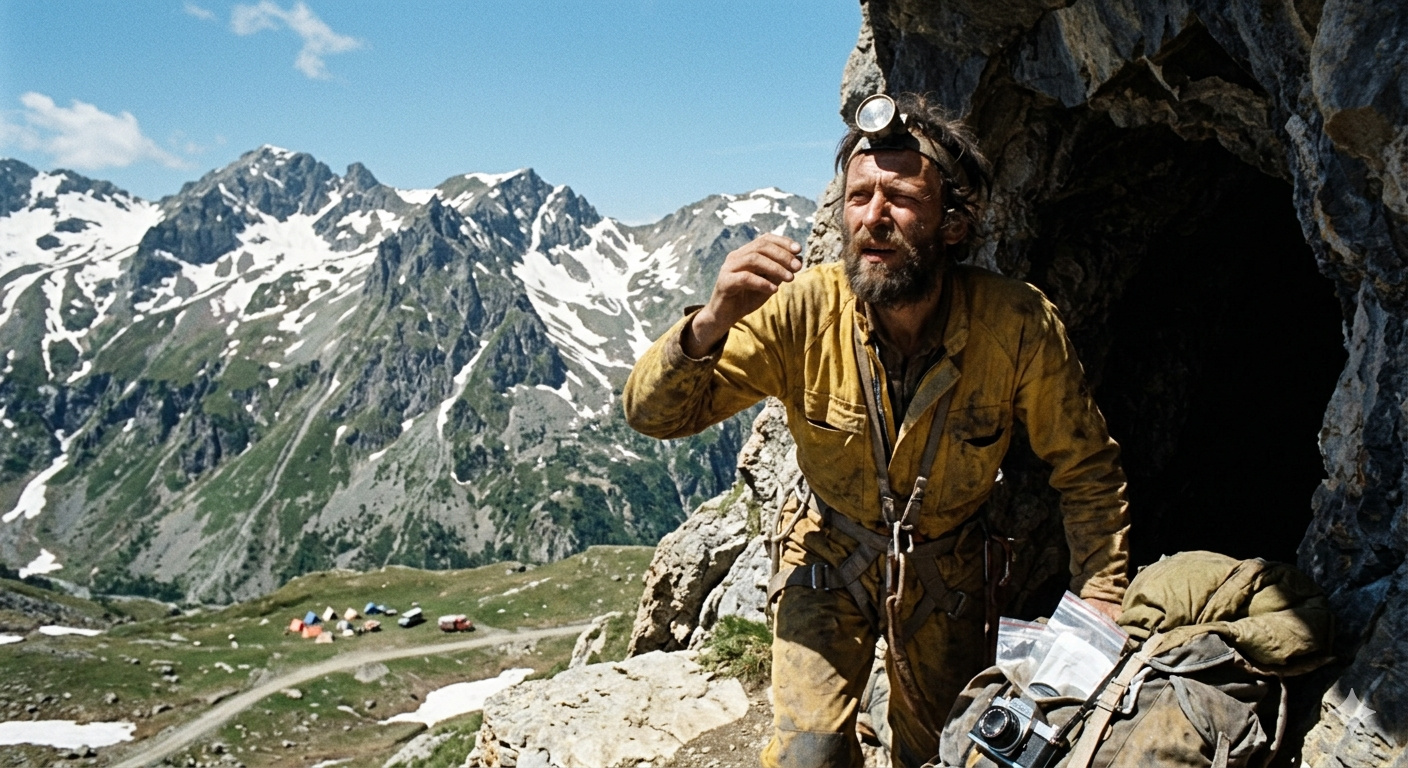

Isolated from light and clocks, Michel Siffre revealed how the body measures time on its own, following internal rhythms that challenge the artificial precision of modern life.
According to Cabinet Magazine, which published one of the most comprehensive interviews Michel Siffre gave about his experiments, the central discovery of his stays in caves was simple and disturbing: without external time anchors, the human body does not descend into chaos — it adopts its own rhythm, slightly longer than the Earth day, and begins to lose entire days of memory without realizing it. “When you are surrounded by darkness, with just a lamp, your memory does not register time. You forget. After one or two days, you don’t remember what you did one or two days before,” Siffre said. “It’s like a long continuous day.”
The idea that changed the plan
In 1961, Michel Siffre was 22 years old, had a geology degree from the Sorbonne, and a map of a newly discovered glacier in the Maritime Alps, 70 kilometers from Nice. The original plan was to spend 15 days studying the ice formation in the Scarasson Abyss, a cave system 130 meters below the surface, between France and Italy. It was a conventional geological expedition.


But it was 1962 — the year following Yuri Gagarin in space, the year of the space race at full speed — and Siffre began to think of a different question. Not about the glacier, but about himself. What would happen to a human being if removed from all external markers of time? Without sunlight to indicate when the day begins, without a clock to count the hours, without the rhythm of society to impose when to eat, work, and sleep — what would the body do?
-
Scientists Convert Food Waste into Aviation Fuel, Successfully Test 50% Blend with Conventional Kerosene to Cut Emissions and Promote Sustainable Flights

-
OnePlus N6 Smartphone to Launch in India with 8,000mAh Battery and 45W SuperVOOC Charging, Lasting Up to Three Days
-
Scientists Plan to Release Air Bubbles Underwater to Protect Antarctica’s “Doomsday Glacier” from Melting

-
Chinese R6000 Drone Combines Airplane and Helicopter Features, Carries Up to 12 People for Multiple Missions



Start of Siffre’s experiment
Siffre descended to Scarasson on July 16, 1962. On the surface was a team with strict instructions never to reveal the time — only to record, without comment, each phone call he made upon waking, before eating, and before sleeping. The phone was one-way: he called, they listened. The geologist brought all the food and water needed for two months and set up a tent next to the glacier, under a constant temperature of a few degrees above zero.
The only source of light was an electric lamp powered by a cable that descended from the surface. He then began to live like an animal, he said later — sleeping when he was sleepy, eating when he was hungry, waking up when the body decided.
What happens when time stops
The first weeks were reasonably normal. But at a certain point, something subtle began to change in the way Siffre perceived the duration of things. He started to include a simple protocol of counting aloud 120 seconds — two minutes — to measure his temporal perception with each phone call to the surface.
At first, the count reasonably coincided with the actual two minutes. Over time, it began to take five minutes to complete what he thought were 120 seconds. His subjective time was expanding, becoming slower than the time of the external world.
Without the cycles of light and darkness that normally anchor the biological clock, Siffre’s sleep-wake rhythm began to “free run” — a phenomenon that chronobiologists call free running, where the body’s internal clock follows its natural rhythm without being compressed by the solar day. The natural human rhythm, Siffre would discover, is slightly longer than 24 hours. Without correction by the Sun, the cycle progressively drifts: the person sleeps a little later each “day,” wakes up a little later, and gradually loses synchronization with the outside world without realizing it.

At the end of September, the team on the surface called to inform that the experiment had ended — that the two combined months had run out and it was time to come up. Siffre was in shock. For him, his diary indicated that he had spent only 35 days underground. He had lost 28 days. Two months had felt like just over one.
“When I came out of the cave, my colleague Robert Lépineux told me the date: it was September 14. But in my mind, it was August 20. I lost 25 days of my life,” Siffre would say years later.
The importance of the experiment for NASA
Siffre’s exit from the cave generated huge media coverage in Europe and the United States. But those who were truly interested were not the journalists: it was NASA. In 1962, the American space agency was in the early years of its institutional existence, working to send men to the Moon by the end of the decade. One of the issues that concerned space medicine engineers was exactly what Siffre had studied involuntarily: what happens to a human’s biological clock when deprived of external time markers?
Astronauts in orbit lose the natural cycle of day and night — the ISS experiences 16 “sunrises” a day, completing an orbit every 90 minutes. On missions to Mars, the temporal isolation will be even deeper. NASA funded the mathematical analysis of Siffre’s 1962 data and began to study his findings systematically.
The French Army’s interest in Siffre’s data
The French Army had an even more immediate interest: France had launched its nuclear submarine program, and commanders needed to know how to organize the sleep schedules of sailors confined for months in submarines without natural light.
If the human body has an internal rhythm that differs from the 24-hour day, this has direct implications for when to keep crew members awake, when to let them sleep, and how to prevent accidents from happening during times of lowest biological vigilance.
Siffre had unknowingly opened an entire field of research: human chronobiology — the study of how organisms perceive and structure time.
The Return: Six Months in Texas
Throughout the following decade, Siffre organized more than a dozen underground experiments with other volunteers — mainly spelunkers, who by training and temperament could endure isolation for longer periods. The results were consistent and intriguing: all the other volunteers he sent to caves developed 48-hour sleep-wake cycles — 36 hours of continuous wakefulness followed by 12 to 14 hours of sleep. Siffre, in the first experiment, had maintained something close to 25 hours.
He wanted to know what would have happened if he stayed longer. And there was something that bothered him: all the other people he had sent underground had captured the 48-hour cycle, and he had not. He wanted to prove that he could do it too. On February 14, 1972, Siffre, now 33 years old, descended for the second time — this time to Midnight Cave, near Del Rio, Texas, 134 meters below the surface. The plan was to stay for six months.
Siffre Isolates Himself Once Again
The underground chamber where he set up camp was about 30 meters long and had a high ceiling. There was a tent on a wooden platform with a bed, table, and chair, 800 gallons of water, enough frozen food for six months, and electrodes connected to his head, heart, and muscles to monitor all vital functions. And again, no clock, no calendar, no natural light.
The protocol was more rigorous than in 1962: upon waking, he would call the surface; researchers would turn on the lights controlled by them; Siffre would complete four hours of experiments — measuring blood pressure, mental and memory tests, three miles on the stationary bike, five rounds of target shooting with a pellet gun. After recording the data, he had the rest of the “day” free to read, listen to music, and work on his geological studies.
The Cost of Time Without Time
The first weeks were relatively normal. But as the months passed, Siffre plunged into something he had not anticipated: radical loneliness. Memory began to deteriorate. He could not recall what he had done one or two days before. Each “day” began to feel identical to the previous one — the only difference between them was the time he woke up and the time he went to sleep. Time became an amorphous mass, without markers, without texture, without difference between one cycle and the next.
On Day 162 of the experiment, he heard a noise in the tent and realized that a mouse had entered. He was ecstatic. It was the first living creature besides himself that he had encountered in over five months. He tried to capture and tame it.
He set a trap with jelly and an upside-down saucepan. When he captured the animal, which he named Mus, the saucepan hit it on the head as it fell. The mouse died. Siffre recorded in his diary: “Desolation consumes me.”
Isolated for 205 days, Michel Siffre faced physical and mental collapse
There were thoughts of suicide. Vision deteriorated. Short-term memory was severely compromised. The sound system broke, and the books rotted from the cave’s humidity. At one point, he tore the electrodes from his body and almost abandoned the experiment.
“Overcome by lethargy and bitterness, I sit on a stone and look at my camp in the depths of Midnight Cave,” he wrote in a passage that would be published in a scientific journal years later. “Behind me lie a hundred days of solitude; ahead loom another two and a half months of complete isolation. But I — an exotic and displaced Frenchman — know nothing of this, because I live ‘beyond time,’ divorced from calendars and clocks, from the sun and the moon.”
On September 5, 1972, after 205 days, the team reported that the experiment had ended. Siffre believed it was mid-August. He had lost almost three weeks of memory.
The end of the experiment
When he emerged, he was $100,000 in debt — he had greatly underestimated the cost of transporting the experiment from France to Texas. The marriage fell apart. Psychological recovery was partial and lengthy. He vowed never to descend into a cave again.
But he returned, briefly, in 1999 — this time to a cave in southern France, spending two months studying the effects of aging on the perception of time. He celebrated the turn of the millennium underground and lost track of the date for three and a half days. He also missed his 61st birthday.
What the cave taught the world
Siffre’s discoveries, combined with those of Nathaniel Kleitman — who had spent a month in Mammoth Cave, Kentucky, in 1938, with his student Bruce Richardson, being the first to demonstrate that humans have an internal clock — founded modern chronobiology. The human circadian clock is now studied down to the molecular level: in 2017, Jeffrey Hall, Michael Rosbash, and Michael Young won the Nobel Prize in Physiology for describing the molecular mechanisms that control circadian rhythms in cells.
The human internal clock, without external anchors, runs at approximately 24 hours and 10 minutes to 24 hours and 30 minutes — slightly longer than the solar day. Every day, morning light “resets” this clock, compressing it back to the planet’s 24-hour cycle. This is why people deprived of sunlight — whether in polar expeditions, nuclear submarines, space, or chronic night shifts — develop sleep disorders: their internal clock progressively drifts, decoupling from the outside world.
Applications of the discovery
The discovery has applications ranging from crew schedules on submarines to treatments for seasonal depression, from designing astronaut routines to protocols for night workers in refineries. In each of these contexts, the central principle is the same as what Siffre discovered at the bottom of a cold cave in the Alps: humans have their own biological clock, and this clock does not perfectly align with the 24-hour day that civilization uses.
Siffre’s question — “What is time?” — remains unanswered definitively. “We don’t know,” he told Cabinet Magazine in 2008. “All we know is that we experience it — and that the way we experience it does not correspond to reality.” Michel Siffre died of pneumonia in Nice on August 25, 2024. He was 85 years old.