






 Portuguese
  Spanish


Researchers Analyzed Beethoven’s DNA, Revisiting Secrets About His Health, Ancestry, and a Mystery That Surprised Scientists
On a stormy Monday in March 1827, Ludwig van Beethoven passed away after a long and painful illness. He had been bedridden since Christmas of the previous year, suffering from jaundice, which caused swelling in his limbs and abdomen, making every breath a struggle.
Shortly before his death, Beethoven left behind a will, written 25 years earlier, in which he requested that the details of his medical condition be made public. He wished for the world to know about the tragedy that accompanied him throughout his life — his progressive loss of hearing.
Beethoven: The Deafness That Challenged Art
Beethoven, one of the greatest musical geniuses of all time, was diagnosed with functional deafness around the age of 45.
-
ChatGPT Alerts FBI to Prevent Planned Murder of 8-Year-Old in Brazil’s Espírito Santo

-
Scientists Discover 125-Million-Year-Old “Pregnant Fossil” with Preserved Embryos and Microscopic Larvae Inside Mollusk in England

-
17-Year-Old Justin Bernstein Develops Bacteria to Produce Glass on Arctic Ice to Reflect Sunlight, Wins $50,000 U.S. Scholarship

-
The 19-Meter Rocket-Helicopter: A Private Industry Prototype That Challenged Space Race Logic



What initially began as tinnitus later evolved into severe hearing loss, which made his career as a performer impossible.
The irony did not go unnoticed, and in a letter to his brothers, Beethoven admitted he was “irremediably distressed.” Although he remained vibrant nearly two decades after the onset of his deafness, the reasons behind this condition remained a mystery to this day.
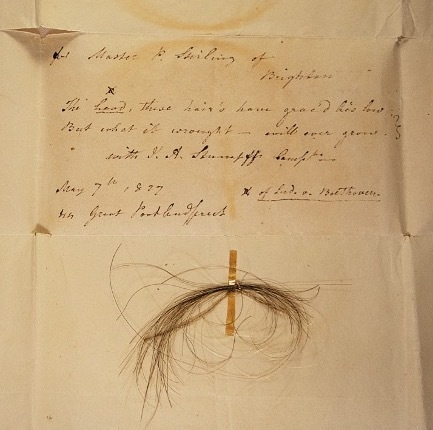
Current Biology, 2023)
The Scientific Revolution That Uncovered His Secrets
In 2023, a revolutionary study rescued a part of Beethoven’s legacy. Researchers analyzed authenticated hair samples from the composer, aiming to better understand his health conditions.
Biochemist Johannes Krause, from the Max Planck Institute for Evolutionary Anthropology, led a research project and stated that the main objective was to shed light on Beethoven’s hearing loss and other illnesses he suffered during his life, such as gastrointestinal and liver problems.
The exact cause of Beethoven’s deafness has never been identified, but now, with advancements in science, researchers have revealed that the hearing loss may be related to multiple factors, including previously unknown genetic conditions.
The investigation also revealed a new cause of the composer’s death. During research, scientists discovered that Beethoven likely died from a hepatitis B infection, which was exacerbated by his excessive alcohol consumption and other risk factors, such as medical treatments of the time that utilized lead.
The lead poisoning theory, proposed in 2007, was refuted, showing that Beethoven’s death had a more complex cause that is still not completely understood.
Genetics, Mysteries, and Family Secrets
The questions, however, are not limited to the composer’s health. The study also revealed fascinating details about Beethoven’s genetic history.
By comparing hair samples with DNA from his relatives, researchers found an incompatibility in the Y chromosome, indicating that there was an extramarital paternity event in his paternal line, something Beethoven never discovered. This fact adds another mystery to the life of one of the most enigmatic composers in history.
Beethoven’s request, made in an old will, seemed simple but brought to light complex issues regarding his health and personal life.
In the end, the investigations revealed more than he imagined. As he well knew, the mysteries of his life would still be unraveled long after his death, and now, two centuries later, the answers continue to emerge.


“… os pesquisadores revelaram que a perda auditiva pode estar relacionada a múltiplos fatores, incluindo condições genéticas ainda desconhecidas”. Escreveu muito, não explicou nada. Para que serviu afinal, a tal pesquisa?
Amo Beethoven, para mim ele foi e sempre será extraordinário
A matéria não revela **** nenhuma. Grande perda de tempo.