






 Portuguese
  Spanish
  4 min of reading
  0 comments


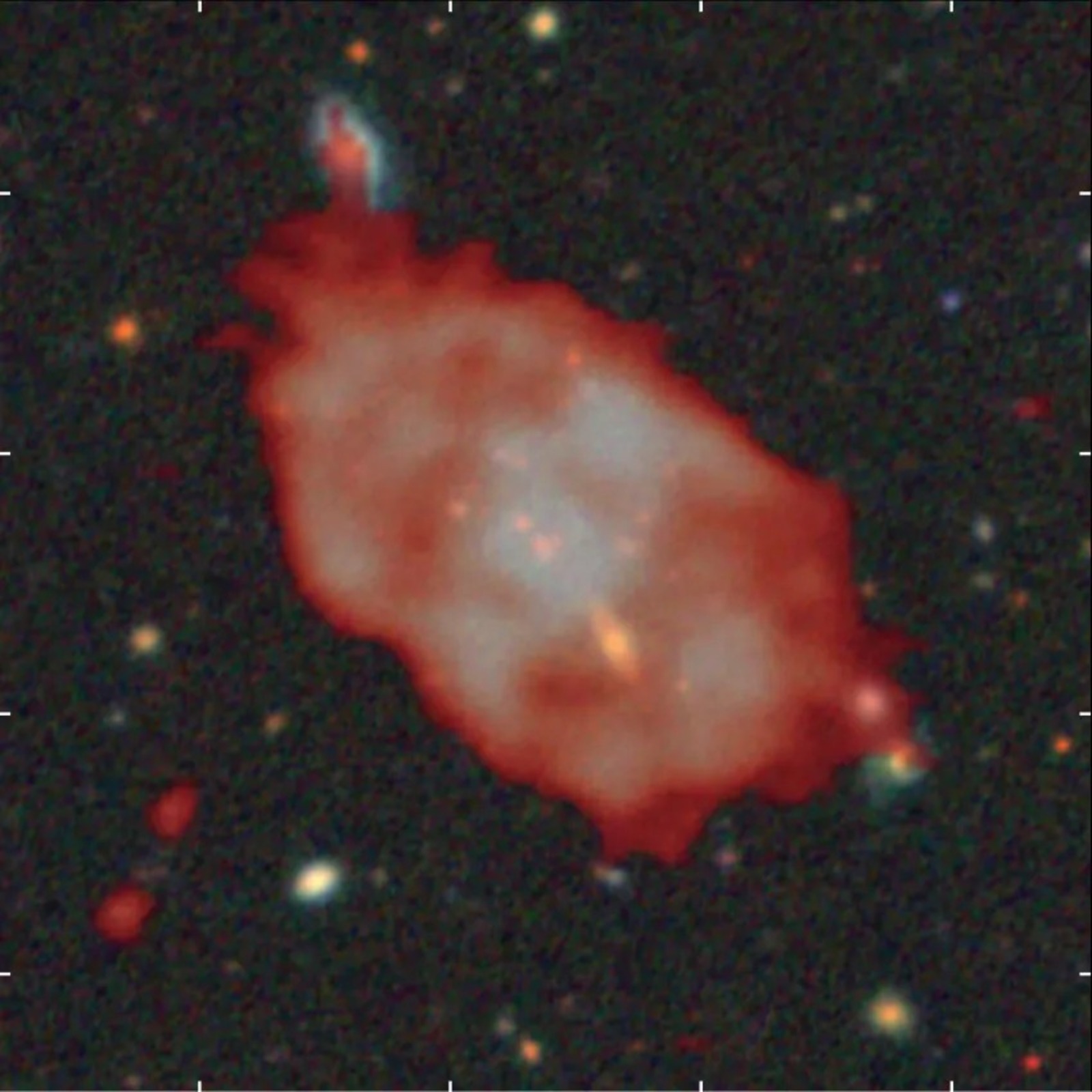
Citizen Scientists Identify Three New ORCs in Distant Clusters, Elevating Global Records, Detailing Giant Invisible Radio Structures at Other Frequencies and Reinforcing Links Between Extreme Black Hole Jets
Citizen scientists identified three new strange radio circles, known as ORCs, in distant galaxy clusters, expanding the number of these rare objects and offering new clues about their formation and cosmic significance.
The ORCs were first identified in 2019 by Anna Kapinska from the National Radio Astronomy Observatory while analyzing data from the Australian Square Kilometre Array Pathfinder, known as ASKAP.
These colossal structures can reach sizes up to 50 times larger than the Milky Way, which is about 100,000 light-years in diameter, revealing uncommon scales even by astronomical standards.
-
Helicopter Drops 180 Tons of Sand and Gravel on Swedish River to Revive Ecosystem Damaged by Decades of Exploitation

-
Brazilian Company Launches Retro Smartphone with 48 MP Camera, T9 Keyboard, and Privacy Features for Social Media-Free Use

-
Self-Taught Chinese Farmer Builds 5-Ton Submarine from Scrap, Launches It in Anhui River
-
Invisible Induction Technology Enables Wireless Power for Blenders, Coffee Makers, and Air Fryers, Reducing Countertop Cables





Despite their extreme size, ORCs remain invisible in optical, infrared, and X-ray wavelengths, being detectable only through observations made with sensitive radio telescopes.
For Ananda Hota from the University of Mumbai, who led the research, these structures are among the most enigmatic ever observed, potentially revealing crucial information about the co-evolution of galaxies and black holes.
So far, only eight ORCs had been confirmed across the observable universe, a number that makes each new detection particularly relevant for the advancement of astronomical knowledge.

Citizen Science Expands the Reach of Cosmic Discoveries
The three new identifications were made possible thanks to the efforts of citizen scientists who analyzed data at the RAD@home Astronomy Collaboratory, the first citizen science platform in India, conceived by Hota.
Participants examined large volumes of radio information and flagged unusual patterns, allowing professional researchers to conduct more detailed analyses of the suspected structures.
After this initial screening, the radio signals were confirmed by LOFAR, a low-frequency antenna array distributed across Western Europe and centered in the Netherlands.
This collaborative process demonstrated that human analysis still plays a crucial role in identifying complex patterns, even in a landscape dominated by automated algorithms.
According to Pratik Dabhade from the National Centre for Nuclear Research in Warsaw, citizen participation reinforces the ongoing importance of human perception in modern astronomy.

Twin ORCs Reveal Extreme and Distant System
One of the newly discovered ORCs consists of two giant expanding rings, each with a diameter of 978,000 light-years, surrounded by even more extensive diffuse emission.
This radio fog reaches 2.6 million light-years in diameter and is connected to a giant radio galaxy cataloged as RAD J131346.9+500320.
Located about 7 billion light-years away, with a redshift of 0.94, this is the most distant and powerful ORC system ever identified.
This is only the second time that twin ORCs have been observed, indicating exceptional energetic events in the history of this distant and massive galaxy.
The team led by Hota suspects that the rings are relics of a previous explosion, currently re-energized by a superwind associated with an active black hole.
Structures Linked to Black Hole Jets
Two other large ring-shaped structures have been found in closer giant radio galaxies, both located about 1.3 billion light-years away.
In these cases, the ORCs appear to be directly associated with radio jets emanating from the galactic nuclei, where supermassive active black holes reside.
These jets are beams of charged particles that, when interacting with magnetic fields, produce radio emission through synchrotron radiation.
In one of the galaxies, cataloged as RAD J122622.6+640622, the diffuse emission extends about 3 million light-years, forming a colossal structure.
One of the jets in this galaxy curves sideways and returns toward the core, ending in a radio emission ring with a diameter of 100,000 light-years.
In the other giant radio galaxy, RAD J142004.0+621715, with a total emission of 1.4 million light-years, a similar jet also culminates in a large ring.

Cluster Environment Shapes the Radio Rings
The three galaxies share the fact that they are embedded in massive galaxy clusters, filled with a dense fog of hot plasma known as the intracluster medium.
Especially in the two closer systems, the radio jets appear to interact intensely with this medium, directly influencing the shape of the jets and the rings.
This interaction suggests that ORCs do not arise in isolation but result from dynamic processes between black holes, energetic jets, and dense galactic environments.
For Dabhade, these structures are part of a broader family of exotic plasma formations, shaped by winds, jets, and extreme environmental conditions.
Future Prospects for New Discoveries
The results reinforce the value of citizen science in a period where artificial intelligence takes on an increasing role in analyzing large volumes of astronomical data.
Even so, human recognition of patterns remains crucial for revealing rare phenomena, as demonstrated by the recent new detections of ORCs.
Looking ahead, many more ORCs are expected to be identified by the Square Kilometre Array, a vast network of radio telescopes in South Africa and Australia.
With operations anticipated to begin in the early 2030s, the project is expected to significantly expand the catalog of these structures, deepening the understanding of their origin and evolution.
The detailed results of these discoveries were published on October 2 in the Monthly Notices of the Royal Astronomical Society, marking another advancement in the exploration of the universe invisible to the human eye.
With information from Space.com.




-

-

-

-

-

28 people reacted to this.