





 Portuguese
  English
  Spanish
  4 min of reading
  0 comments



The Smallest Quantum Computer in the World Has Been Created and Works at Room Temperature, Being Compact Enough to Fit on Your Desk. Discover How This Innovation Can Transform the Technology and Computing Market!
Researchers have achieved an impressive milestone in the development of quantum computing: they have built the smallest quantum computer in the world, which can operate at room temperature and is the size of a desktop PC.
This advancement represents an important leap in the accessibility and usability of these machines, which were previously known to require extreme conditions, such as cooling close to absolute zero.
How the Quantum Computer Works at Room Temperature
This new device is powered by a single photon, or light particle, which acts as the qubit — the fundamental unit of information in quantum computing. Traditionally, most quantum computers use superconducting qubits, which only function when cooled to incredibly low temperatures.
-
800-year-old skeletons found embracing have their impressive story revealed after DNA results

-
Christmas trees thrown away become a natural barrier in Alabama, where teams repurpose thousands of pines on the beaches of Gulf Shores to trap sand, rebuild dunes, and protect houses against storms and hurricanes for almost four decades.

-
Cane fences become a natural wall in Catalonia, where researchers and residents use sand traps on the beaches to capture sediments, rebuild dunes, and protect cities after Sant Pere Pescador lost 50 meters of coastline in 50 years.
-
Archaeologists open a 2,300-year-old tomb near the Great Wall of Qin and find a bronze bottle with preserved ancient beer.





However, the machine created by these scientists can perform complex calculations without the need for heavy equipment and cooling systems.
The Concept Behind the Technology
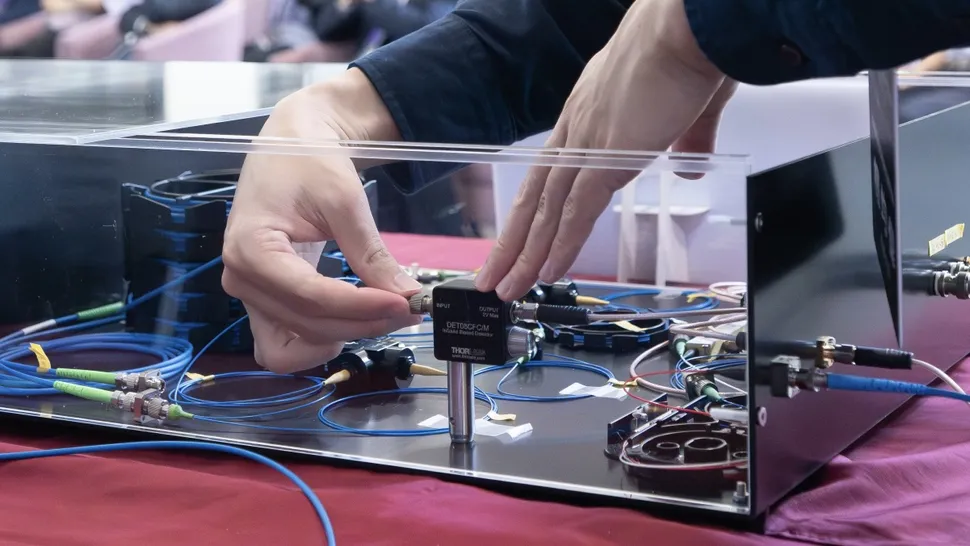
The key to the operation of this quantum computer lies in a ring-shaped optical fiber, where the photon is stored and manipulated.
According to the study published in the journal Physical Review Applied on September 3, the device can perform operations such as factorization of prime numbers, demonstrating its ability to process information efficiently and accurately.
Unlike previous models that relied on superconducting qubits, this new approach utilizes optical quantum computing, a technique that has long been suggested as a promising alternative.
In a previous study in February, researchers proposed that qubits based on laser pulses could enable the development of quantum computers stable at room temperature, and now this has been proven in practice.
Advancements and Challenges
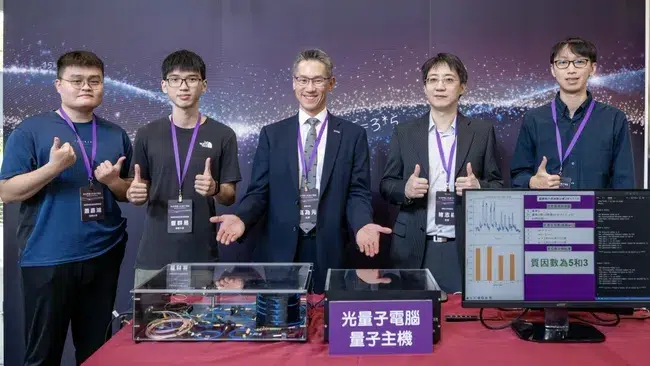
The team led by quantum optics professor Chuu Chih-sung from Tsing Hua University in Taiwan achieved a remarkable feat by storing information in 32 time intervals or dimensions within the waveform of a single photon.
This sets a new world record for the number of computing dimensions accessible by a single qubit. This innovation could revolutionize not only computing but also other fields, such as quantum communication.
However, the challenges have not been completely overcome. Optical quantum computers that use photons face limitations, mainly concerning the difficulty of capturing large numbers of photons, as they appear probabilistically, meaning they can “disappear” at a crucial moment during the calculation process.
The Efficiency of the New Model
The great advantage of this quantum computer over traditional systems is its energy efficiency and operational simplicity.
While machines that use trapped ion qubits, for example, rely on complex lasers to maintain the stability of their quantum states, the new photon device can operate with less energy and without the need for constant precise adjustments.
The metaphor used by Professor Chuu to explain the advancement is quite illustrative: he compares the previous technology to a bicycle that transports one person, while the new device would be a train with 32 cars, capable of carrying a large amount of information efficiently.
Future Prospects
The next steps in research involve further improving the storage and processing capabilities of the quantum computer. The objective is for the machine to handle even more complex calculations, which could expand its applications in areas such as data security, artificial intelligence, and communications.
Furthermore, by using photons as qubits, the device can be easily integrated into quantum communication networks, where light is used to transmit information securely and virtually instantaneously. This opens up a range of opportunities for developing technologies that combine quantum computing with light-based systems.
In summary, the smallest quantum computer in the world not only marks a significant advancement in computing but also signals a future where these technologies will be accessible to more people and can be used more practically and efficiently in everyday life.





-

1 person reacted to this.