






 Portuguese
  Spanish


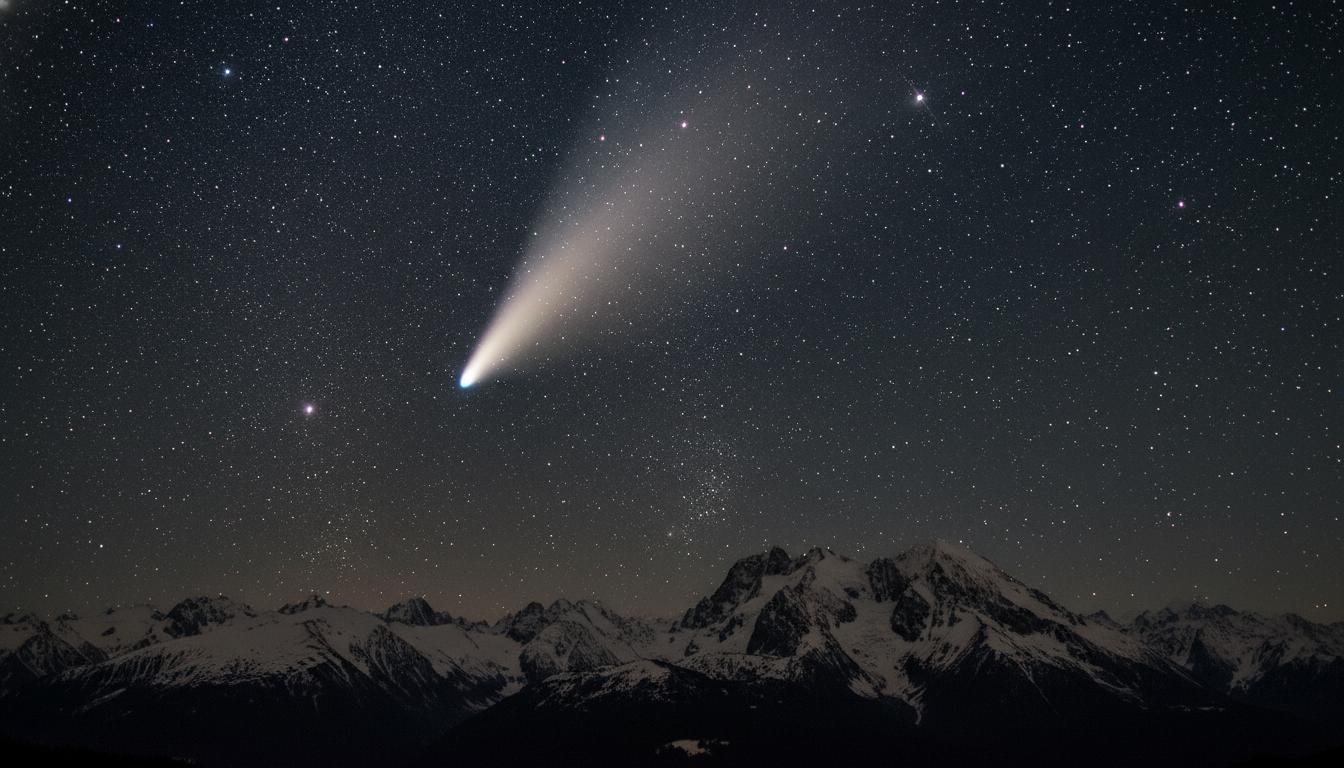

Discovered by a telescope in Hawaii, comet C/2025 R3 PanSTARRS had not passed by Earth for 170,000 years — when our ancestors still lived in caves — and is now visible in the April 2026 sky
The last time this comet crossed Earth’s sky, Homo sapiens had not yet left Africa. Comet C/2025 R3 PanSTARRS has an estimated orbital period of 170,000 years, and is now back — visible in the April 2026 sky.
According to data from the National Observatory (gov.br), the comet will be visible in Brazil starting April 18. Its estimated brightness could reach magnitude 2.5 — comparable to the faintest star of the Three Kings (Orion’s Belt).
The PanSTARRS telescope in Hawaii detected the comet on September 8, 2025. Since March 20, 2026, it can already be observed with common binoculars.
-
He lost R$ 340,000 in bets, R$ 75,000 in a single day, and escaped the “mental prison” in the most radical way possible: Thiago Moita, 35, enlisted in the Ukraine war to overcome his gambling addiction.

-
The industrial waste that even recyclers didn’t want has gained value in the interior of Bahia: two entrepreneurs invested R$ 2.8 million to transform 350 tons per year of foam, rubber, and plastic into boards that can replace wood and MDF.

-
Erected in just 30 minutes over the water that had already engulfed the courtyard, a motorized floating bridge from China evacuated more than 6,000 students trapped inside a school surrounded by the flood in the south of the country, after Typhoon Maysak turned the region into a flooded area.
-
Employee buys a ticket that a customer left behind, discovers a million-dollar prize, tries to claim the fortune, is fired after 20 years, and ends up in a legal dispute with the company.





However, what makes this event special is the possibility that it may be unrepeatable. With a hyperbolic orbit, the comet may never return to Earth’s vicinity.

Perihelion on April 19: when the comet passes closest to the Sun and can shine like a planet
The closest point to the Sun — called perihelion — occurs on April 19, 2026, when the comet will be 0.499 AU (astronomical units) from the star, about 75 million kilometers.
It is at this moment that its brightness peaks. Estimates range from magnitude 3 to 4 (visible to the naked eye under dark skies) up to magnitude -1 (brighter than any star) if there is favorable forward scattering.
The new moon on April 17 favors observations, eliminating natural light pollution from moonlight.
- Discovery: September 8, 2025 (PanSTARRS, Hawaii)
- Visible with binoculars: since March 20, 2026
- Perihelion: April 19, 2026 (0.499 AU from the Sun)
- New moon: April 17 (dark skies)
- Visible in Brazil: from April 18
- Estimated magnitude: 2.5 to 4 (naked eye) — potential -1 with scattering
- Orbital period: ~170,000 years

How to observe the comet in Brazil: times, direction, and what to expect
In the Northern Hemisphere, the comet is most visible until April 25, in the eastern morning sky. Afterwards, it gets too close to the Sun on the horizon.
For Brazil and the Southern Hemisphere, the best window begins after April 25 and extends into May, in the evening sky. The National Observatory described it as a “beautiful weekend program” for Brazilians.
On April 15 and 16, the comet appeared in conjunction with the Moon, Mercury, Mars, and Saturn — a rare photographic event that brought together five celestial objects in the same visual field.
The comet is currently in the constellation Pegasus, below the Great Square. After perihelion, it migrates to Pisces.
In 2026, other astronomical events also draw attention. NASA revealed 10 unmissable phenomena of the year, including a total eclipse and supermoons.
From the Oort Cloud to history: why this comet may never return
C/2025 R3 PanSTARRS is a hyperbolic comet originating from the Oort Cloud — a frigid region at the edge of the Solar System, far beyond Neptune.
Its orbit suggests that it is not a regular visitor. With an estimated period of 170,000 years, it is possible that humanity will never see it again.
Comets from the Oort Cloud are unpredictable by nature. Some disintegrate when passing close to the Sun. Others are ejected into interstellar space by the gravity of giant planets.
Other comets like the Devil Comet, which passed by the Sun in 2024 with gas horns, show that each passage is unique and can reveal surprises.

Caveats: the comet may not survive perihelion and urban skies hinder visibility
On the other hand, comets are notoriously unpredictable. There is no guarantee that C/2025 R3 will survive the perihelion on April 19. Oort Cloud comets can fragment near the Sun.
Furthermore, the comet is described as “dust-poor,” which may limit forward scattering — precisely the phenomenon that could elevate it to magnitude -1.
In cities with light pollution, naked-eye visibility is not guaranteed. 10×50 binoculars are recommended even in the best scenarios.
Brightness predictions vary significantly among experts — from magnitude 2.5 to 4 at the base, with potential for -1 in the best case. Only perihelion will tell.
Still, the opportunity is real and unique. If the comet shines according to the most optimistic predictions, April 2026 will be remembered as the month when a 170,000-year visitor illuminated Earth’s sky — possibly for the last time.


