Portuguese
  Spanish



Green hydrogen is the future of the renewable energy market, and with that in mind, scientists are seeking new methods to produce fuel from renewable sources, such as solar energy.
Scientists, environmentalists, and engineers have been working for decades to develop a device that can be powered by solar energy, collecting water through the humidity in the surrounding air and providing green hydrogen, the clean fuel that is generating a lot of expectation in the market. Currently, two simultaneous advances in the sector show that this dream is not far from being achieved, and both are technologically advanced, having been discovered at the end of last year.
Swiss Researchers Develop New Method to Produce Green Hydrogen
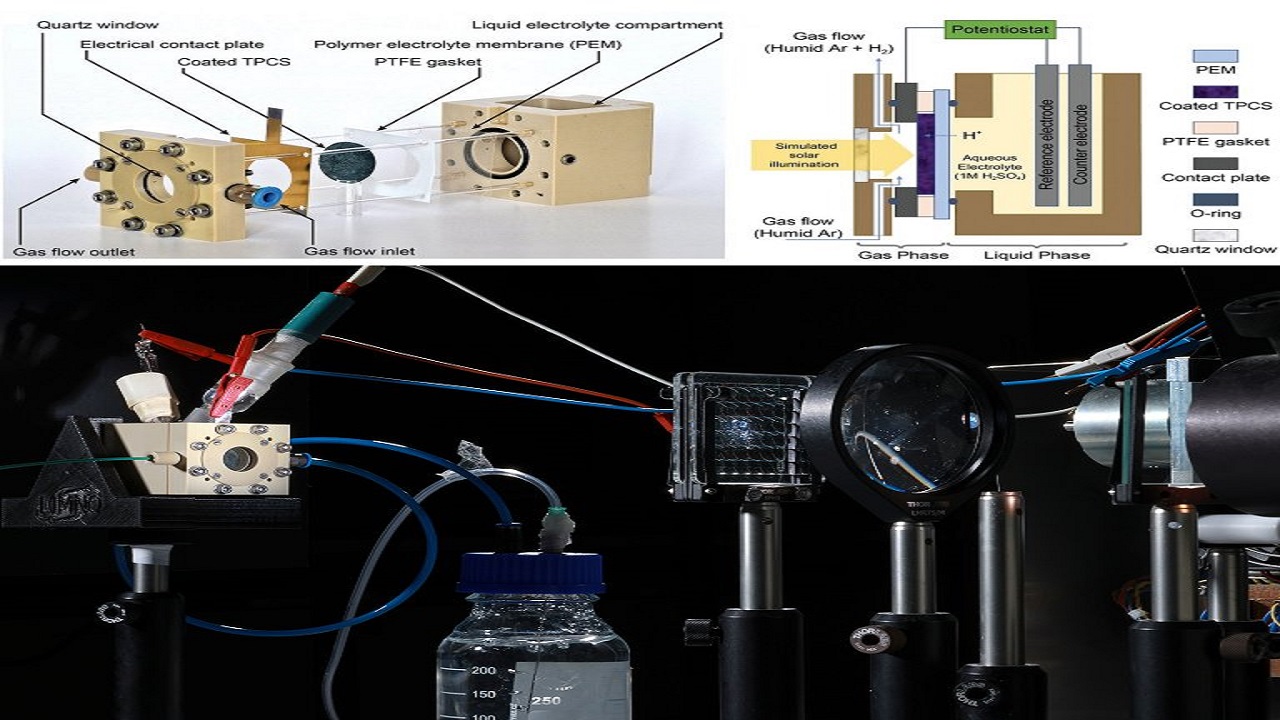
Marina Caretti and other scientists from the Swiss Federal Institute of Technology in Lausanne created an ingenious yet simple system that combines semiconductor technology used in solar cells and electronics with new electrodes to break water molecules into hydrogen and oxygen.
The main focus is not exactly on these electrodes, which have two main characteristics: their porosity, ideal for maximizing contact with water in the air, and their transparency, to maximize exposure to light from the semiconductor coating. The system uses solar energy to break the water molecules present in the normal humidity of the air, generating clean hydrogen.
-
In September 2035, Mars to Shine Brightest Since 2003, Aligning with NASA and China’s Planned Human Mission to the Red Planet

-
Robots Descend Four Kilometers to Operate in the World’s Deepest Mine, Unbearable for Humans

-
Brazilian Students Develop Membrane to Clean Contaminated Water for Just $0.01 Per Use, Removing Oil, Dye, Turbidity, and Microorganisms, Reusable 20 Times, Offering Affordable Treatment to Communities Without Potable Water
-
Brazilian Students Turn Manganese Mining Waste into Functional Battery, Present at Major Science Fair




In this way, the innovation can fit into the category of artificial photosynthesis, considering that it acts similarly to how plants transform solar energy into chemical energy, using CO2 from the atmosphere. The gas diffusion transparent electrodes, coated with light-harvesting semiconductor material, function like an artificial leaf, collecting water from the air and using solar energy to produce green hydrogen.
Although the team has not measured the efficiency of the method, they acknowledge that it is simple for this prototype. However, based on the materials used, the theoretical maximum efficiency of converting solar energy into hydrogen is 12%. The same team of scientists has already achieved an efficiency of 14.2% in solar hydrogen production using high-cost materials.
USA Also Generates Innovation in Green Hydrogen Production
The second innovation came from Peng Zhou and other scientists at the University of Michigan in the USA, who developed a type of solar panel that achieved 9% efficiency in converting water into hydrogen and oxygen, also similar to photosynthesis. Operating outdoors and lacking controlled laboratory conditions, the prototype represents an advancement in technology, being nearly 10 times more efficient than solar experiments of this type.
Peng Zhou states that, in his experiment, the size of the semiconductor was reduced by more than 100 times compared to some semiconductors that only operate under low light intensity, highlighting that this reduction allows solar light to be concentrated through lenses up to 160 times greater than the normal brightness of the Sun without damaging the semiconductors, significantly enhancing the operational efficiency of the cell, despite imposing other engineering restrictions for practical use.
Company Develops Solar Panel That Generates Hydrogen for Residential Use
The company KU Leuven is developing solar panels that can generate green hydrogen from atmospheric water. The researchers at the company have been developing this technology for over ten years, with the final prototype incorporated into an attractive design by Comate Engineering & Design.
These new solar panels are, moreover, identical to conventional solar panels, but instead of being connected by an electric cable, they are connected by gas pipes.
The upper layer of the panel generates energy, beneath it is a system of tubes that generate hydrogen from extracting water molecules present in the air.