






 Portuguese
  Spanish



Scientists Intrigued: NASA Captures An Array of Unusual Disturbances in the Antarctic Sky, Raising New Hypotheses About Climatic and Spatial Phenomena
The atmosphere above the Antarctica is facing a highly unstable winter in 2024. About 30 kilometers above the frozen surface, in the stratosphere, a series of unexpected warming events caught the attention of scientists, starting in July 2024.
Unexpected Temperature Increase
Normally, temperatures in the stratosphere over Antarctica during the month of July hover around -80°C (-112°F). However, on July 7, there was a drastic rise in temperatures, increasing by 15°C (27°F), reaching a historical record for the month of July in the region. Subsequently, there was a cooling on July 22, followed by a new increase of 17°C (31°F) on August 5.
These sudden temperature spikes surprised scientists Lawrence Coy and Paul Newman from the Goddard Space Flight Center of the NASA. Both are responsible for developing atmospheric models for the Global Modeling and Assimilation Office (GMAO) of NASA. Coy emphasized that the warming observed in July was the first recorded in 44 years of monitoring the Antarctic stratosphere.
-
3-Billion-Year-Old Crater May Be Earth’s Oldest Known, with Tiny Minerals Helping Scientists Solve a Billion-Year Mystery

-
Giant Asteroid Impact Crater in Australia Suggests Possible “Gold Rain” 790,000 Years Ago

-
Construction Begins on First U.S. Modular Nuclear Reactor, Smaller Than a Sports Court
-
Dutch Innovator Develops Dual Battery and Electrolyzer Machine for Solar and Wind Energy Storage, Raises €30 Million Following 1 MW Pilot


Impact on the Polar Vortex
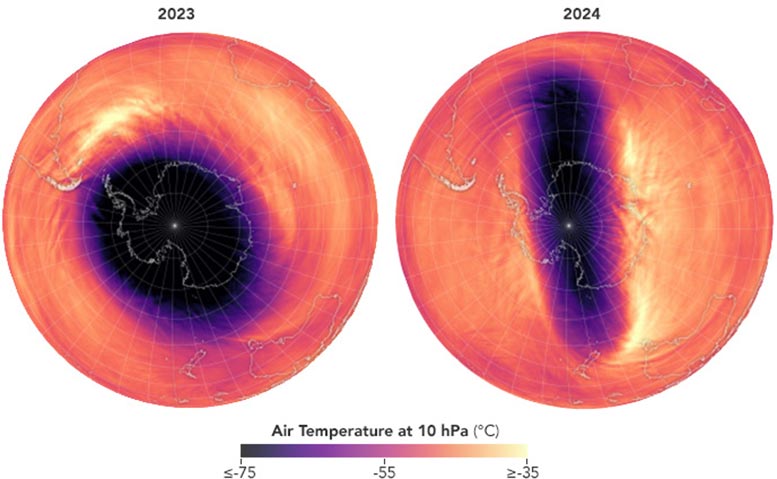
During winter, westerly winds circulate around the South Pole in the stratosphere, moving at about 300 km/h, creating the phenomenon known as the polar vortex. However, at times, this symmetrical flow is interrupted, resulting in weakened winds and changes in the shape of the vortex.
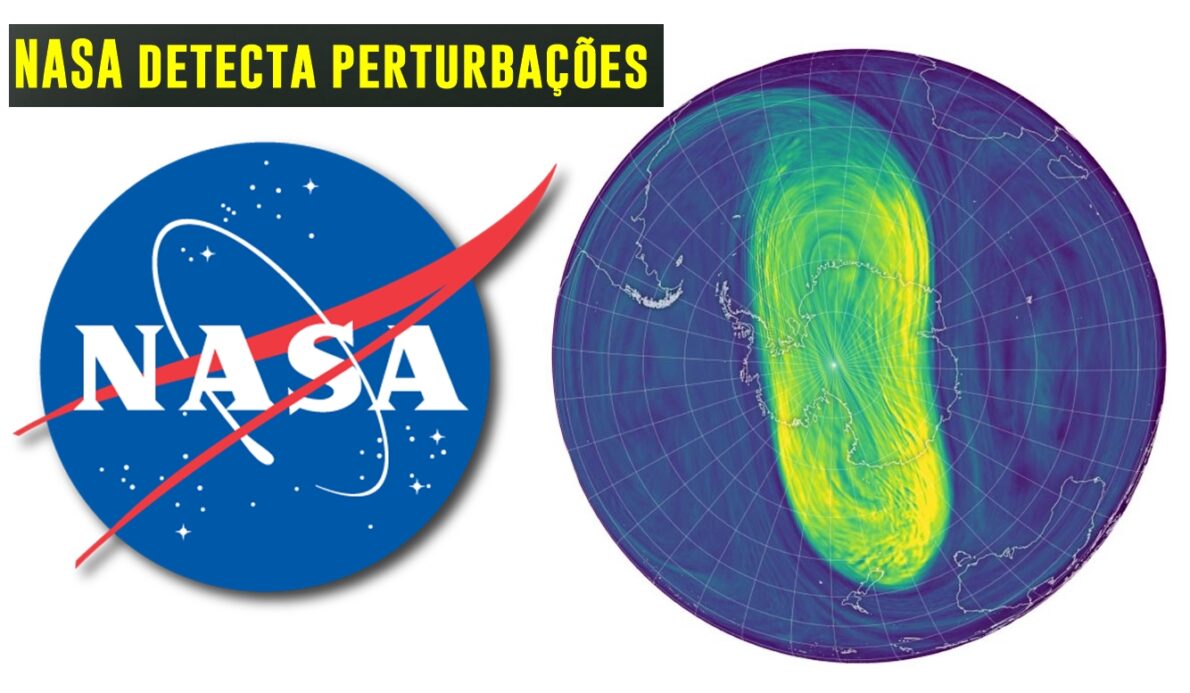
When this occurs, the polar vortex stops circulating uniformly and elongates, contributing to a significant increase in temperature in the stratosphere. In August 2024, the weakening of the vortex was evident, as shown in maps generated by NASA’s GEOS-FP model. This model utilizes data from satellites and ground observation systems for the analyses.
Comparison with the Northern Hemisphere
Unlike the Arctic, where stratospheric warming events occur approximately once a year, in the Southern Hemisphere, these phenomena are much rarer, occurring on average every five years. Coy explains that the difference is partly due to the presence of more land in the Northern Hemisphere, which ends up interfering with the tropospheric wind flows that reach the stratosphere, causing disturbances in the polar vortex.
In addition to the conditions in the stratosphere, the weather in the Antarctic troposphere also exhibited unusual behaviors in July 2024. Large parts of the continent recorded temperatures 4°C (7.2°F) above average, making July 2024 one of the five hottest July’s ever recorded in Antarctica. Despite the climatic anomalies, Newman warns that it is not straightforward to attribute these events in the troposphere to the warming in the stratosphere.
Implications for Climate and the Ozone Layer
Scientists are still investigating the causes of surface disturbances that result in changes in the stratosphere. Newman suggests that variations in sea surface temperature and sea ice may be contributing to these events, but it is difficult to precisely determine the reasons behind the development of these climatic systems.
Within the stratosphere, sudden warming events have been linked to higher concentrations of ozone over Antarctica. The ozone layer plays a crucial role in absorbing harmful ultraviolet radiation, protecting life on Earth.
With the circulation change caused by the warming events, there is a transport of ozone from other regions to the South Pole. So far, in 2024, the ozone hole in the Southern Hemisphere has been smaller than usual.
Scientists will continue to monitor these phenomena and investigate their causes, seeking to better understand how these disturbances may impact global climate and ozone concentrations, which are essential for the health of the planet.


