






 Portuguese
  Spanish
  3 min of reading
  1 comment


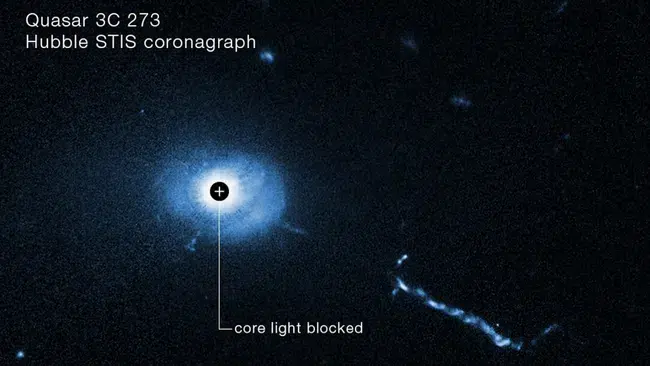


The Hubble Telescope Revealed Impressive Images of a Supermassive Black Hole, Showing L-Shaped Structures and Mysterious Phenomena That Intrigue Scientists.
The Hubble Space Telescope, even after 35 years of operation, continues to surprise scientists and unveil secrets of the cosmos. In a recent discovery, researchers used the telescope to observe the quasar 3C 273, located 2.5 billion light-years away.
The study brought new information about the functioning of these bright objects and revealed enigmatic structures in their proximity.
“We detected bubbles of various sizes and a strange L-shaped structure about 16,000 light-years from the black hole at the center of the quasar“, stated Bin Ren, an astronomer at the Côte d’Azur Observatory and the Côte d’Azur University, in a NASA statement.
-
Engineers in Brazil deploy a robot dog to enter pipelines of a R$ 134.7 million project, facing mud, sand, humidity, and toxic gases, and send data in real-time without exposing workers.

-
Brazilian family creates machine that transforms seawater into fresh water, produces up to 130 liters per hour, facilitates routine on vessels, and boosts family business along the country’s coast.
-
A doctor from Minas Gerais warns that sleeping with the fan pointed at the body all night is not as harmless as you think; it dries out the respiratory tract, causes mucus buildup, spreads dust mites, and can even irritate the cornea of the eyes.

-
Ecuadorian volcano at 6,268 meters is more than 2,000 meters closer to space than Everest, which is 8,848 meters, because the Earth is wider at the equator.




These discoveries reinforce the mysterious nature that still surrounds quasars and their environments.
What Are Quasars?
Quasars, or “quasi-stellar radio sources“, are extremely bright objects that emit radio waves and are powered by supermassive black holes. Although they were discovered in the 1950s, much about them is still unknown, especially regarding the regions surrounding them.
Due to their intense brightness, exploring these environments is a challenge, but Hubble has proven to be up to the task.
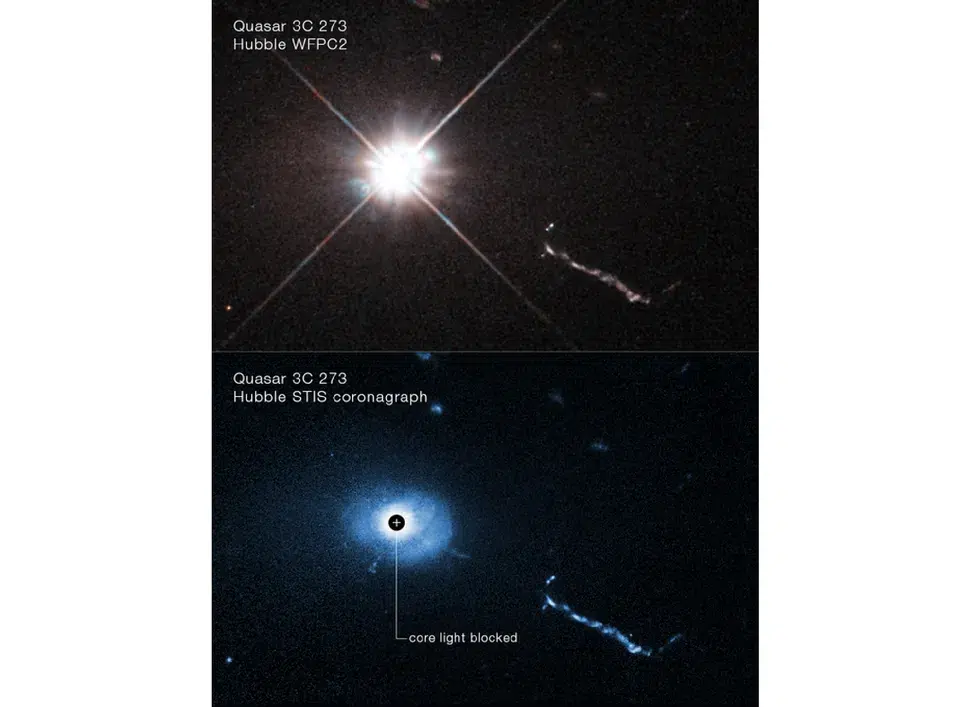
The key to this observation was the STIS (Space Telescope Imaging Spectrograph) tool, which was able to block the intense light from the quasar, similar to how the Moon obscures the Sun during an eclipse.
This blocking allowed scientists to focus on the structures around the quasar 3C 273, the first quasar officially identified in 1963.
With thousands of times more brightness than the average galaxy, it is powered by a massive black hole that consumes the remnants of smaller galaxies around it.
Intriguing Discoveries
The images captured by Hubble show a jet of material an impressive 300,000 light-years long being ejected by the quasar.
Scientists compared this data with images taken by the telescope 22 years ago and noted that the jet appears to move faster the further it is from the central black hole.
This observation suggests that the black hole plays an active role in driving the brightness of the quasar while consuming the remnants of neighboring galaxies.
The mysterious L-shaped structures, as well as the detected bubbles, may be part of these galactic remains, but this remains only a hypothesis. “Hubble has allowed us to fill a gap between small-scale observations made by radio interferometry and large-scale optical images. This helps us better understand the morphology of the quasar’s host“, explained Ren.
The Future of Research
Although the new images provide important clues, many questions remain.
To address the raised doubts, scientists plan to use the James Webb Space Telescope, capable of observing in the infrared spectrum.
This technology promises to further detail the composition and interactions of 3C 273 with its surrounding environment.
The combination of Hubble and Webb is seen as crucial for advancing the understanding of quasars, one of the most fascinating phenomena in the universe.
Studies like this not only reveal details about black holes and their structures but also help decode the puzzle of galactic evolution.
With increasingly sophisticated technologies, the future promises significant advances in exploring the cosmos. For now, scientists remain intrigued by the “strange things” observed near 3C 273 — a reminder that the universe still holds many secrets waiting to be unveiled.


O Lula tem pressa e quer se perpetuar no poder. Por isso está nos dando de bandeija aos chineses. Perderemos tudo o que temos inclusive a liberdade, viraremos escravos monitorados 24 hs por dia, viveremos de ração sem direitos mas com obrigações.