Portuguese
  Spanish


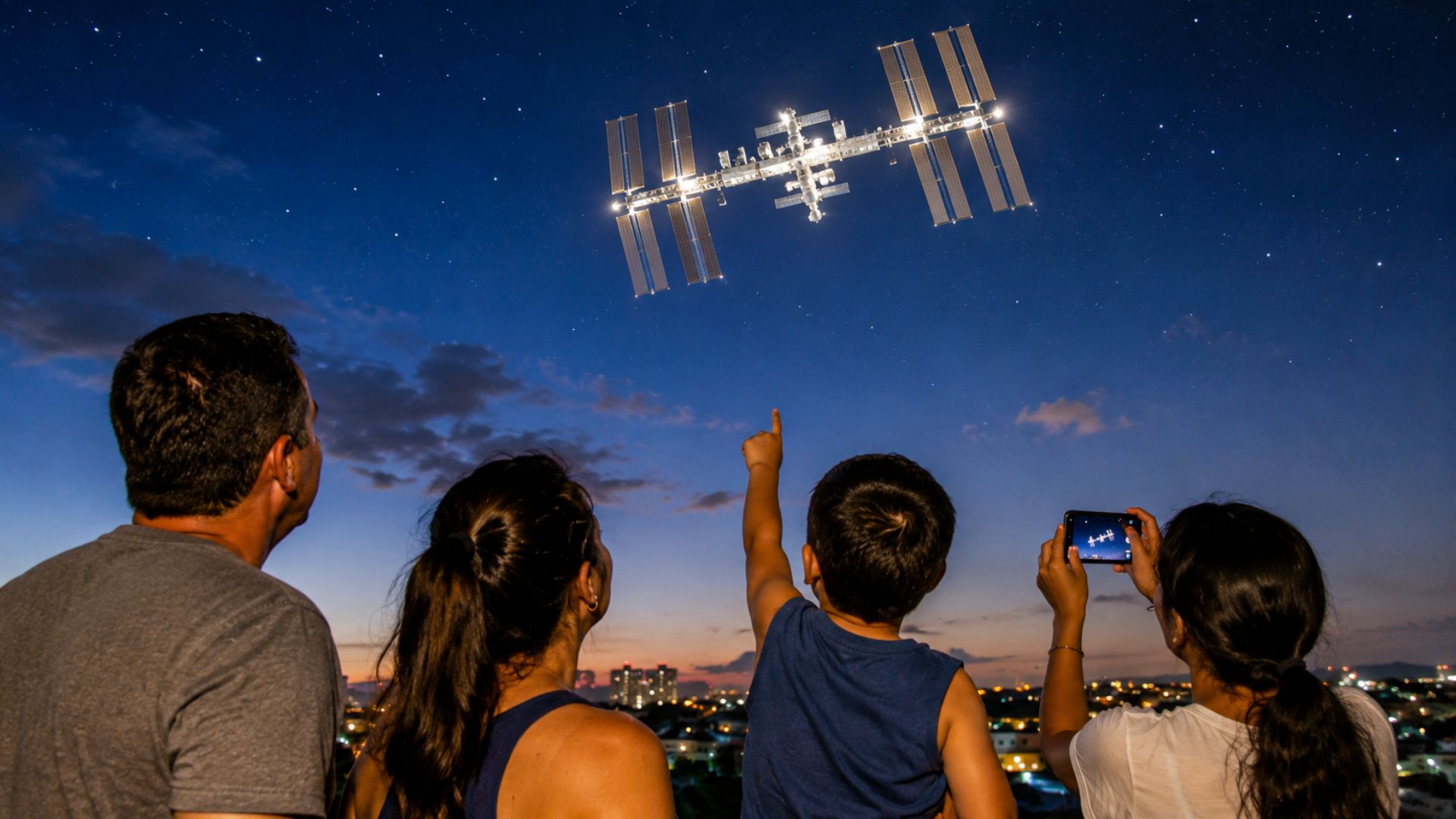

Phenomenon can be observed during the early morning in cities of Espírito Santo, when the International Space Station will cross the sky as a bright point in continuous motion. Quick passes should occur between May 20 and 24, depending on weather conditions and visibility.
Between May 20 and 24, residents of Espírito Santo will have the opportunity to observe the International Space Station without the need for telescopes or special equipment, as long as weather conditions are favorable and the sky remains with little interference from artificial light.
During the early mornings and the first minutes of the morning, the ISS should appear in the sky as an extremely bright point in continuous motion, crossing the horizon in a few minutes and drawing attention for the speed with which it disappears.
Unlike commercial airplanes, the space station does not have flashing lights or sudden changes of direction, a characteristic that usually makes it easier to identify for those observing the phenomenon for the first time.
-
2027 Total Solar Eclipse to Feature Unprecedented Duration, Turning Day into Night

-
China Unveils 300-Ton Hybrid-Electric Truck as the Heavy Machinery of the Future

-
Brazilian mechanic invents simple solar lamp using water and chlorine in a PET bottle, providing up to 60 watts of light during the day

-
Swiss glaciers melting fast enough to fill an Olympic pool every 6 seconds, France confirms 3,700 heatwave deaths, and WMO predicts strong El Niño intensifying extremes until 2027


Times to see the ISS in Espírito Santo
The observation opportunities are concentrated in five consecutive days, always at times close to dawn, a period when the station can reflect sunlight while much of the sky still remains dark.
On Wednesday, May 20, the passage is scheduled between 5:38 AM and 5:44 AM, while on Thursday, May 21, the phenomenon should occur from 4:40 AM to 4:44 AM, according to astronomical monitoring platforms.
On Friday, May 22, the ISS can be seen from 5:16 AM to 5:22 AM. On Saturday, May 23, the forecast indicates a passage between 4:17 AM and 4:23 AM, while on Sunday, May 24, the sighting should happen from 4:54 AM to 5:00 AM.
Although the times are estimated in advance, small variations may occur depending on the observer’s location within the state, which is why specialized apps help track the trajectory in real time.
Why the International Space Station appears in the sky
Despite appearing in the sky with intense brightness, the International Space Station does not produce its own light like stars or planets visible at night. What makes the structure noticeable from Earth is precisely the reflection of sunlight on its modules and panels.
This type of visualization mainly occurs in periods close to sunrise or just after sunset, when the station still receives sunlight while certain regions of the Earth’s surface remain dark.
Under these conditions, the contrast between the dark sky and the brightness reflected by the ISS makes it easier to observe with the naked eye, especially in areas away from large urban centers and with less light pollution.
Currently, the station orbits the Earth at about 28 thousand kilometers per hour and completes approximately 16 laps around the planet per day, maintaining a trajectory that allows frequent observations in different countries.
How to identify the passage of the ISS
To increase the chances of clearly viewing the ISS, experts recommend looking for open areas with a good view of the horizon and away from poles, very illuminated facades, or regions with excessive urban lighting.
The less light interference, the greater the clarity of the bright spot crossing the sky in a straight line, a behavior that differentiates the space station from conventional aircraft observed during the early morning.
Moreover, the movement of the ISS tends to be continuous and relatively fast, without the characteristic blinking of airplane lights, a detail that helps the observer recognize the passage a few seconds after the start of the trajectory.
Even so, weather factors can completely compromise observation, as dense clouds, rain, or fog can hide the station even when the passage occurs within the scheduled time.
Space laboratory brings together astronauts and scientific research
Besides sparking curiosity among sky watchers, the International Space Station performs important scientific functions since it began operating as a permanent orbital laboratory in cooperation with different space agencies.
Inside the structure, astronauts and researchers conduct experiments in a microgravity environment, a condition considered essential for studies involving biology, physics, medicine, technology, and the adaptation of the human body outside Earth.
The ISS also functions as a research platform aimed at future long-duration space missions, including studies related to human permanence in space and the development of technologies used in manned trips.
Even being seen from the ground only as a small bright spot crossing the sky, the station is among the largest structures ever placed in orbit and can vary in brightness depending on the angle of sunlight.
Apps help track the space station’s route
Those who intend to follow future passages of the space station can resort to free apps that monitor the position of the ISS in real-time based on data provided by international space agencies.
Among the most used platforms are Spot The Station, developed by NASA, as well as the apps ISS Detector and ISS Live Now, which display times, trajectories, and automatic alerts for the city chosen by the user.
Since the passage of the station usually lasts a few minutes, advance notices help the observer position themselves correctly before the phenomenon begins and prevent the sighting from being missed during the early morning.
These apps also show the approximate direction in which the ISS will appear on the horizon and the point where it will cease to be visible, making it easier to track even for those who have never observed the station before.
Weather conditions influence ISS observation
Even with scheduled times and conditions considered favorable for observation, viewing the ISS still depends on weather factors and the location chosen by the observer at the time of passage.
The presence of clouds, fog, rain, or excessive urban lighting can make it difficult to identify the space station, especially in areas with many buildings or little visibility of the horizon.
On the other hand, regions further away from large centers usually offer better observation conditions, although residents of urban areas can also follow the phenomenon if they are in high places with a partially clear sky.
The main recommendation is to arrive a few minutes before the scheduled time, avoid intense lights near the field of view, and allow the eyes to gradually adapt to the darkness before the passage begins.