Portuguese
  Spanish


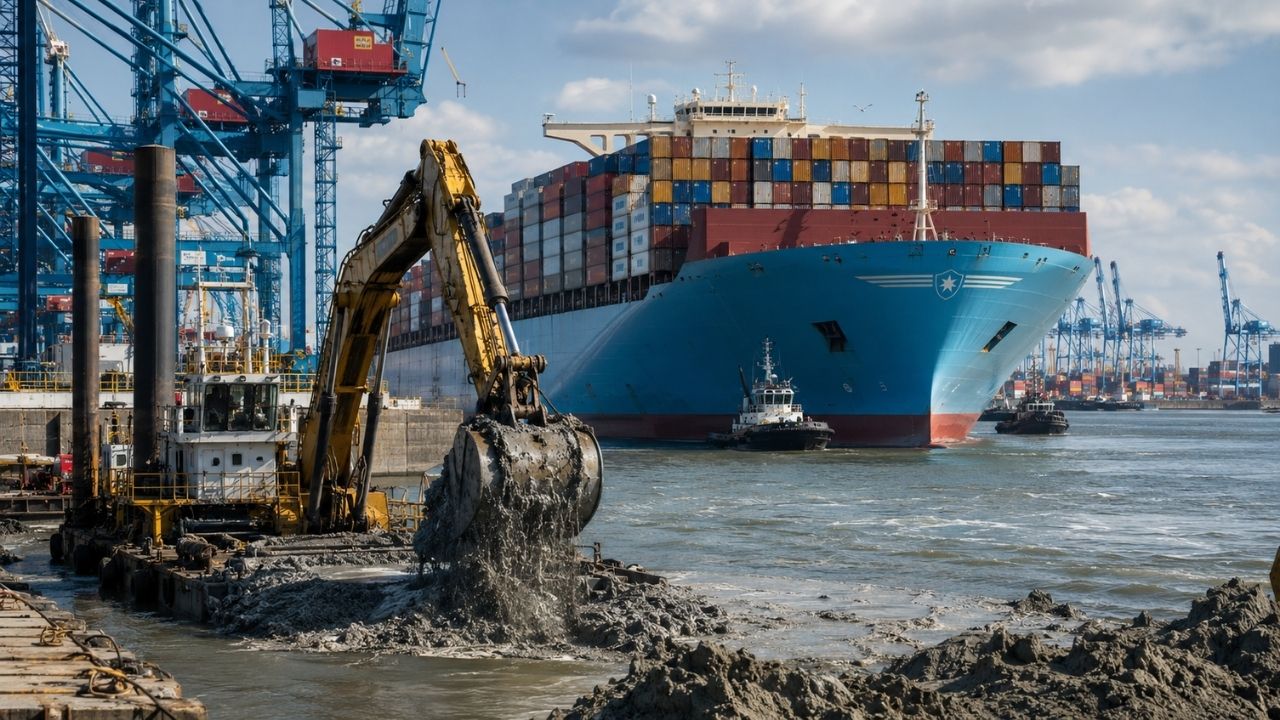

At the Port of Gothenburg, the Skandia Gateway plans to dredge about 11 million m³ to deepen the navigation channel, adapt the port to larger vessels, and strengthen Sweden’s foreign trade with a strategic intervention for its maritime and industrial logistics.
The Port of Gothenburg is preparing a strategic project to expand its maritime capacity. In the Skandia Gateway, the dredging of about 11 million m³ aims to deepen the navigation channel and strengthen Swedish foreign trade by paving the way for increasingly larger vessels.
The project involves the Port of Gothenburg itself and the Swedish Maritime Administration, in a plan initiated after years of preparation. The goal is to increase the available depth, reinforce quays and operational areas, and ensure that Swedish foreign trade remains connected to the main global maritime routes.
Why the Port of Gothenburg needs to deepen its channel
The Port of Gothenburg is presented as the only port in Sweden capable of receiving the world’s largest ocean-going vessels. The problem is that, under current conditions, these ships cannot arrive fully loaded. This limits logistical efficiency and reduces the port’s potential for large-scale international operations.
-
Amsterdam Repurposes Retired Boats and Plants to Restore Contaminated Industrial Land Instead of Removing All Polluted Soil

-
Saudi Arabia to Build 33,000-Seat Desert Arena with Retractable Roof and Clay Courts for 2028 Masters 1000 Tournament

-
Copenhagen Builds 92 Homes Using Reclaimed Materials from Demolished Carlsberg Brewery, Highlighting Each Material’s Origin
-
Nigerian Housing Crisis Addressed with Innovative Solution: Architect Builds Solar-Powered Modular Homes from Recycled Waste in Just 4 Hours for Low-Income Families



Currently, the maximum reported depth is 13.5 meters. With the Skandia Gateway, this depth is expected to reach a range between 16.5 and 17.5 meters, depending on the section and navigation needs. This difference may seem small on the surface, but it is crucial for giant ships loaded with thousands of containers.
The logic is straightforward: larger vessels require deeper ports. The more cargo a ship carries, the greater the draft needed to operate safely. Therefore, deepening the channel has become a central piece to keep Sweden competitive in maritime trade.
The project also carries strategic weight. Maritime transport accounts for a large part of Swedish foreign trade, and the Port of Gothenburg occupies a central position in this flow. Without adaptation, some of the largest ships may continue to face barriers to operating in the country at full capacity.
The project plans to remove 11 million m³ of clay from the seabed

The area to be deepened is almost five kilometers long. In this section, the plan includes dredging about 11 million cubic meters of clay, a volume that illustrates the scale of the work on the seabed. It’s not just about clearing a path, but redesigning a strategic passage for large vessels.
The dredging is part of a larger set of interventions. In addition to deepening the navigation channel, the project also plans to expand the external maneuvering area of the container terminal. This is necessary so that larger ships can enter, exit, and turn safely in a highly complex port operation.
The goal is to allow ships up to 430 meters to reach the Port of Gothenburg fully loaded. This type of vessel requires robust infrastructure, with adequate depth, maneuvering space, and docks prepared to receive large-scale cargo.
The work also includes reinforcements on the docks and terminal areas. With the port basin deeper and the structures reinforced, the port should gain the capacity to handle two large vessels simultaneously, increasing the operational capacity of the complex.
Skandia Gateway moved from the preparation phase to dock construction
The Skandia Gateway began preparation in 2019, when studies and initial stages were underway. Then, in February 2024, the Port of Gothenburg started the dock reinforcement work, an essential step before the heavier dredging of the channel.
Project updates indicate gradual progress in construction. In 2025, there were reports of fronts related to the installation of foundation blocks, structural reinforcement, and sustainability. By February 2026, important parts of the dock structure had already been completed, despite the harsh winter conditions.
This progress shows that the work is not limited to the channel. The port needs to adapt its infrastructure on land and at the maritime edge to accommodate the new depth. Dredging creates the path for the ships, but the dock needs to support the operation that will follow.
The schedule appears in phases. The project material indicates dredging in a later stage, with services planned between 2026 and 2027 as part of the operation, while the overall completion of the Skandia Gateway is presented for a longer horizon, reaching 2029. This reinforces the continuous nature of the intervention.
Giant ships change the scale of maritime logistics
The need to deepen the Port of Gothenburg is linked to a major transformation in maritime transport. Increasingly larger container ships concentrate cargo, reduce costs per unit transported, and require terminals prepared for more intensive operations.
When a giant ship cannot enter fully loaded, the logistics chain loses efficiency. The vessel may need to reduce cargo, make additional stops, or operate under less advantageous conditions. For an economy dependent on exports and imports by sea, this bottleneck becomes relevant.
In the Swedish case, the adaptation of the port is directly related to the industry. The Skandia Gateway was designed to ensure that the country’s companies continue to access international routes competitively, without relying on physical limitations at the main maritime point capable of receiving the largest ships.
The depth of up to 17.5 meters can transform the port into an even stronger gateway for Sweden’s foreign trade. The change is not just technical; it affects deadlines, costs, cargo capacity, and the country’s position on global routes.
The project also involves sustainability, safety, and emission reduction
The updates to the Skandia Gateway highlight not only construction but also safety and sustainability initiatives. One of the reported fronts involves reducing 10,000 tons of CO₂ emissions through the choice of materials and renewable fuels.
This point is important because large port works tend to have environmental and operational impacts. The dredging of millions of cubic meters of clay requires planning, technical control, and monitoring so that the intervention progresses within the defined parameters.
The project also involves documentation, licensing, and monitoring of different stages. The opening of a bidding process for the dredging company was pointed out as a milestone of one of the largest operations of this type in Sweden in more than two decades.
The scale of the project forces the port to balance logistical urgency with environmental responsibility. The challenge is not only to deepen the channel but to carry out the intervention without compromising the safety, operation, and environmental requirements of the project.
The expansion of the maneuvering area is as important as the depth
In addition to the deepening of the channel, the Skandia Gateway plans to expand the external maneuvering area of the container terminal. This step is crucial because giant ships do not only need depth; they also need space to move safely.
The turning area allows vessels to perform maneuvers before docking or leaving the terminal. In operations with large ships, every available meter can make a difference to reduce risks, avoid delays, and keep the port’s flow efficient.
The reinforcement of the docks also follows this logic. A deeper structure increases the demands on the berthing areas. Therefore, the project combines dredging, structural reinforcement, and operational expansion into a single strategy.
With these changes, the Port of Gothenburg aims to prepare for handling large ships simultaneously. The goal is to create a deeper, more resilient port that is more compatible with the current scale of international maritime trade.
A local project with an impact on Sweden’s foreign trade


Although the work takes place in a specific area of the Swedish coast, the expected impact goes beyond Gothenburg. The port is an essential piece for connecting Sweden to the world, especially in a scenario where maritime transport remains dominant in international trade.
By allowing 430-meter ships to arrive fully loaded, the country reduces a limitation that affects its integration with major ocean routes. This can benefit exporters, importers, logistics operators, and industrial chains that depend on predictability.
The Skandia Gateway also reinforces the global competition between ports. As ships increase in size, terminals that do not keep up with this evolution may lose relevance. Those that adapt, on the other hand, tend to gain competitiveness.
Therefore, the dredging of 11 million m³ of clay is not just an engineering work. It is an attempt to keep Sweden’s largest strategic maritime point prepared for a new scale of navigation.
Deeper port, larger ships, and a question about the future
The advancement of the Skandia Gateway shows how works invisible to much of the population can have a direct effect on global trade. The removal of clay from the seabed, the reinforcement of the docks, and the expansion of the maneuvering area form a structural transformation at the Port of Gothenburg.
The project also reveals a clear trend: ports that wish to remain relevant need to keep up with the growth of ships. Without depth, space, and structure, even a strategic port may find limits to compete on high-volume international routes.
By preparing the channel for up to 17.5 meters of depth, Sweden tries to ensure that its industry remains connected to the largest maritime flows on the planet. The work still has to go through important stages, but it already signals a significant change in the country’s port infrastructure.
And you, do you think that gigantic projects like this are indispensable to keep countries competitive in global trade, or is the growth of ships forcing ports worldwide to enter an expensive and endless race? Share your opinion.