






 Portuguese
  Spanish


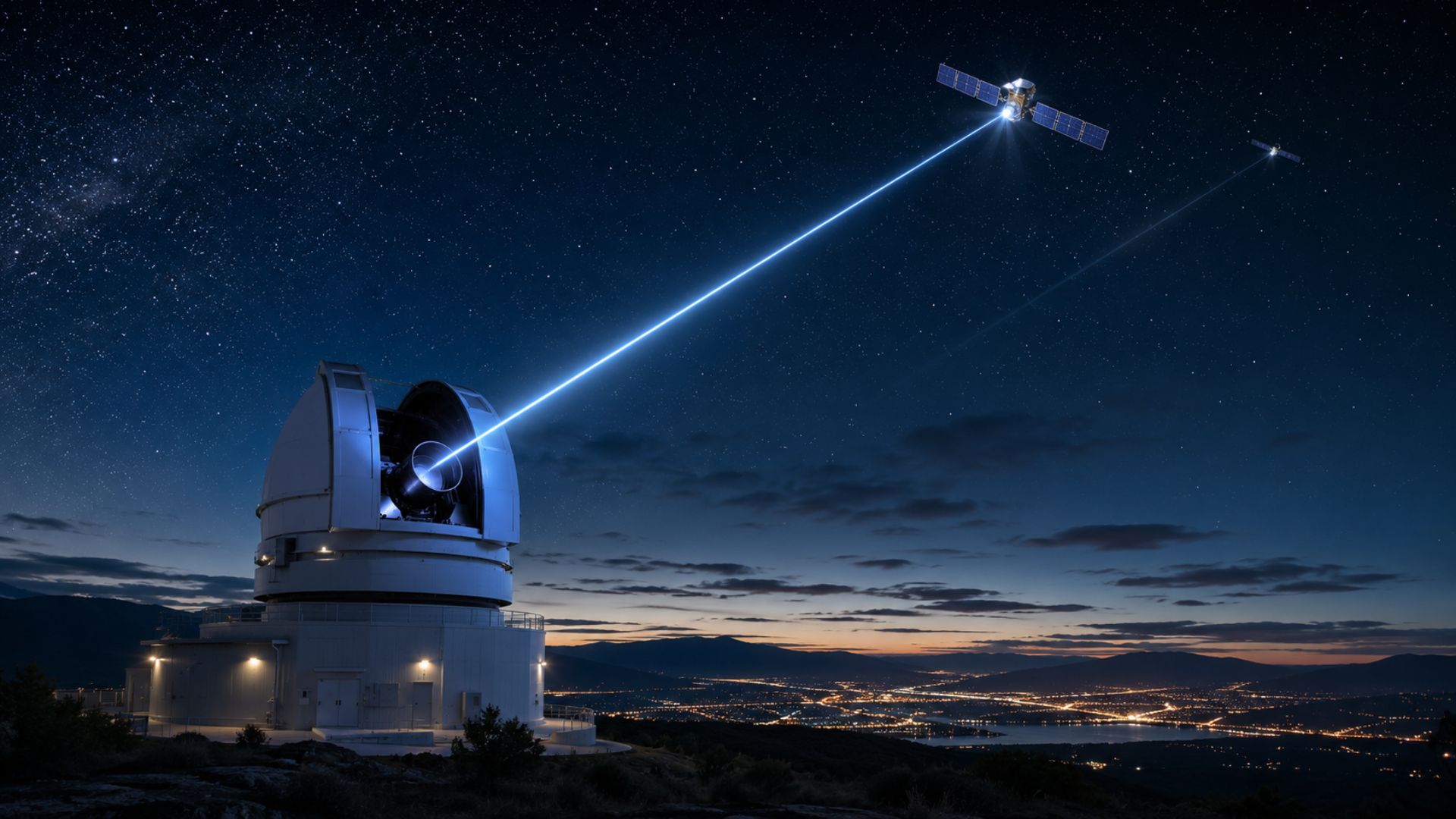


In May 2026, Europe activated a station that receives data from satellites via infrared laser beams at 2.5 Gbps. The project, supported by ESA, uses CubeSats launched in March, Lithuanian Astrolight technology, and challenges the dominance of radio waves in communication between space and Earth.
On May 18, 2026, the Lithuanian company Astrolight and the Aristotle University of Thessaloniki announced the operational activation of the Holomondas Optical Ground Station, the first fully integrated European station for receiving satellite data via infrared laser beams, installed in an old astronomical observatory on Mount Holomondas, in the Chalkidiki peninsula, northern Greece. The station was developed within the Greek Connectivity Program, managed by the European Space Agency (ESA) on behalf of the country’s Ministry of Digital Governance, and marks an important step in the global transition of space communication from radio waves to high-speed optical links.
The innovation reaches a transmission speed of up to 2.5 Gbps and is tested with two Greek CubeSats, PeakSat from the Aristotle University of Thessaloniki and ERMIS-3 from the National and Kapodistrian University of Athens, launched on March 30, 2026, aboard SpaceX’s Transporter-16 flight. The two satellites carry the ATLAS-1 optical terminal, developed by Astrolight itself, and serve as proof of concept for the so-called space-to-Earth optical communication, a technology that promises to eliminate the easy interception and intentional jamming that threaten current space communication, almost entirely dependent on the radio frequency spectrum.
How laser communication between satellites and Earth works

Laser communication replaces radio waves with concentrated beams of infrared light, invisible to the human eye. In the Greek project, the terminal onboard the CubeSats emits the beam towards the ground station, which uses a C-band optical receiver calibrated by an 808-nanometer laser beacon. This beacon serves as a guide to align both sides of the connection with millimetric precision, a mandatory condition for the photons emitted by the satellites to reach the station’s mirror on the ground.
-
Engineers Develop Jacket That Converts Air Humidity Into Drinkable Water, Producing Up to 900 ml Daily for Hikers, Campers, Rescuers, Rural Workers, and Military in Remote Areas

-
NASA Plans to Repurpose Mars Rover for Lunar Mission, Sending a 1-Ton Nuclear-Powered Vehicle to Explore the Moon’s South Pole Without Solar Dependence
-
Early Humans Made Beds Nearly 200,000 Years Ago in African Caves, Study Reveals

-
Japanese Smart Bike Detects Cyclist’s Intent to Turn and Potential Falls


The technical gain is significant. Optical beams have much greater bandwidth than conventional radio waves and, being directional, make interception attempts by third parties more difficult. In radio systems, any antenna tuned to the correct frequency can capture signals from satellites in its coverage area. With lasers, one must be exactly in the beam line, in a very narrow cone, making military, governmental, and sensitive commercial use much safer. The risk of jamming, or intentional blocking, also decreases significantly due to the physical nature of the optical signal.
Why Europe Bet on This Technology Now
The reason is practical: the radio spectrum is saturated. Constellations like SpaceX’s Starlink and dozens of other commercial and military satellite fleets compete for frequency bands that are finite by nature. With more than ten thousand satellites already in low orbit and projections of new launches in the coming years, traditional communication is heading towards a bottleneck that could compromise everything from scientific applications to essential civil services, such as climate phenomenon observation.
It is in this scenario that the ESA decided to accelerate investments in optical communication. Besides the Greek project, the agency has already demonstrated in previous tests an optical link capable of transmitting 2.6 Gbps between an aircraft and a geostationary satellite, signaling that the technology has the potential to bring high-speed internet to remote regions, ships, commercial airplanes, and even mobile military units. The Greek Connectivity Program is funded by the European Union’s Recovery and Resilience Facility, showing that the continent treats communication by laser satellites as a matter of technological sovereignty.
The Role of PeakSat, ERMIS-3, and the ATLAS-1 Terminal
The two CubeSats launched in March 2026 perform complementary missions. The PeakSat is a 3U platform, approximately the size of a cereal box, developed by undergraduate students at the Aristotle University of Thessaloniki. Its function is to validate the operational performance of the Holomondas Optical Ground Station at different elevation angles, atmospheric conditions, and lighting scenarios. Meanwhile, the ERMIS-3, a 6U platform, is one of the main missions of the Greek connectivity program and focuses on high-capacity and high-security optical links.
The link between the two CubeSats and the ground station is the ATLAS-1 optical terminal, created by Astrolight, a Lithuanian defense and space company. The ATLAS-1 is classified as a low SWaP device, an acronym in English for reduced size, weight, and power, precisely to fit in CubeSats with limited resources. Astrolight is already developing the next generation, named ATLAS-2, also aimed at communication between satellites in orbit, and not just space-Earth, which would allow for the creation of optical networks entirely independent of the ground.
The Technical Challenges of Space Optical Communication
Despite the advantages, laser communication is not free from problems. The main limitation lies in its sensitivity to atmospheric conditions. Thick clouds, heavy rain, and atmospheric turbulence can distort or block the beam, requiring redundancy in the network and stations in locations with clear sky coverage for most of the year. Therefore, the choice of Mount Holomondas, at altitude and in a predominantly dry climate region, was considered strategic by the project engineers.
Another delicate point is alignment. When a CubeSat passes through the station’s coverage area, the useful window to establish the connection lasts only a few minutes and requires an extremely precise pointing system, known as PAT, an acronym for acquisition, tracking, and pointing. Any small deviation drops the link. Current engineering combines sensors, fine precision motors, and algorithms that learn from each passage, but performance still depends on external factors that radio waves tolerate without major issues.
The parallel with Starlink and the race for optical communication
The latest satellites in SpaceX’s Starlink constellation already operate with optical links between each other in space, forming a communication mesh that reduces reliance on ground stations in each part of the globe. When a satellite captures data in a region, it can forward it to another neighboring satellite until it reaches the network point with a direct connection to the ground. This logic reduces latency and increases the overall efficiency of the satellite internet network.
The European project led by Astrolight and ESA expands this concept to a scenario where the optical link is not only between satellites but also between satellites and common ground stations. If the approach proves reliable under real operating conditions, Europe could take an important step towards building its own optical space communication infrastructure, reducing technological dependence on external suppliers and increasing autonomy in sensitive applications, such as military observation, border monitoring, and government operations.
What changes for satellite internet and global services
For the end user, the transition from radio frequency to laser may take time to appear in everyday life, but it tends to materialize in faster and more stable connections. Companies operating fleets of Earth observation satellites, for example, usually generate enormous volumes of daily images that need to be downloaded to ground servers. With optical links at 2.5 Gbps or more, this data arrives sooner, is processed faster, and can feed services such as meteorology, precision agriculture, city management, and disaster response.
In the consumer-oriented satellite internet sector, the trend is also positive. As constellations incorporate laser communication both between satellites and towards the ground, it is reasonable to expect lower latencies and greater total network capacity. The question is no longer if the technology will be adopted on a large scale, but how long it will take to become standard for all new commercial satellite launches, especially in segments with high demand for bandwidth.
The activation of the Holomondas Optical Ground Station marks an important chapter in the race for space optical communication. What was discussed in the laboratory now circulates in orbit, with real CubeSats connecting satellites and Earth through invisible light beams. If the test is successful, Europe may pave the way for a new generation of faster, more secure satellite networks that are less dependent on an increasingly contested radio spectrum band by dozens of operators around the world.
Do you think laser communication will replace radio waves between satellites and Earth in the next decade, or will atmospheric limitations hold this transition back for longer? Leave your comment, let us know if you already use satellite internet in your daily life, and share the article with those who follow space technology, defense, and telecommunications.


