






 Portuguese
  Spanish
  3 min of reading
  0 comments


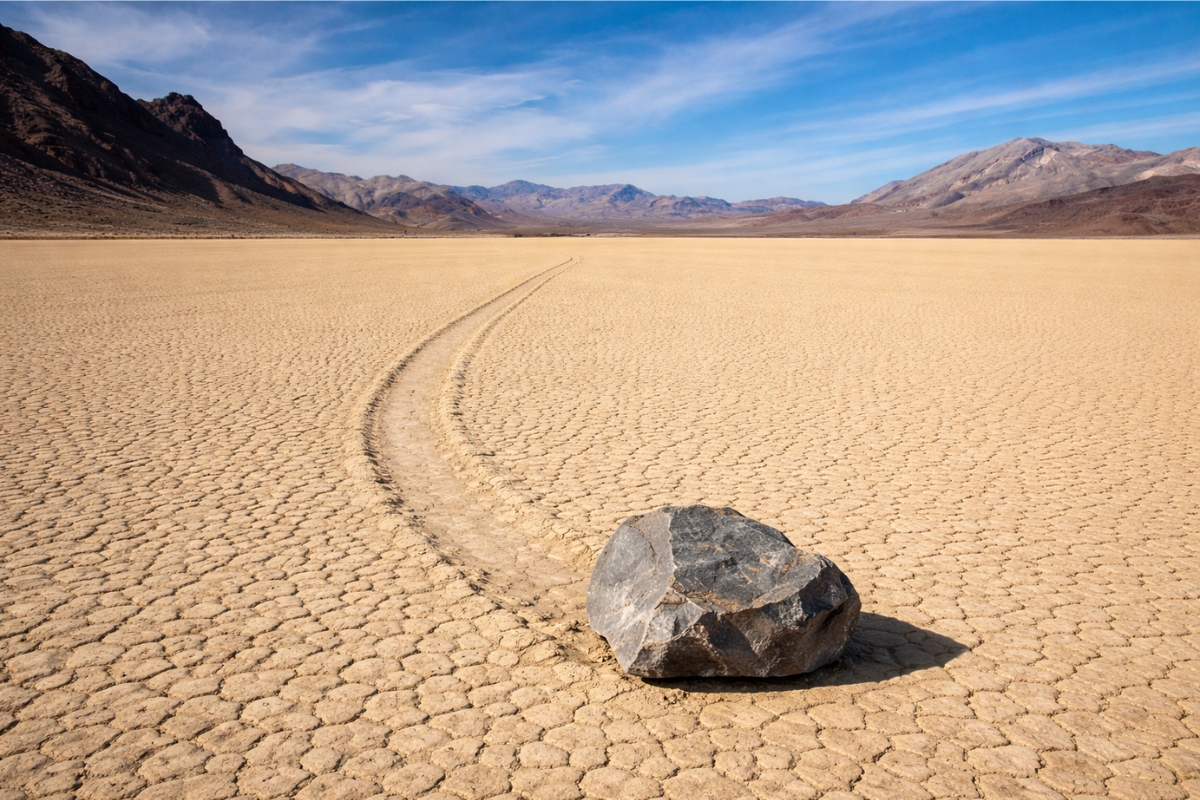
In The Aridest Place In The United States, A Few Millimeters Of Ice Becomes A Natural Engine, Breaking Into Floating Plates And Pushing Heavy Rocks For Dozens Of Meters, Proving That Nature Doesn’t Need A “Mysterious Force”
For decades, the so-called “sailing stones” of Racetrack Playa, in Death Valley National Park, California, have fueled theories about supernatural and even extraterrestrial forces. Rocks weighing several pounds appeared displaced on the dry, cracked ground of an ancient lake, leaving long traces in the hardened mud. The most intriguing part was that no one had ever witnessed the movement directly.
The phenomenon seemed to defy the laws of physics. How could such heavy stones move on their own in one of the most arid and extreme places on the planet? The lack of witnesses and the rarity of the event turned the case into one of the greatest natural mysteries in the United States.

Where Is Racetrack Playa And Why Is It So Special
Racetrack Playa Is A Dry Lake Bed Located In A Remote Region Of Death Valley. For Most Of The Year, The Ground Remains Hard, Cracked, And Completely Dry, Creating The Perfect Setting For Any Movement To Leave Visible Marks For Months Or Even Years.
-
Tired of relying on a conventional house, a young woman with no construction experience built an off-grid studio apartment with solar energy, rainwater, a biodigester bathroom, and a routine designed to live with more autonomy.

-
The European city hall that transformed an old urban avenue back into a canal, recovered a section that was filled in the 1970s, and delivered a new public space with water, vegetation, and pedestrian paths.
-
Buenos Aires and Montevideo are about 200 kilometers apart in a straight line, but the road trip can exceed 570 kilometers and take up to 8 hours and 30 minutes; see how long the journey takes by plane, ferry, car, and bus.
-
Couple sold house in São Paulo, resigned from their jobs, and paid R$ 15,780 to start over in Portugal, but the promised trip turned into a fraud complaint: suitcases remain packed, tickets were not delivered, and the European dream ended up stuck in a cramped rented room.



The Region’s Extreme Climate Plays A Key Role In The Phenomenon. Although It Is Known For Its Intense Heat, Death Valley Can Also Record Temperatures Near Freezing In Winter, An Essential Condition For The Stones To “Sail” Across The Surface Of The Dry Lake.
The Scientific Explanation Confirmed In 2014
The Mystery Started To Unravel When Researchers Set Up Monitoring Equipment At The Site, Including GPS On Some Stones And Observation Cameras. In 2013, They Finally Recorded The Phenomenon Happening In Real Time, Providing A Definitive Answer.
The Movement Occurs When A Thin Layer Of Water Covers The Surface Of The Playa After Rare Rains. During The Cold Night, This Water Freezes And Forms A Very Thin Sheet Of Ice. At Dawn, The Ice Begins To Break Into Large Floating Plates.
With Gentle But Steady Winds, These Ice Plates Slowly Slide And Push The Stones Over The Wet And Slippery Mud. The Movement Is Extremely Slow, Almost Imperceptible To The Naked Eye, Which Explains Why No One Had Seen The Rocks Move For So Long.

Why The Phenomenon Continues To Fascinate The World
Even With The Proven Scientific Explanation, The Sailing Stones Continue To Evoke Admiration. The Phenomenon Depends On A Rare And Precise Combination Of Climatic Factors, Which Means It Can Take Years For The Ideal Conditions To Repeat.
Moreover, The Fact That Something As Simple As Thin Ice And Moderate Wind Can Move Heavy Stones Reveals How Nature Can Produce Extraordinary Events With Apparently Discreet Mechanisms. There Is No Magic, No Hidden Forces, Just Physics In Action.
The Stones Of Racetrack Playa Remind Us That Many Mysteries Of The Planet Still Await Patient Observation And Careful Investigation. And They Show That Often, The Scientific Explanation Is As Impressive As Any Legend Created Over Time.
This Article Was Prepared Based On Official Information From The National Park Service, The Agency Responsible For Death Valley National Park, And Data From The Scientific Study Published In The Journal PLOS ONE, Which First Recorded The Movement Of The So-Called “Sailing Stones” At Racetrack Playa





-

-

-

-

-

-

50 people reacted to this.