






 Portuguese
  Spanish


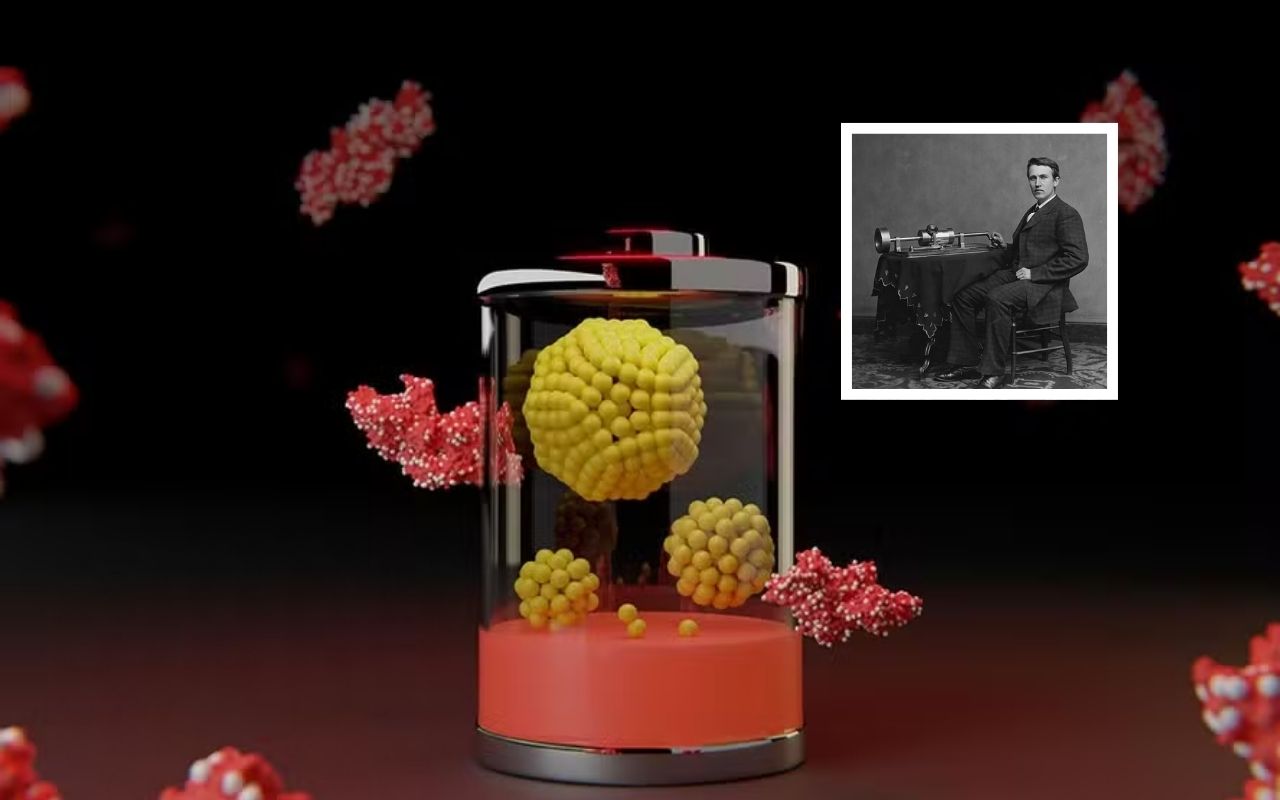


More Than A Century Later, Scientists Revive Battery Proposed By Thomas Edison In 1901 And Achieve Ultra-Fast Charging And Thousands Of Cycles.
An international team of scientists achieved something improbable: validating, with current technology, a battery envisioned by Thomas Edison in 1901.
The group, co-led by the University of California, Los Angeles (UCLA), developed a modern prototype based on the same nickel-iron concept.
Tests showed recharging in seconds and resistance to over 12 thousand charge and discharge cycles.
-
What is a red flashlight used for, after all? See why it is so commonly used at night.

-
He has never read a line of code, but he already knows how to work: the French company UMA presented in Paris the Northstar, its first AI-powered humanoid robot designed for factories and warehouses, capable of copying tasks just by observing an employee in action.

-
A young Kenyan engineer collects plastic waste from the streets and transforms it into robots that translate physics lessons into sign language in real-time, a machine made with old bottles that teaches what was missing to deaf children left out of science.
-
What is the dark substance found in the sand of Ipanema Beach? Civil Police conduct an examination, collect samples of the material, and initiate an investigation to identify the composition, clarify the origin, and verify if there was an environmental crime.



The study was published in August 2025 in the scientific journal Small and reignited the debate over sustainable energy storage alternatives.
The achievement draws attention not only for its technical performance. It resurrects an idea considered outdated and demonstrates how scientific advancements can transform historical projects into contemporary solutions.
Modernization Of The Battery Proposed By Thomas Edison In 1901
The most impressive aspect of the new battery is the speed of recharging. According to researchers, the device can store energy in a matter of seconds.
This performance is directly linked to the structure of the materials. Instead of traditional metal plates, the scientists used nanometric particles of nickel and iron.
When the components are extremely small, almost all atoms are exposed. This increases the surface area for chemical reactions, speeding up charge and discharge processes.
“When the particles are so small, almost every atom can participate in the reaction,” explains Maher El-Kady, a researcher at UCLA and co-author of the study.
Durability Is Another Highlight Of The Battery
In addition to speed, tests revealed high resistance. The prototype withstood more than 12 thousand complete charge and discharge cycles.
In practice, this amounts to more than 30 years of use with daily recharges. Therefore, it indicates a lifespan far superior to many conventional technologies.
Still, the scientists note limitations. The energy density is still lower than that of lithium-ion batteries.
Inspiration From Nature Shaped The Modern Battery
To achieve this result, the scientists turned to unusual strategies. The architecture of the battery was inspired by biological processes.
The researchers analyzed how natural structures, like bones and shells, form. In these systems, proteins act as “scaffolds” that organize minerals.
In the laboratory, proteins derived from byproducts of beef production were used as molds. They guided the formation of the metallic nanostructures.
Later, the material was combined with an ultrathin sheet made of carbon and oxygen. This layer is only one atom thick.
By heating the assembly, significant chemical changes occurred. The proteins turned into carbon, the oxygen was removed, and the metals were incorporated into the matrix.
The result was an extremely lightweight and porous structure. By volume, about 99% of the material is made of air.
Applications Of The Battery Go Beyond Electric Cars
Despite the promising performance, immediate use in vehicles is not a priority. The storage capacity still does not compete with modern automotive batteries.
However, the scientists see strategic applications. One of the main bets is renewable energy storage.
The battery could store excess electricity produced by solar plants during the day. Later, the energy would be returned to the grid at night.
Additionally, the system can serve as an emergency power source. Critical infrastructures, such as data centers, are among the potential beneficiaries.
“As this technology can extend the lifespan of batteries for decades, it could be ideal for storing renewable energy or quickly stepping in when a power outage occurs,” El-Kady states.
Before This, Thomas Edison Already Predicted Another Battery In 1901
Long before the current tests, Thomas Edison believed he could revolutionize the energy sector. In 1901, the inventor began investing in a battery of nickel-iron.
At the turn of the 20th century, the competition among different propulsion technologies was still open. Contrary to what is imagined today, electric vehicles occupied a significant space on the streets and were not exceptions.
Historical data indicates that in 1900, electric cars were the majority in circulation in the United States. Still, enthusiasm was thwarted by a decisive practical limitation: the battery.
Lead-acid batteries, the standard at that time, showed modest performance.
They were bulky, expensive, and allowed short trips, around 30 miles per charge.
In this environment of technical challenges, Thomas Edison proposed an alternative. The inventor believed that a nickel-iron battery could significantly increase the range of electric vehicles.
According to his projections, the new system would achieve up to 100 miles per charge. Moreover, it promised greater durability and an estimated recharge time of around seven hours — numbers considered ambitious for the time.


Why Did Edison’s Battery Not Prosper?
Despite the expectations, the technology did not evolve as the inventor predicted. Practical limitations persisted over the following decades.
Meanwhile, combustion engines advanced rapidly. They became more powerful, efficient, and financially accessible.
Gradually, gasoline cars dominated the market. Thus, Edison’s proposal ended up being sidelined.
Modernization Of The Battery Proposed By Thomas Edison
More than a century later, the work of the scientists reveals a shift in perspective. Historical concepts can gain new relevance with modern tools.
In this context, the battery proposed by Thomas Edison in 1901 ceases to be merely a technological curiosity. It becomes part of research aimed at the future of energy.
The team is now investigating ways to make the process cheaper and scalable. Among the alternatives is the use of more abundant natural materials.
If advancements continue, an idea born in the early 20th century could contribute to more sustainable energy systems. Therefore, the past may again influence the future.
Source: Galileu Magazine


